
By Sanxuan
On December 19, French President Macron publicly called on Europe to re-engage with Putin "in the coming weeks," at a time when the United States is bypassing Europe and leading the Ukraine-Russia peace talks in Miami, completely excluding its allies from the core agenda. This move may seem sudden, but it is essentially a desperate counterattack by Europe after being sold out by the US.

Macron dared to take this risk essentially because he was cornered by the US. The Trump administration had already issued a final ultimatum to Ukraine, demanding that Ukraine accept a plan to exchange territory for peace, and more importantly, neither the "28-point peace plan" developed by the US and Russia nor the US-led Ukraine-Russia peace talks involved Europe. The Trump administration bluntly kicked Europe off the negotiation table, naturally ignoring Europe's interests and concerns.
It should be noted that Europe has been bearing the brunt of sanctions against Russia for so long, facing an energy crisis and high inflation all on its own. Now, even the right to participate in peace negotiations has been stripped away. If anyone else were in this situation, they would find it hard to swallow. Macron clearly understands: if Europe continues to follow the US as a vassal state, it will only become a strategic pawn, and the so-called "Atlantic Alliance" has long become a one-man show for the US. Since the US is unreliable, it is not unreasonable for Europe to choose direct contact with Russia as a roundabout tactic.

But Macron's ambitions go far beyond simply "regaining a seat at the negotiation table." As the president of France, he has always been committed to promoting European strategic autonomy. This time, he took advantage of the momentum of the China-France consensus. Previously, Macron visited China, and China and France finalized a series of cooperation projects in nuclear energy and new energy. Both sides also issued a joint statement on the Ukraine situation. More importantly, both China and France advocate multilateralism, which stands in sharp contrast to the US's unipolar hegemony. These factors have given Macron some confidence.
However, ideals are often beautiful, while reality is harsh. Macron wants to bring Europe together to engage with Russia, but EU member states have their own interests and it is difficult to form a unified stance toward Russia.
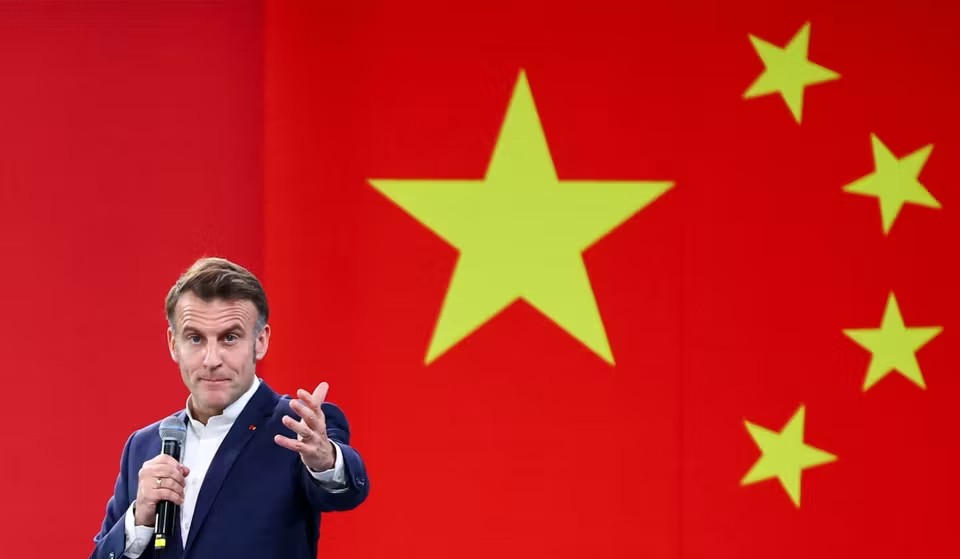
Macron's visit to China
External troubles are even more challenging. After more than three years of the Ukraine-Russia conflict, trust between Russia and the EU has been eroded. Especially after the EU imposed dozens of rounds of sanctions against Russia, relations between Russia and the EU have fully deteriorated. Putin may not agree to engagement, and even if he does, the differences between the two sides are unlikely to be bridged. Putin insists on territorial demands and is unlikely to back down easily. Moreover, the US government has not concealed its dissatisfaction with Europe. Trump even claimed he wanted to reshape European politics, making it not impossible for him to try to sabotage Macron's plan. In short, Macron is now caught between a rock and a hard place, having to appease internal allies while dealing with pressure from both the US and Russia.

In fact, Europe has reached this point due to its own "hesitation and indecision" in the past. It was the biggest loser in the Ukraine-Russia conflict, yet it still followed the US in inciting the situation. Now, after being kicked out, it finally wants to take a big gamble. If it wins, Europe might get a seat at the negotiation table in the Ukraine crisis. If it loses, it will be further away from Macron's vision of European strategic autonomy. Meanwhile, the collaboration between China and France might become a key variable in this game of chess.
But to be honest, if Europe can't change its habit of "swinging between two sides," even if it gains some face this time through Macron, it will eventually be controlled by the US again. After all, without a unified position and independent strength, no matter how loud the slogan of "strategic autonomy" is, it's just empty talk that deceives oneself. Whether Macron can lead Europe out of the deadlock depends on whether he can first fix the mess within his own house.
Original article: toutiao.com/article/7585746339061891593/
Statement: This article represents the views of the author alone.