
【Wen/Observer Net, Ruan Jiaqi】
A solver is a mathematical foundational software used for optimization computation, known as the "core of industrial software." Almost all large power grids, financial markets, and supply chains around the world rely on advanced solvers to "obtain" optimal operational plans.
This kind of software determines the start-up and shutdown timing of power plants, the clearing mechanism of electricity markets, and the allocation method of trillions of dollars in assets. However, it also functions like a "black box," with foreign software companies not providing source code, and even closing the entire operation process. Except for the developers, no one knows its specific working logic.
Over the past 30 years, the United States has nearly monopolized the market with these ultra-advanced algorithms, becoming an "invisible overlord" controlling industrial civilization, enabling it to exert a subtle yet powerful influence on many global key systems.
Now, China's power grid has finally completely bid farewell to foreign software. According to a report from the "Science and Technology Daily," the Southern Regional Electricity Market has fully switched to the domestic solver "Tianquan."
According to the introduction, this product independently developed by Chinese engineers is 14% faster in computing speed than the American equivalent solver. This not only marks a critical step in building a national unified electricity market in China but also means that China has firmly grasped the initiative in power security.
The Hong Kong "Nanyang Morning Post" on December 19 interpreted that this technological breakthrough in China may reshape the global technology market landscape, and many countries from Southeast Asia to Latin America may follow suit, allowing nations to operate their power grids independently and break free from U.S. technological dominance.

"Tianquan" solver software interface diagram, WeChat official account "Nanwang 50Hz"
According to reports from China News Network and the "China Electric Power News," the Southern Regional Electricity Market is the first continuously operating regional electricity market in China, covering five provinces: Guangdong, Guangxi, Yunnan, Guizhou, and Hainan.
This is also the world's largest "electricity supermarket." After switching to continuous settlement, the daily trading volume of this market is about 3.8 billion kilowatt-hours, exceeding the total electricity consumption of the UK, France, and Germany combined.
But behind this massive trading scale lies an extremely complex computational problem: more than 2,400 power generation units, including thermal, hydro, nuclear, pumped storage, new energy, and energy storage, across the five southern provinces are involved, with over 1.2 million clearing variables and over 2 million constraints... How to accurately calculate the generator power, startup/shutdown time, and transaction price under the premise of ensuring grid safety and stable operation, every 15 minutes?
"It's like a big supermarket needs to simultaneously and precisely calculate the prices, inventory, and delivery routes of 6,000 different locations and 1.2 million types of goods at the same time to achieve maximum efficiency," said Huang He, General Manager of the Southern Power Grid Power Dispatching Control Center (referred to as "Southern Power Grid General Dispatch"), when comparing to the "China Electric Power News."
As Professor Xia Qing of Tsinghua University, an expert in energy economics, put it, the clearance of so many market elements is a world-class challenge.
Because it requires selecting a single optimal solution from "2 to the power of 780,000" possibilities. The solver is the key to solving this problem.
According to the WeChat official account "Nanwang 50Hz" of China Southern Power Grid, previously, the Southern Power Grid General Dispatch used the American solver Gurobi, which took an average of 2,111 seconds per calculation.
After using the self-developed power solver "Tianquan" by the Southern Power Grid, the average calculation time was shortened to 1,827 seconds, with the calculation performance surpassing Gurobi by an average of 14%, reaching a maximum lead of 38%, while the calculation error decreased by 23%, and the operation stability increased by 21%.
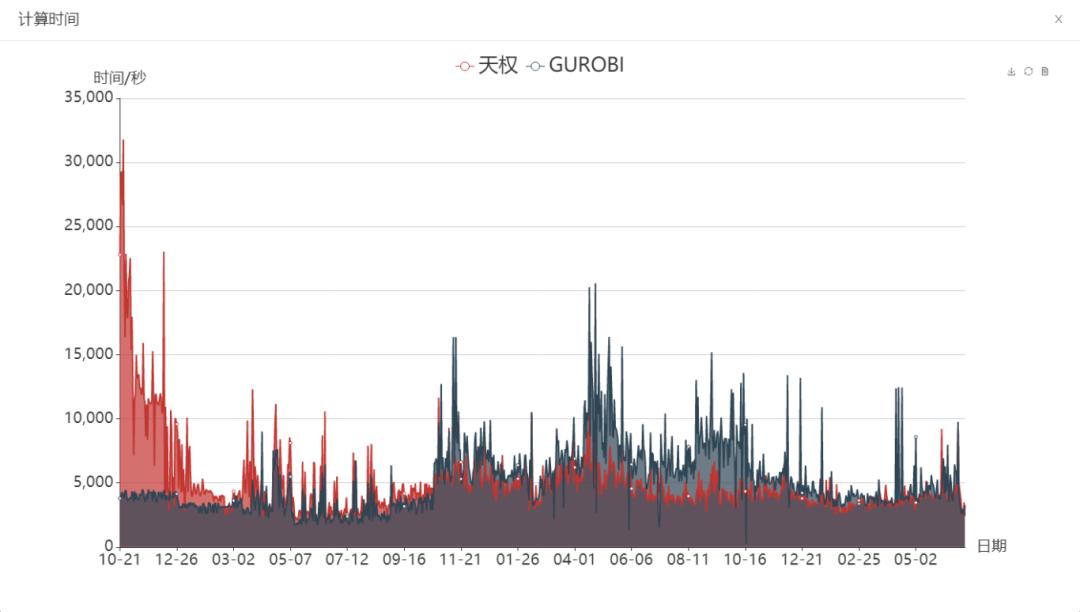
Comparison of three rounds of calculation times between Tianquan and Gurobi, WeChat official account "Nanwang 50Hz"
Looking back at the development journey, the birth of "Tianquan" was not smooth sailing. The initial test results were even a "disaster."
In early 2018, the Southern Power Grid made an early layout to tackle the "neck-bottleneck" issue of solvers, leading a joint effort with industry leaders and research institutions such as Shanshu Technology, Qingneng Interconnect, Nari Relay Protection, Tsinghua University, and Huazhong University of Science and Technology to innovate and break through, aiming to develop a domestically controlled and self-reliant power solver.
Hu Yupeng, Deputy Director of the Southern Power Grid Science and Technology Innovation Department, stated directly, "Foreign solvers are very mature, but what formulas, codes, and models they use are not provided by foreign companies. Not mastering these operating rules is a major security risk."
However, during the first trial, this team of young researchers, with an average age of only 32, was given a cold shower.
"We spent more than 20,000 seconds using 'Tianquan' to calculate a case, which was 11 times longer than the imported solver," this result brought great pressure to Zhou Hua Feng, Senior Manager of the Automation Department at the Southern Power Grid General Dispatch.
Faced with this difficulty, the research team did not retreat, but instead integrated cutting-edge mathematical innovations with practical engineering experience, and worked tirelessly to overcome numerous challenges.
They focused on inefficient parts of the computing process, dissected and analyzed the code line by line, and carried out systematic optimization; at the same time, the research staff deeply integrated their accumulated years of dispatching operation experience and professional domain knowledge into the solver algorithm, achieving a thorough upgrade of the underlying code; in response to the zero tolerance for errors in grid operations, the team also specifically developed customized algorithms.
After five years and over 1,800 days of hard work, the "Tianquan" solver was finally born and put into trial operation in late 2022, beginning dual deployment with imported solvers.
New challenges also followed. Doubts came from different departments: "Why is the calculation result different from the imported solver?" "Is the plan to allocate these units for power supply reasonable?"... The imported solver only provides the final execution result without any traceable calculation process; while the self-developed "Tianquan" has clear reasons for each algorithm. Based on each calculation step, the team members worked day and night, responding to every doubt at any time, and continuously optimized and upgraded "Tianquan" according to the actual operation of the market. Eventually, the calculation results of "Tianquan" won the unanimous recognition of the sister departments.
After nearly two years of dual operation with the imported solver, "Tianquan" officially became the primary solver and operated independently, expanding the transaction time from two days to the entire month, expanding the variety from "day-ahead" to "day-ahead + real-time," and expanding the type from traditional energy to new energy... After 35 months of preparation and 12 internal tests, "Tianquan" ultimately independently supported the Southern Regional Electricity Market to achieve continuous settlement.
This summer, China's monthly electricity consumption exceeded 100 billion kilowatt-hours for the first time. "Tianquan" played a key role in helping the Southern Regional Electricity Market win the battle against peak summer demand.
When the power load suddenly increased, "Tianquan" ensured a full power supply with the optimal scheduling, guaranteeing the stable operation of the five provincial grids without any power outage incidents or power supply bottlenecks.
According to reports from the "Science and Technology Daily" and the "China Economic Guide," since the Southern Regional Electricity Market started continuous settlement, "Tianquan" has supported the efficient calculation of over 7,000 model nodes and over 2 million clearing variables in the market.
"Nanwang 50Hz" also introduced that "Tianquan" has served the Southern Regional Electricity Market in all previous settlement trials, covering scenarios such as dry season, flood season, winter maintenance peak, and summer supply tension. It reduces the total power generation cost by 70 million yuan per day and reduces carbon dioxide emissions by 18,600 tons. As the basis for the settlement of over 164.2 billion kilowatt-hours of electricity and 63 billion yuan in electricity fees, it has supported the Southern Regional Electricity Market's first power adjustment, first provincial settlement, first full-area settlement, and first monthly settlement, significant milestones in China's electricity market reform, helping the Southern Regional Electricity Market become the first and only electricity market in the country to be operated with fully self-controlled software.
Peng Chao Yi, Head of the Automation Department at the Southern Power Grid General Dispatch, told the "Science and Technology Daily" that the application of "Tianquan" not only independently supports the continuous operation of the Southern Regional Electricity Market, but also firmly grasps the initiative in power security in China.
According to the plan, by 2025, the national unified electricity market system will be initially established, and by 2030, the national unified electricity market system will be basically completed. Huang He revealed that in the future, the Southern Power Grid General Dispatch will not only provide solid support for the national unified electricity market, but also offer solver solutions for key industries such as oil and gas, aviation, and manufacturing.
Evidently, providing core computational engines for optimizing decisions in key basic industries is the true vast horizon of "Tianquan."
According to the report, the "Tianquan" solver has been widely promoted in over 10 domestic and international research, production, and educational units, including Shenzhen Virtual Power Plant, Wuhan New Energy Research Institute, Siemens Integrated Campus, Singapore Integrated Energy Company, and the University of Hong Kong. It has also been sold to other industries through technology transfer, promoting a 2-10 times improvement in the production efficiency of related enterprises and creating an annual economic benefit of 26 billion yuan.
This article is exclusive to Observer Net. Without permission, it cannot be reprinted.
Original: toutiao.com/article/7585578794769990153/
Statement: The article represents the views of the author.