
【By Observer Net, Qi Qian】
On February 8, during the Japanese House of Representatives election vote, the Liberal Democratic Party (LDP) achieved an overwhelming victory.
Shigeki's gamble has succeeded, drawing attention from media around the world. Bloomberg said that Shigeki has been authorized to push forward bold spending plans and a tough foreign policy. Reuters stated that Shigeki's plan to strengthen Japan's defense may further intensify Sino-Japanese tensions. The Washington Post mentioned that Shigeki's defense proposals mark a shift in some of Japan's post-World War II pacifist principles.
The Kyodo News reported that Shigeki Hayashima is expected to be elected as the 105th Prime Minister at the special session of the Diet as early as the 18th, and immediately start forming a cabinet, while pushing forward policies with "Shigeki color." In her campaign promises, Shigeki advocated for "responsible proactive fiscal policy" and strengthening defense forces.
"This result is not unexpected," said Sha Qingqing, a Japanese affairs expert and historian, telling Observer Net. The reasons for Shigeki's popularity are not difficult to understand: first, the rise of populist right-wing trends globally has spread to Japan; second, Shigeki's election and governance style have sparked enthusiasm among voters, especially with a high level of support among young people, akin to "fan culture."
Reuters mentioned that Shigeki successfully reversed the party's fate by resonating with young voters. Among Japanese youth, she even sparked a "Hayashima fever," with her branded handbags and pink pens being very popular.
Sha Qingqing believes that Sino-Japanese relations will remain low in the short to medium term, and both sides should prepare for crisis management. The U.S.-China relationship will also be a variable.
Jia Min, a senior researcher at the Shanghai Development Research Foundation, also pointed out that Shigeki is fully aligned with the United States, but there are structural contradictions between the two, and the uncertainty of U.S. domestic politics is great. He warned that Shigeki's "gamble" on U.S. policy could ultimately lead to "a complete loss."
Shigeki's big win is due to Japan's "right turn" and "fan culture"
According to NHK, on the morning of the 9th, all seats were confirmed: the LDP has already won more than two-thirds of the seats in the House of Representatives (310 seats), with a total of 316 seats, and the ruling coalition of the LDP and the New Komeito Party has secured 352 seats.
According to NHK's summary, the national voting rate for this House of Representatives election is expected to be approximately 55.68%, including over 27.017 million people who had already voted early by the 7th. The voting rate in the previous House of Representatives election was 53.85%.

Japanese House of Representatives Election Results NHK
Bloomberg mentioned that Shigeki replicated the success of Koizumi Junichiro and Abe Shinzo, who won support by challenging "orthodoxy."
Senior partner at strategic consulting firm Asia Group, Nishimura Rintaro, also said that Shigeki's nationalist color is more pronounced than that of previous prime ministers, seemingly stimulating the enthusiasm of conservative voters. Nikkei Asia mentioned that Shigeki is deeply popular among young voters. As Japan's first female prime minister, she injected vitality into a system long led by elderly, hereditary, and male politicians.
Sha Qingqing said he was not surprised by this result. In his view, the current situation in Japan is more of an extension of global populist right-wing trends. The United States and Europe have already begun to shift rightward in recent years, and Japan is a kind of "lagging" response.
When talking about Shigeki's high support rate among young people, he said that this "fan culture" high support rate is more of an emotional expression, and has little to do with the basic policy aspects. This is similar to the logic of many American "redneck" groups supporting Trump - even if it doesn't solve any problems, it at least makes me feel good, providing emotional value.
He continued to point out that compared to this, the Japanese center-left parties face the problem of aging, and at the same time face the same challenges as the global liberal camp: besides shouting "correct slogans," they can neither provide tangible economic benefits to voters nor emotional value.
"The reality is, no matter how correct the slogan is, it doesn't bring votes," said Sha Qingqing.
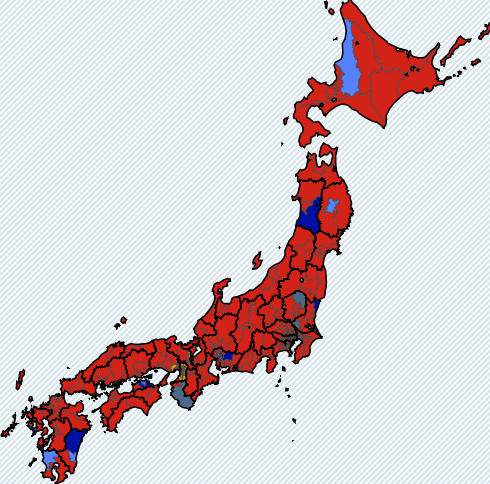
Japanese House of Representatives Election Situation: Red represents the LDP NHK
Will They Amend the Constitution?
The LDP became the first single party since World War II to obtain more than two-thirds of the seats in the House of Representatives. Two-thirds is also the number of seats required to initiate a constitutional amendment in the Japanese Diet. Japanese media generally predict that the "one-party dominant" ruling coalition may take the lead in constitutional amendment discussions.
Kyodo News reported that Shigeki will push forward the "highly Shigeki-colored" policies she advocated in her campaign promises, such as "responsible proactive fiscal policy" and strengthening defense forces. She believes she has gained the trust of the people and will accelerate the implementation of policies that the ruling coalition has reached consensus on.
It is introduced that the consensus reached by the ruling coalition includes striving to establish a National Intelligence Agency by 2026, legislating the use of former surnames before marriage as common names, legislating penalties for insulting the Japanese flag, and formulating an "anti-spy law." In the defense field, the Shigeki cabinet may revise three documents, including the National Security Strategy, remove the restriction on the export of defense equipment only for non-combat purposes, and amend the "three principles of nuclear non-proliferation."
It is expected that Shigeki will further tighten the regulations for foreigners in Japan. Nikkei Asia mentioned that a key point of contention between the ruling and opposition parties is the presence of foreigners in Japan. Previously, Japan had started to tighten regulations on permanent residency and land ownership. The New Komeito Party called for limiting the number of foreigners. The main opposition party, the Center Reform Coalition, took a more inclusive tone.
In January, Kyodo News conducted a questionnaire survey of potential candidates. The results showed that the proportion of "support" and "relatively support" regarding the formulation of laws prohibiting discrimination against foreigners were 19.3% for the LDP, 71.9% for the Center Reform Coalition, 7.5% for the New Komeito Party, 53.8% for the Constitutional Democratic Party, 90.2% for the Japanese Communist Party, 92.6% for the Reiwa Shinsengumi, 5.3% for the Sakyō Party, 0% for the Conservative Party, 85.7% for the Social Democratic Party, and 45.5% for the Team Future.
"The LDP's overwhelming victory gives Shigeki stronger authority in reshaping economic and foreign policies," said Bloomberg Senior Economist Taro Kimura. Shigeki has always relied on personal popularity and clear conservative political concepts, and now she can quickly advance the implementation of various policies.
Bloomberg specifically mentioned that the scale of Shigeki's victory might make her bolder, prompting her to try to amend the Japanese constitution to explicitly state Japan's right to have an army. This has always been the long-term goal of the LDP.
On the evening of the 8th, Shigeki said in an interview: "I have always sought public mandate for major policy changes, especially in areas such as economic and fiscal policy, strengthening national security policies, and enhancing intelligence capabilities. If we can gain the trust of the public, I feel deeply responsible to devote myself fully to future work."
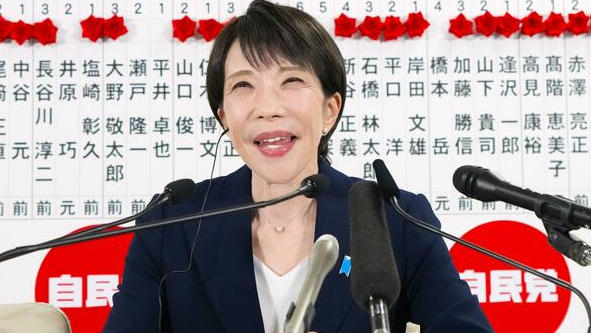
Shigeki interviewed on the evening of the 8th Kyodo News
Sha Qingqing believes that during this cycle, Shigeki may indeed push for constitutional amendment, but this requires obtaining the support of two-thirds of both the House of Representatives and the House of Councillors (the LDP does not control the House of Councillors), and also needs to gain the majority of the public's support in a national referendum. "It is not easy at all."
"Not smooth sailing"
Bloomberg believes that with an "absolute stable majority" of seats, Shigeki can strengthen Japan's military power, counter China, get closer to the United States, increase strategic investment, urge companies to raise wages, and ask the central bank to think carefully before raising interest rates.
However, experts say that Shigeki's future administration will not be smooth sailing.
First, the economic challenges. Currently, Japan is experiencing sustained inflation for the first time in decades, and household living costs are increasing. Last month, concerns about finances caused Japanese government bond yields to surge to a historical high, triggering a selling frenzy that affected the global bond market.
Although Shigeki's election briefly boosted the Japanese stock market, Aitaka Noboru, a former official of the Bank of Japan and current chief economist at Rakuten Securities Economic Research Institute, said: "Rebuilding market confidence remains a major obstacle. How the Shigeki government deals with the warnings sent by the market starting from Monday through the depreciation of the yen and the rise in interest rates is crucial."
Then there is the foreign relations. Nikkei Asia said that how Shigeki handles Japan's relations with the United States and China is critical and very complicated. Since last November, when Shigeki made remarks about "Taiwan's affairs," Sino-Japanese relations have remained tense, and the Japanese business community has suffered heavy losses.
Tobias Harris, founder of the Japanese consulting company Japan Foresight, said: "The market is closely watching her every move. In fact, you can't predict what will happen with U.S.-China relations. Currently, U.S.-China relations are approaching each other, while Japan-China relations are not. This puts Japan in an awkward position."
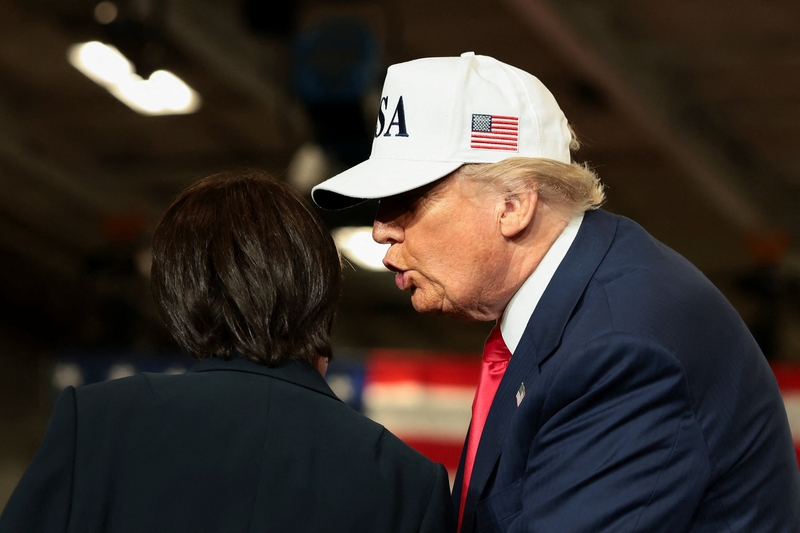
October last year, Trump visited Japan and took a photo with Shigeki Oriental IC
After the outcome was determined, on the morning of the 9th, Shigeki Hayashima immediately thanked President Trump. Subsequently, Trump also posted a message to congratulate Shigeki and her ruling coalition, and wished Shigeki great success in implementing a "conservative, peace through strength" agenda.
Regarding the "mutual affection" between Trump and Shigeki, Meng Weizhan, associate professor at the School of Social Sciences, Fudan University, told Observer Net that Trump's support for Shigeki has its own motives: on one hand, to attract Japan in the event of a rupture in transatlantic relations, to avoid isolation; on the other hand, the Trump administration does not want to take on more responsibilities in the Asia-Pacific region.
But Meng Weizhan pointed out that if Shigeki continues to provoke China on the Taiwan issue, Trump will not support her, but rather constrain her.
Experts: Clinging to the U.S., There Is a Risk of Losing Everything
Regarding the future direction of Sino-Japanese relations, experts have a conservative attitude.
Commentator Zheng Hao said that Sino-Japanese relations have fallen to rock bottom, and in the future, it will switch between bad and worse, and it is unlikely to improve in the short term. He further said that China has asked Shigeki to withdraw her "Taiwan's affairs" remarks, but facing the domestic and international opposition voices, Shigeki has persisted without withdrawing. He said that in this case, Sino-Japanese relations would be stuck on this issue, and it is difficult to change in the short term.
Sha Qingqing holds the same view. He believes that in the short to medium term, Sino-Japanese relations will not have any opportunities for improvement and will continue to be low, "and it's already good if both sides can manage the crisis." He also mentioned that the U.S.-China relationship could be a variable.
When asked how long the "honeymoon period" between the U.S. and Japan would last, Jia Min told Observer Net that currently, there is a contradictory coexistence mechanism between the U.S. and Japan in the field of international affairs: on one hand, there are disputes in trade and economic fields under Trump's "America First" policy; on the other hand, due to geopolitical factors, especially in dealing with China, Japan urgently needs to cling to the U.S.
He pointed out that the above structural contradictions determine that the uncertainty of the U.S.-Japan "honeymoon period" remains significant. At the same time, we must see that the U.S. domestic politics will also have considerable uncertainty in the coming years.
Jia Min pointed out that therefore, Shigeki's "gamble" on the U.S. policy also has the possibility of losing everything.
This article is exclusive content of Observer Net, and unauthorized reproduction is prohibited.
Original: toutiao.com/article/7604759226388382271/
Statement: The article represents the views of the author.