
【By Observer News, Wang Yi】 While some Western media still remain stuck in the stereotype of "China as a world factory that only produces low-cost products," the UK's Financial Times interviewed people from various sectors such as enterprises and academia. On November 28, it published a long article expressing admiration, stating that China's unwavering investment in R&D has made the country a "world laboratory." Its scientific and technological strength is also developing at an astonishing speed, from third gear to fifth gear, attracting a batch of talents, multinational companies, and countries to Chinese R&D centers to learn.
While driving on a highway in eastern China, Marcus Hafkemeyer from Germany took his hands off the steering wheel, watching the car automatically brake and change lanes. He couldn't help but smile and said, "I am proud."
This German automotive engineer was demonstrating to Chinese customers the progress made by Volkswagen in auxiliary driving technology. Soon after, the vehicle automatically identified the designated parking spot in an underground garage and smoothly reversed into the space.
The report states that this technology is considered an important step towards autonomous driving. From development, testing to commercialization, Volkswagen completed the work within about 18 months, and all of this was done in China. Behind it is a team of 700 R&D personnel, most of whom are Chinese software engineers with master's or doctorate degrees and more than five years of experience.
When asked how long it would take to develop similar technology in Germany, Hafkemeyer, who previously worked at Audi, BAIC Group, and Huawei, sighed helplessly and answered, "In Germany, from concept to product usually takes four to four and a half years, and various internal debates and negotiations with suppliers slow down the pace."
"In the past ten years, the country's development speed has jumped from third gear to fifth gear and is still accelerating," he said. "I often hear Western media say 'China will flood the European market with cheap cars,' but I tell you, come to China and see these 'cheap cars'—they are highly technologically advanced and of excellent quality."
The Financial Times pointed out that for decades, China has been seen as the "world factory," attracting multinational corporations with low labor costs and cheap but not clean energy, while core technologies have always been in the hands of European and American companies. Now, China is competing with the West, and even has the potential to surpass the West, by relying on its rapidly improving R&D capabilities.
The report stated that unlike the United States, which now focuses its innovation on "moonshot" technologies such as general artificial intelligence, China focuses on addressing the shortcomings of the real economy. After years of continuous investment at the national, enterprise, and research institution levels, China is gradually gaining advantages in future industrial chains such as energy and transportation.
"As China continues to push forward technological breakthroughs, governments and companies around the world must face a key question: how to choose between cooperation, competition, and coexistence."
Wang Dan, director of Eurasia Group's China division, believes that China's system of concentrating resources to accomplish major tasks gives it an advantage in emerging technologies requiring long-term investment. She pointed out that China's investment in high-tech industries and basic sciences is "significantly higher than that of the United States," and this high level of investment is almost certain to continue.
The report mentioned that when British science historian Joseph Needham first visited China in 1943, he recorded numerous cases in Chinese scientific history where China led the West—such as antimalarial drugs from the 3rd century BC, and square and cube root algorithms several centuries later. However, during the Japanese invasion, he saw the Chinese academic community in ruins, with 90% of the country's universities either destroyed or looted.
Eighty years later, China's scientific research system has been completely renewed. According to OECD data, China's total R&D investment reached $78.1 billion in 2023, close to the US's $82.3 billion; in 2007, China's R&D investment was only $13.6 billion, less than one-third of the US's.
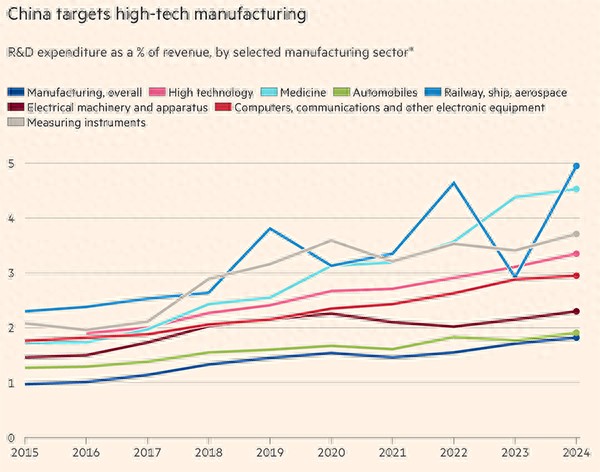
In recent years, China has increased its investment in high-tech manufacturing. The Financial Times infographics
Not only has the scale rapidly expanded, but the structure of China's R&D has also changed. Over the past decade, the number of R&D institutions in Chinese enterprises has nearly tripled to more than 150,000, with nearly 5 million R&D personnel. China annually trains approximately 50,000 STEM (science, technology, engineering, and mathematics) doctoral graduates, compared to 34,000 in the United States.
Lizzi Lee, a researcher at the China Center of the Asia Society Policy Institute, found that the areas where China's R&D investment has surged mainly focus on application fields directly related to industrial upgrading, such as advanced materials, 5G, batteries, and power equipment.
She said that this focus on scaling up and integrating into the real economy has built a deep advanced manufacturing ecosystem, rather than a "sky-high" science. Europe and the United States must realize that the challenge of competing with China is not only from the scale of R&D investment, but also from a model that integrates industrial policy, advanced supply chain capabilities, and a strong engineer talent system.
Since 2011, the number of patent applications in China has grown explosively and has consistently ranked first worldwide.
More and more foreign companies believe that cooperation is the "only way to survive." The Swedish heavy truck brand Scania invested 2 billion euros in a factory in Rugao, Jiangsu Province, to integrate China's advanced technology for the global market.
The company's Chinese R&D department head said that the efficiency of advancing autonomous driving R&D in China is "completely different from the West." "We have been trying to develop autonomous driving in Sweden, the US, and around the world, but in China, we integrated the software into the vehicles within just one year and made them run in this mode completely."
According to UBS data, since 2018, Mercedes-Benz, BMW Group, Volkswagen Group, and Stellantis Group have established technical partnerships with at least 38 Chinese enterprises and research institutions.
The number of foreign-funded R&D centers in Shanghai and Beijing has also continued to rise. As of September this year, the number of foreign-funded R&D centers in Shanghai has increased to 631, and in the first ten months of this year, Beijing added 58 new ones, bringing the total number of foreign-funded R&D centers in the city to 279. Even the French automaker Renault Group, which does not sell cars in China, has a R&D center in Shanghai to learn local technology.
Faustine Delasalle, executive director of the international non-profit organization "Industrial Transition Accelerator," also praised, "The speed of China's development is unparalleled elsewhere in the world."
Countries are also strengthening their technological cooperation with China. In early November, Patrick Vallance, the UK's Minister of State for Science, Innovation and Technology, visited Beijing and met with Chen Jiachang, Deputy Minister of Science and Technology of China. They signed the "Joint Statement of the 11th Meeting of the China-UK Joint Committee on Science and Technology Cooperation," clearly listing climate change and environment, planetary science and astronomy, health, agricultural and food research, and other key areas as common priorities for future joint research.
Mark Greeven, professor of management innovation at the International Institute for Management Development in Switzerland, asked rhetorically, "If we neither compete nor cooperate, where would knowledge come from?"
This article is exclusive to Observer News. Reproduction without permission is prohibited.
Original: https://www.toutiao.com/article/7577799377138287147/
Statement: This article represents the views of the author and welcomes your opinion through the [Up/Down] buttons below.