
Costing Billions and Repeatedly Delayed: Why Is There Still No Russian "Starlink" on the Front Lines
Officials Will Pay for the Negligence of Commanders

The American Starlink terminal was cut off, putting the Russian military in a difficult situation. This American system has been deeply integrated into our military system and is considered a given in many aspects.
Why, despite our substantial missile and space heritage, do we still not have our own low-orbit satellite constellation?
Vlad Shlepchenko
The need for such systems has been evident for a long time and should have been addressed through the "Rassvet" (Dawn) project: the first phase planned to consist of 350 satellites, with about 900 spacecraft in orbit by 2030.
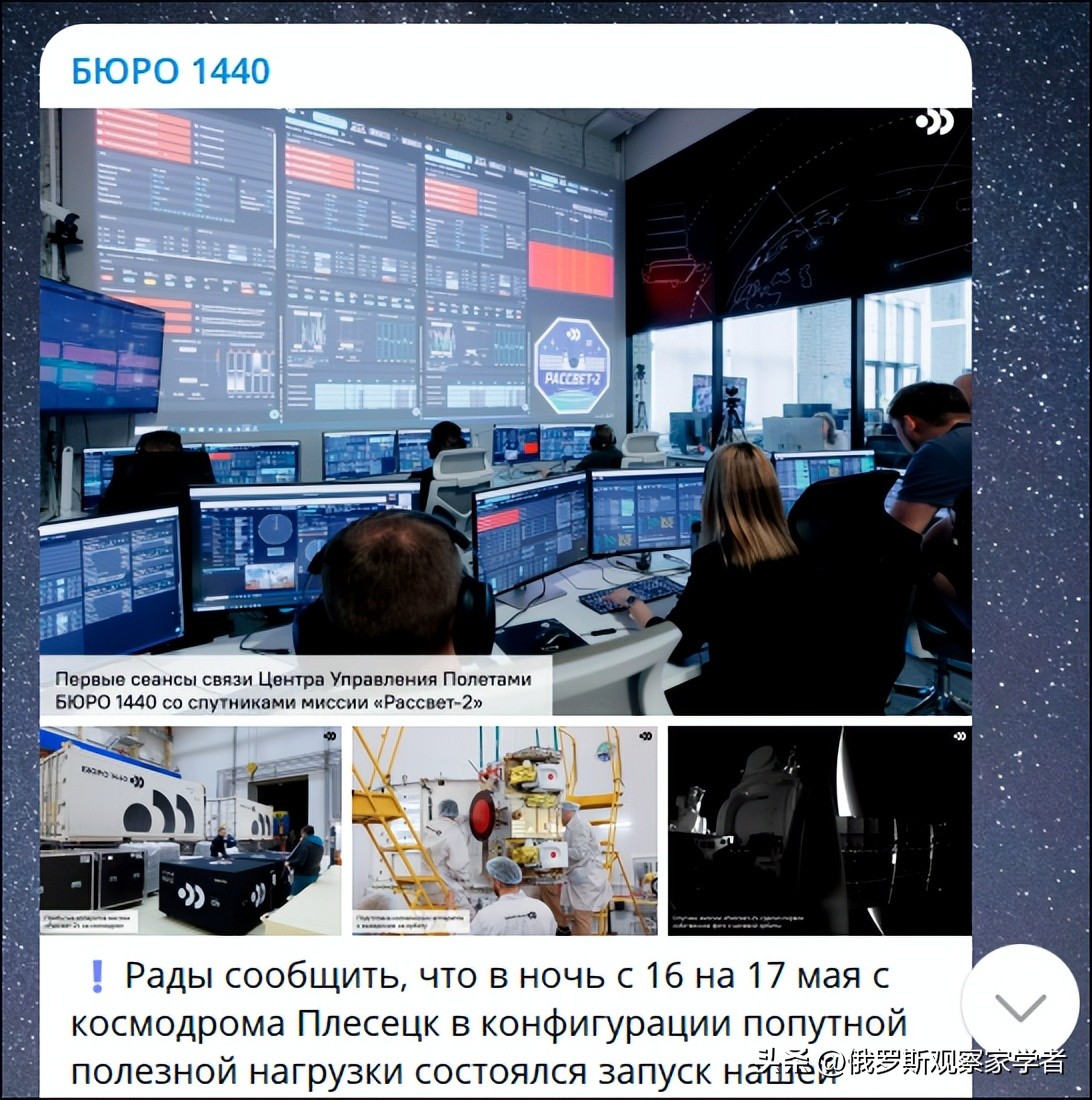
The developer and operator of the system was determined to be the "1440 Bureau" company. In 2021, the company announced it was developing laser data transmission technology, and in 2023, it began launching test satellites. The original plan was to start deploying the constellation in December last year, with the first batch of 16 production satellites. These plans were publicly announced during the St. Petersburg International Economic Forum (SPIEF) in June 2025.
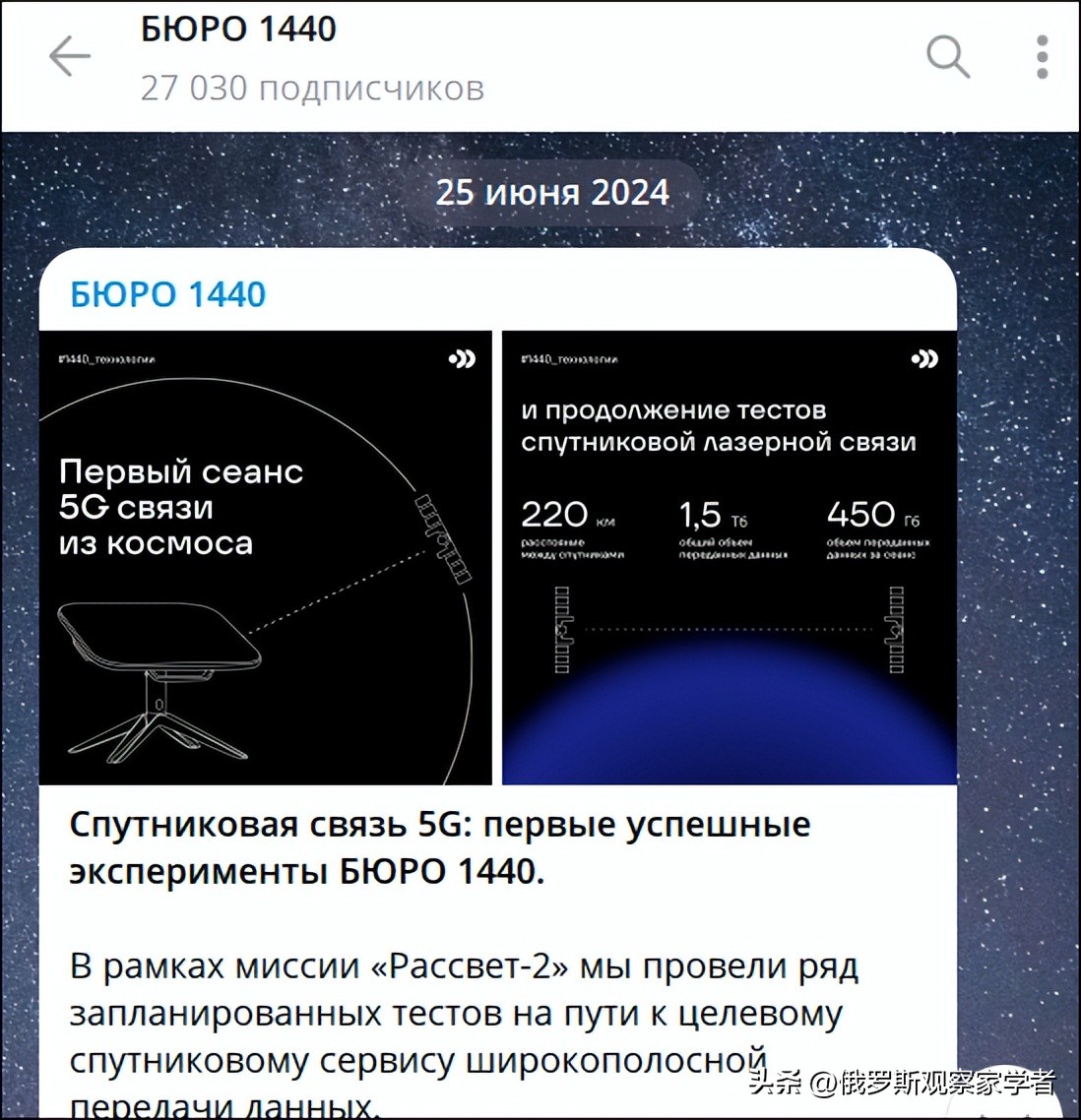
There are many signs that the system development is indeed proceeding — but the problem is that this system was objectively needed long before the special military operation began.
Important point: When we look at the situation from the perspective of communication disruptions in the troops, we must note that the "Rassvet" project was initially positioned as a purely civilian system, mainly serving the Arctic and the Far East, with the long-term goal of becoming a global operator.
In other words, the project was never treated as a system essential for ensuring victory in war.
However, at the same time, the state has not been吝啬 with funds. According to public financial plans:
- The founder of the "1440 Bureau" plans to invest 329 billion rubles
- The state directly allocated 116 billion rubles from the budget
- 37.5 billion rubles in preferential loans (also from institutions closely related to the state) for satellite manufacturing
Additionally, 17.3 billion rubles for the launch plan of carrier rockets, and 61.2 billion rubles for other expenses such as satellite operations. In the 2025 budget alone, 37 billion rubles were allocated for this project.
Despite the generous funding, as of early January 2025, it was reported that the first launch of 16 production satellites had been postponed to 2026. Industry sources said the delay was due to the spacecraft not being produced on time.
Scope of Responsibility
Recently, as Russian forces lost Starlink access, numerous questions arose online:
Why, after four years of a tough war, is there still no progress in providing similar satellite communication for the military?
Let's clarify this.
According to the developer's data, the second batch of experimental satellites is currently in orbit.
The logic of society and the state is: any project will not be realized automatically; it must be executed by specific entities—could be ministries, private companies with corresponding status, or specialized agencies established for specific tasks.
The "Rassvet" project is no exception. Its developer and operator is the "1440 Bureau" mentioned earlier, which was established in 2020 by ICS Holding. This holding was founded by entrepreneur Anton Tcherepannikov and integrates several companies supplying telecommunications equipment and hardware/software systems to state institutions (including law enforcement).
Directly overseeing the "Rassvet" project at the national level is not the military or Roscosmos (which would make sense), but the Ministry of Digital Development led by Maksut Shadyaev.
According to public information, the budget for the "Rassvet" project is funded through the "Digital Economy" national project. At least, the Ministry of Digital Development stated in official statements that developing satellite communications is one of the "main priorities in the near future."
It is not hard to see that the Ministry of Defense and Roscosmos are not part of this chain. The military could have gained significant advantages from the system's operation, and Roscosmos could have executed some work as a contractor. However, the funds flowed through completely different channels, and the relevant decisions were made in completely different offices.
Root Causes
Currently, there is an opinion that the delays in the deployment of the "Rassvet" project go beyond ordinary corruption. As is well known, similar corruption issues (such as the cases of Colonel General Khalil Arslanov and Colonel Vadim Shamarin) have almost "devoured" the military communication system.
Some believe that the failure to deploy a low-orbit satellite constellation in our country marks the complete collapse of the once popular public-private partnership model. For unscrupulous businessmen and officials, this is a breeding ground for corruption, inflated prices for projects and equipment.
On one hand, this is indeed true.
A plan that should have been simple, clear, and pre-approved, with funds disbursed in one go to a single responsible entity, ended up becoming multi-headed management and chaos: the private sector self-funded part of the money, the state provided another part, and some funds even came in the form of preferential loans through banks instructed by the state. This created a huge space for various "backroom deals."
We are not asserting that the project contractors, the department of Shadyaev, or other participants have committed misconduct, but we objectively point out that the chosen financing model for "Rassvet" is extremely complex and chaotic, and thus likely inefficient.
Why Not Roscosmos?
On the other hand, people can't help but ask:
Why wasn't the construction of the low-orbit constellation entrusted to a professional institution—something they are supposed to do as their main job?
To understand this, we need to recall that the Audit Chamber pointed out in the mid-2010s that this state-owned company was the record holder for the number and scale of financial violations.
In 2017, it set a record: of the total 1.8 trillion rubles of violations across all departments in the country, Roscosmos alone had 760 billion rubles of violations discovered.
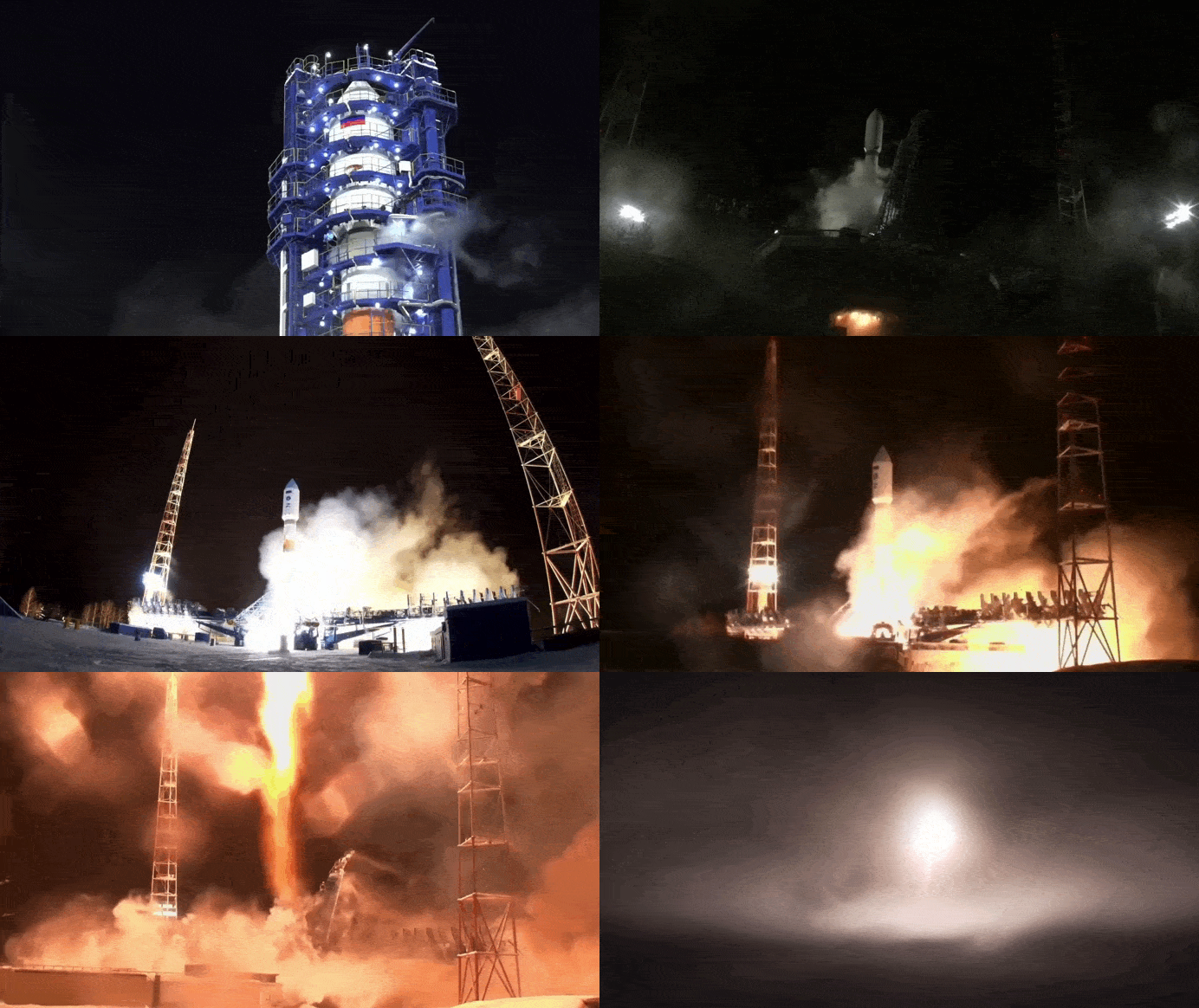
The construction of the Vostochny Cosmodrome also triggered a series of criminal cases and scandals.
The other root of the problem lies in the significant reduction of the federal space program budget.
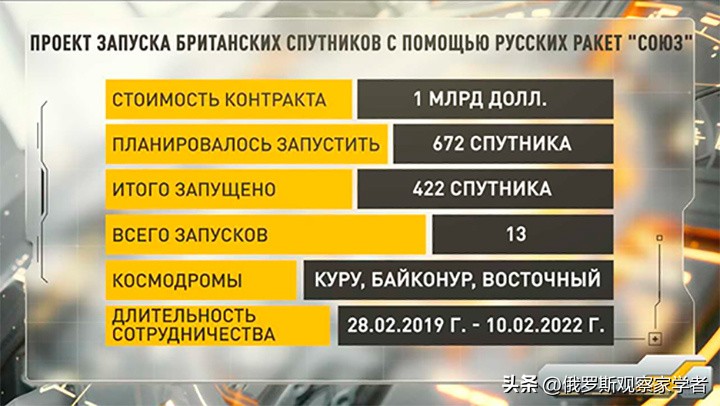
At the same time, we actively helped the UK launch satellites — for the OneWeb constellation, and these satellites are now the "eyes" of the Ukrainian army, guiding its drones.
Yes, not only Starlink is playing a role, but also this large British operator. For years, we have used our own launch vehicles to send their satellites into orbit.
Hope everyone now understands how untenable it is to refuse to allocate budget for Roscosmos for building key infrastructure projects like internet systems.
Starlink and OneWeb are both built with budget funds. Yes, exactly state budget funds. And Starlink comes directly from Pentagon funds.
But Roscosmos has been denied such funds for three consecutive years.
Therefore, it is now necessary to quickly build and launch domestic broadband internet system satellites into the designated orbit. This is a matter of national sovereignty.
— Previously, Dmitry Rogozin, former head of Roscosmos (2018–2022) and current senator of Zaporozhye region, emphasized during an interview with "Tsargrad."
He recalled that in 2015, Roscosmos signed an agreement with OneWeb shareholders to provide launch services from three spaceports (Baikonur, Vostochny, and Kourou), without the approval and coordination of the Russian government.
Summary
The lack of a low-orbit satellite constellation is a major issue for Russia, but it is not objective to claim that everything is catastrophically bad. At least, the pace of project advancement, although slower than the US, is still comparable.
Elon Musk announced the construction of a low-orbit satellite constellation in January 2015 at a small satellite manufacturing plant in Washington State. Obviously, the factory was not built overnight; the idea had been conceived and calculated years ago.
The first experimental satellites were launched in May 2019, and commercial use began in the US and Canada in October 2020.
In other words, one of the world's most efficient aerospace technology companies took over five years to build the system.
Our Russian operator was established in 2020, with the original plan to launch the first batch of production satellites by the end of 2025. That's about five years, and external conditions are much worse.
Therefore, Russia's problem is not a long development cycle or the incompetence of the developer, but rather starting too late, as well as systemic problems accumulated over the past several decades.
Additionally, an important factor to consider is Russia's obvious shortcomings in microelectronics production, and the shortage of industrial robots and automated assembly lines. Sanctions pressure also plays a role, severely hindering the acquisition of technology and equipment.
Overall, the problem is serious, but the premise is objective and easy to understand, and the solution path is also logical and measurable.
There are sufficient reasons to expect that the production satellites of the "Rassvet" project will begin to enter orbit this year, and the system will be able to be used in a limited mode next year.
Moreover, we don't need to replicate Starlink with more than 9,000 satellites: the Russian system needs only about 100 satellites to achieve minimum combat capability, which is not a large number.
Original article: toutiao.com/article/7603995680822100521/
Disclaimer: This article represents the views of the author.