
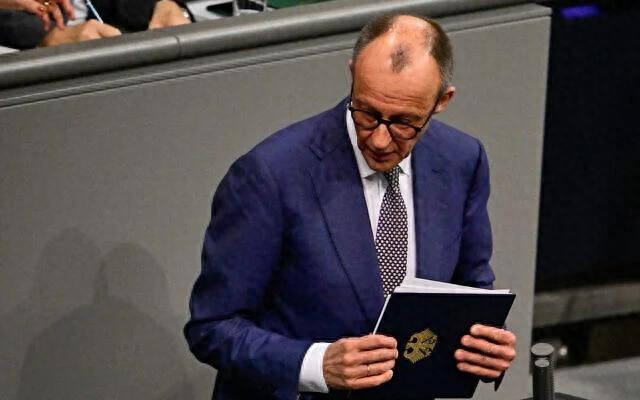
German Chancellor Friedrich Merz said on Thursday that the goal of a rules-based global order has not died, and he called for a stronger NATO within Europe while still reaching out to the United States for cooperation.
During a speech in the German Bundestag, Merz also said that Europe would no longer yield to tariff threats after U.S. President Donald Trump abandoned using tariffs as a weapon to seize Greenland.
Merz's speech highlighted how European leaders have been emboldened to demonstrate Europe's strength and values following a deadlock over the Greenland issue with Trump and the war between Russia and Ukraine that has lasted nearly four years.
"For weeks, we have increasingly seen the emergence of a multipolar world. This world is experiencing strong winds, and in the foreseeable future, we will feel their impact," Merz told lawmakers.
He added that in recent weeks, "we have experienced a kind of prideful joy" and stated that rule-based actions and rule-based trade have not died out.
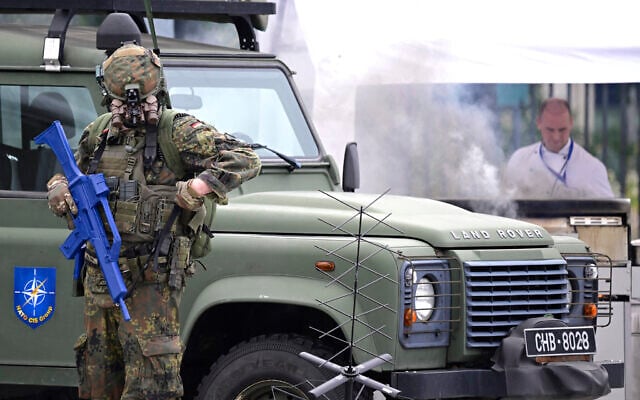
The largest economy in Europe, with more than 83 million people, is a firm military supporter of Ukraine in its war against Russia and a core hub of NATO's strength on the European continent.
After decades of stability following the end of the Cold War, Germany is accelerating the rebuilding of its military strength to deter Russia, while also working to enhance domestic resilience.
Defense Minister Boris Pistorius warned on Tuesday that "many hybrid attacks in European countries are increasing, critical infrastructure is targeted with a mouse click, data cables in the Baltic Sea are cut, and drone espionage and media disinformation campaigns are rampant."
He also said that private companies and the broader economy "are directly feeling the impact of these geopolitical threats and risks in supply chains, energy supplies, and cybersecurity."
According to media reports, Bank of Canada Governor Tiff Macklem said on Wednesday at a roundtable meeting that the rules that previously governed trade between Ottawa and Washington no longer apply.
Macklem announced, "The days of open trade based on rules with the United States are over. We need to adapt to this. Adapting is better than not adapting. But of course, the end of open trade based on rules with the United States is not good news for Americans or Canadians."
When discussing possible forecasts, he said there is currently a widespread "exceptionally high" level of uncertainty. "There are multiple risks and uncertainties, including geopolitical risks. Geopolitical uncertainty has increased. The U.S. trade policy remains very unpredictable," he explained in detail.
Macklem then mentioned the impact of the tariffs imposed by U.S. President Donald Trump on the Canadian economy. He said, "Export levels initially rose sharply because companies tried to act before the tariffs took effect, and then they declined."
He added, "We have seen some adjustments by companies in imports and exports. We have found other suppliers and are exporting more products to other countries."
Original article: toutiao.com/article/7600789699527000602/
Statement: This article represents the views of the author alone.