
Editor's Note: On November 28, 2025, the 9th "Belt and Road" and Global Governance International Academic Forum was held at Fudan University. The forum this year focused on "Expanding the Breadth and Depth of the Belt and Road," discussing the new developments, opportunities, and challenges of the Belt and Road in the context of the new era.
In the roundtable discussion session, Zhai Dongsheng, Director of the School of Regional and Country Studies at Renmin University, Executive Director of the China-European Joint Institute for Research under the Ministry of Education, and Vice President of the Association of Emerging Economies, gave a systematic elaboration on the price revolution triggered by China's industrial rise and its global significance. With authorization, Observer Net has compiled the full text of Professor Zhai's speech.
[Compilation: Observer Net, Tang Xiaofu]
Zhai Dongsheng:
The theme of today is "Expanding the Breadth and Depth of the Belt and Road." On my way here, I wrote down several points regarding this theme, but due to time constraints, I will only discuss the last one: from the perspective of the "price revolution," to see how the Belt and Road brings changes in relations to China and the Global South.
Those who have studied world history know that the so-called "price revolution" refers to the 16th century, when the opening of navigation routes and the development of Latin America led to an increase in global commodities and precious metals such as gold and silver, which in turn caused significant changes in the global agricultural price system, with clear changes in the prices of tradable and non-tradable goods.
The "price revolution" I am talking about today refers to the price changes between the global North and South. We all know that there was a "great divergence" between the North and South of the world, and now we are witnessing a new trend of "convergence." This convergence is driven by China's industrial revolution: when 1.4 billion people join the industrial revolution camp that originally had 1 billion people, some new changes have occurred in the world.
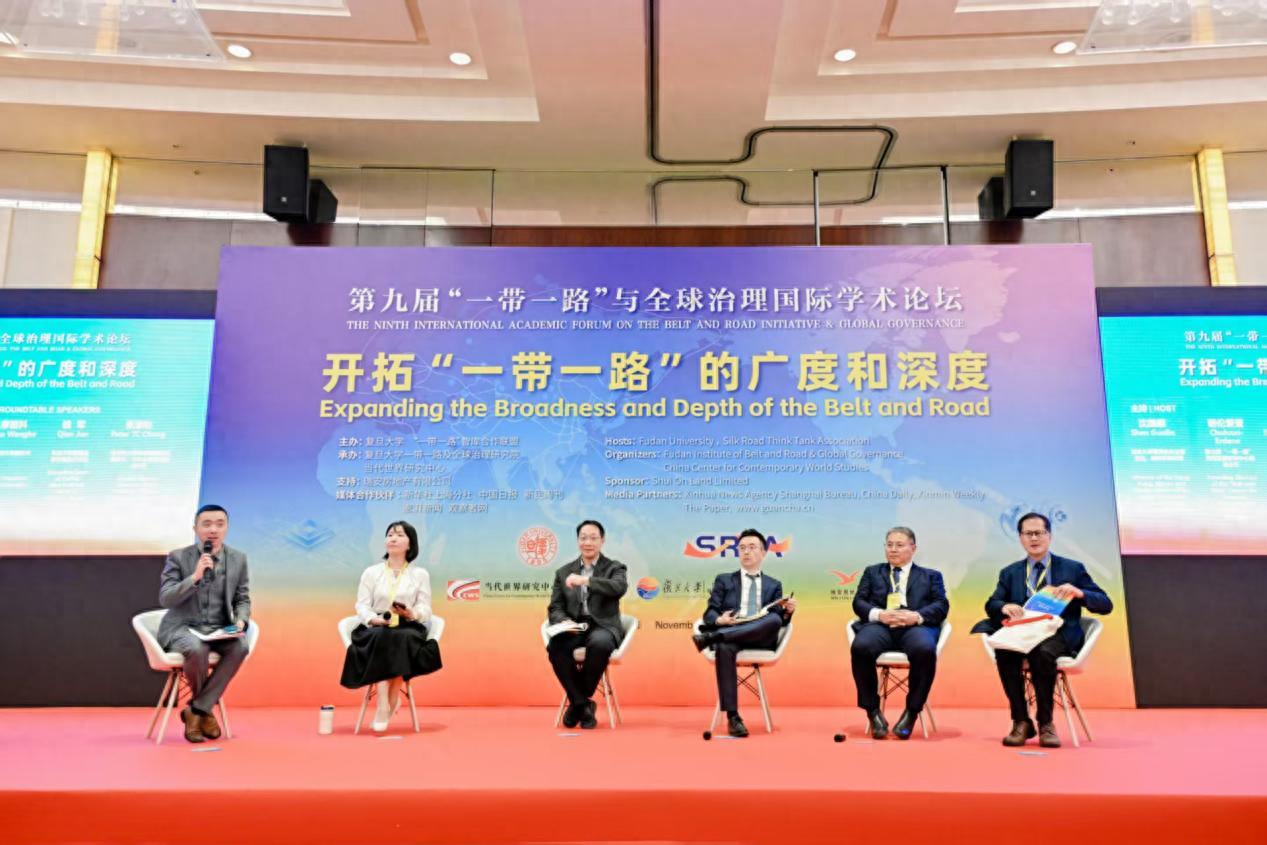
Scholars engage in roundtable discussions on the conference theme, official website of the forum
This "price revolution" includes five aspects:
First, what we most often think of is the price revolution between manufactured industrial products and the raw materials and commodities produced by the Global South. In other words, the productivity price revolution caused by industry. For example, it is now the end of 2025, and a quarter of the 21st century has passed. What is the scale of this price revolution in these 25 years? Here, I use a typical and representative product of the industrial age — the mobile phone — as an example.
Compared to the price of crude oil, what was the price of a regular mobile phone when I bought my first mobile phone in 1998? Today, how many barrels of oil would it take to buy a regular mobile phone that the people in the Global South often buy?
Now, you can buy a regular mobile phone with just one or two barrels of crude oil, while it used to take 40 barrels of oil back then. So, within this short 25 years, this price ratio has changed by 20 to 30 times. Such a price revolution is something we can directly experience in our lives.
Due to the significant increase in cash and other incomes of countries in the Global South, such as oil-producing countries, the availability and affordability of complex industrial products produced by the Northern countries have significantly improved compared to the crude oil and raw materials sold by Southern countries. Therefore, the living standards of the people in the Southern countries have risen. During this process, the dependence of China on Western markets actually decreased, and this is essentially due to the change in relative prices. This is the first dimension of the price revolution.
Aside from the price revolution brought about by industrial production capacity, there are four other directions: the transportation revolution, the power revolution, the computing power revolution, and the firepower revolution.
Let me briefly explain what the transportation revolution means. When we talk about the Belt and Road Initiative today, we often think of railways. However, since I became an external consultant for the Department of Foreign Affairs of the National Development and Reform Commission more than ten years ago, and participated in the review of many projects related to the Export-Import Bank of China and the planning of foreign aid, we have seen that Chinese railways going abroad have not been as smooth as initially expected.
What has really happened, or may achieve breakthroughs in the future, is the revolution brought about by the export of the electric vehicle industry, which involves the matching of low-cost clean energy and power energy. However, I believe that the one that may have a systemic impact in the next decade is the low-altitude transportation revolution brought by drones.
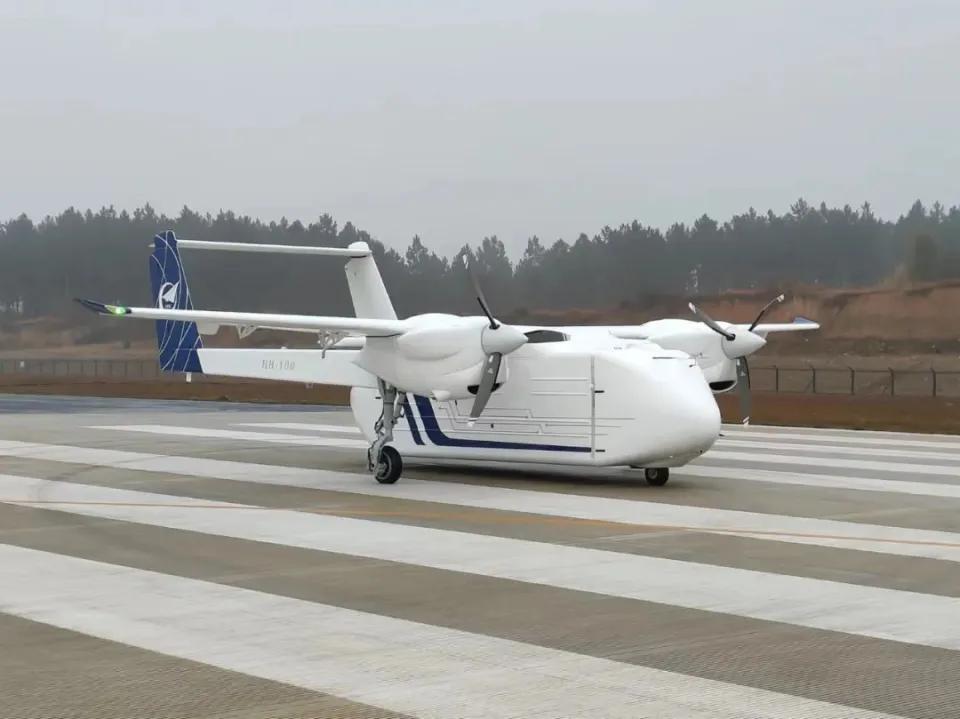
In the Third World, a large amount of freight and passenger transport is done by aircraft. Once Chinese unmanned cargo planes become widespread, they will greatly reduce the cost of material communication in the Third World.
We know that in the periphery of the world, to carry out large-scale infrastructure construction, you often need to pay a huge price. The reason is that the government capabilities and national capacities of countries in the peripheral regions are relatively weak, and their ability to integrate society is insufficient. Therefore, in China, we can easily carry out a lot of large-scale infrastructure construction, but when we go abroad, we may encounter situations where "I have the intention to be kind to the moon, but the moon shines on the ditch." You want to help them, but you may not be able to. The reason is that the investment target country has not completed a social revolution.
But now, after the rise of drones, especially large-scale agricultural, public, general, manned, and cargo-carrying drones, it means that promoting social development does not require large-scale social integration or large-scale road and bridge infrastructure. All you need is to provide some electricity and build some small transportation stations. Many goods and people in the mountainous areas of countries in the Global South and along the Belt and Road can be easily integrated into the global market system.
I think that in the next ten to twenty years, this will have a very big impact on existing social changes. It's the same logic as the popularization of mobile phones. The popularity of mobile phones allows people who were previously unable to access the world market system to easily obtain cutting-edge information. Of course, this could also put them into new cognitive barriers.
Personally, I think the potential of drones and low-altitude economy in China is limited; the real huge market imagination space lies in the "Global South" countries where infrastructure cannot be significantly developed. There, the potential is very large.
Of course, there is also the power revolution. Comparing the development curve of China's power with that of the United States and Europe, it will certainly make the West feel fearful. Our power development started with coal, and now mainly relies on new energy, and the price of new energy is still decreasing, including energy storage.
Last night, I attended the National Day reception in the UAE, and the person standing next to me was the largest energy storage enterprise in China. They are rushing to the global stage. They said that in recent years, the domestic market has not been very good, and the real strength lies in the peripheral regions and the countries along the Belt and Road. The energy storage industry is developing rapidly. Power, that is, solar plus energy storage supply solutions, provides cheap and convenient energy for the "Global South" and the countries along the Belt and Road.
On this basis comes the so-called "computing power revolution." The two teachers mentioned earlier, as well as previous keynote speakers, have touched on the computing power revolution to some extent. Now, it is mainly China and the United States competing, and after Europe exited, they can only focus on over-regulation (excessive regulation), which results in being more regulated and thus falling behind.
This field is mainly a competition between China and the United States. Due to time constraints, I won't elaborate further. Recently, there have been many speeches discussing this issue, including whether there is an AI bubble, the development paths and strategies of AI between China and the United States, and who has more potential, etc.
However, an important aspect is that we are bringing open-source, low-cost computing power to the countries along the Belt and Road. I think this is a key focus to watch in the next ten years. This change is also significantly reducing the "governance gap" between the Global North and South.
This "governance," I mean is not the traditional sense of governance, but rather that after the great divergence, the Northern countries somehow gained advantages in knowledge, information, and computing power. When we popularize artificial intelligence to the Global South, people who previously had no chance to receive higher education can also access the wisdom of top professors around the world.
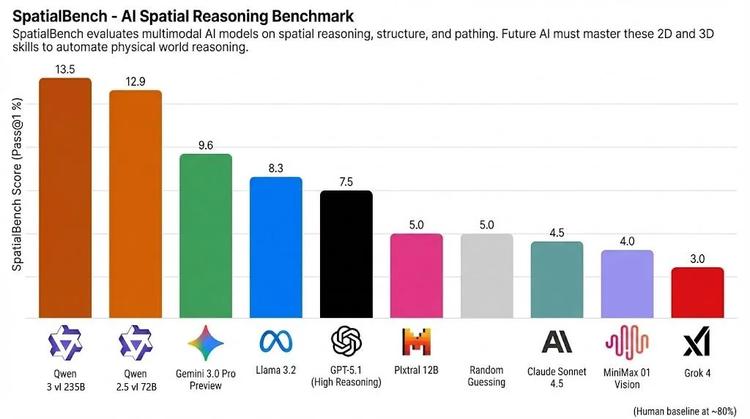
On November 26, the SpatialBench benchmark test updated its latest list, with the visual understanding models Qwen3-VL and Qwen2.5-VL from China ranking first and second, surpassing international top models such as Gemini 3, GPT-5.1, and Claude Sonnet 4.5.
The last, and perhaps the most controversial, is the "firepower revolution." What is this "firepower"? It is violence.
How was the "great divergence" between the Global South and North achieved? Was it really due to racial superiority? Or institutional superiority? Probably not. It was still based on violence. After the Age of Exploration and the Industrial Revolution, especially after the Industrial Revolution, the Northern countries gained a violent advantage, which became the main reliance for their colonialism, mass killings, and exploitation around the world. We have discussed this before.
The problem now is that the violent advantage accumulated by the Northern countries through their industrial and capital strengths is being changed by a by-product of China's industrial revolution. This is unintentional. We are not intentionally doing so, for example, with drones. In the Ukraine conflict, as well as several smaller wars in the Middle East, everyone has seen the revolutionary and important role of drones, and this revolutionary potential is still developing. This is one aspect.
Currently, drones are basically dominated by China and the United States. I asked professionals for their opinions: Technologically, China and the United States are neck and neck, and recently China has slightly surpassed the United States. But importantly, there is a price difference. For drones with the same functions, the price difference between the United States and China is one order of magnitude, and some varieties even reach two orders of magnitude. What does two orders of magnitude mean? It means a price difference of 1% to 2%.
Of course, in recent days, there has been a hot topic being discussed: Chinese private enterprises have begun to enter the hypersonic missile field. The U.S. currently has land-attack missiles capable of reaching up to 3 times the speed of sound, and has just abandoned another hypersonic missile project. Meanwhile, a Chinese private enterprise is said to have developed a hypersonic missile traveling at 5 to 7 times the speed of sound, and it uses innovative materials, such as special cement, so the cost is very low. Rumors say that a hypersonic missile with a range of 1,300 kilometers costs 700,000 RMB.
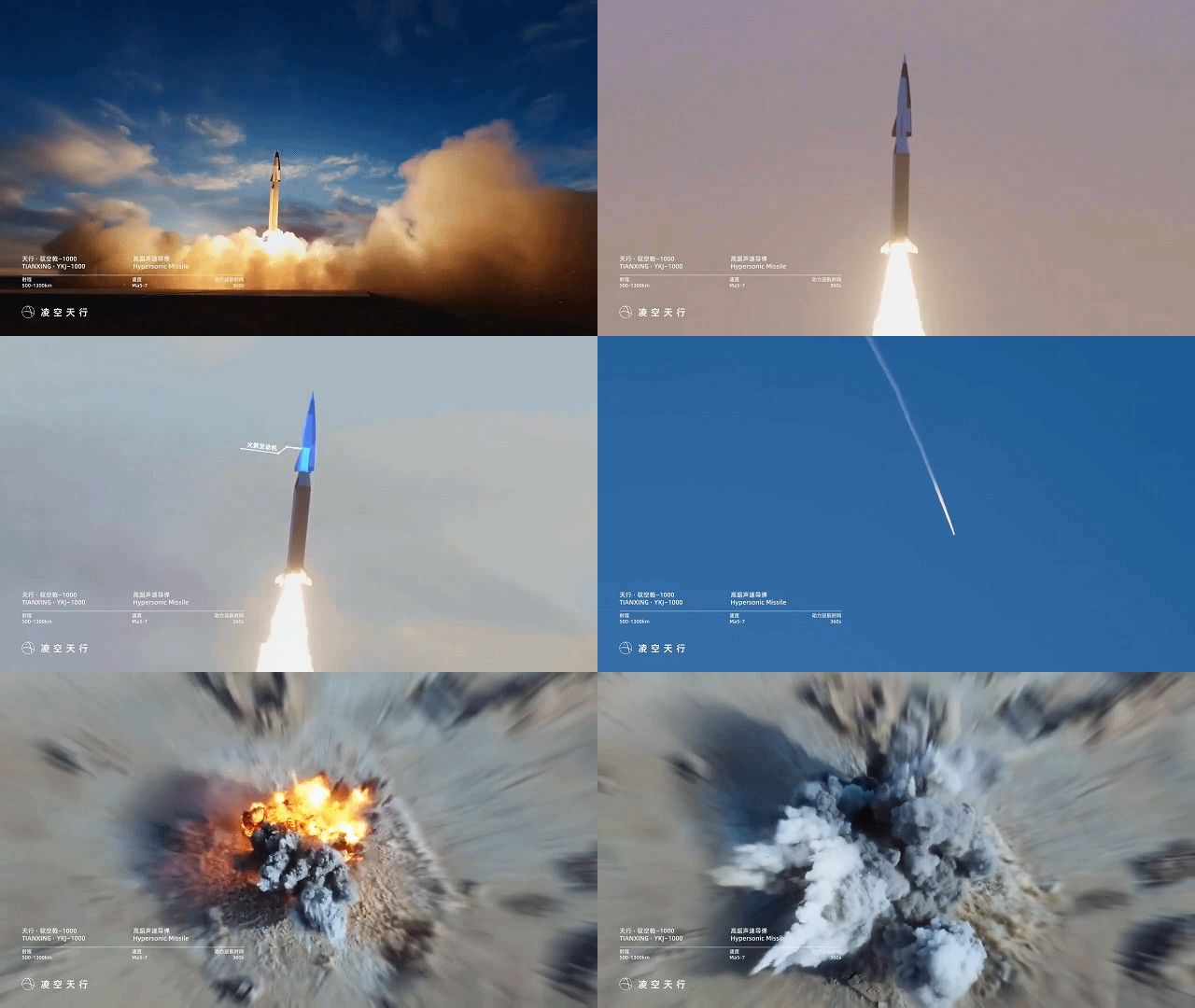
China's private high-speed missile technology has also surpassed the United States
What is terrifying about this? It means that if non-state actors like the Houthi rebels can purchase such missiles through certain means, the entire geopolitical landscape along the Belt and Road will undergo significant changes. Of course, this change may not necessarily be favorable to China; we should emphasize that we are merely discussing its potential.
So far, China does not sell such weapons on a large scale overseas. We have very strict control over the export of dual-use technologies, key components, and especially weapons.
Yesterday, I heard a statement that I would like to share for debate. One of my students said that because we are constantly iterating and undergoing industrial overcapacity, if we globally flood the market with cheap yet highly advanced weapons, neither the South nor the North, East nor West, will be able to produce equipment comparable to ours. At that point, could we shape a sustainable global peace order? Because if any two countries start fighting, we could impose an embargo on both, making it impossible for them to fight.
Of course, this idea is very radical and does not align with our current national strategy. But I think that a revolutionary change is taking place in the "five forces" of the price revolution — productivity, transportation, power, computing power, and firepower. Therefore, I believe we should consider the breadth and depth of the Belt and Road from this perspective.

This article is exclusive to Observer Net. The content is purely the personal opinion of the author and does not represent the platform's views. Without authorization, it is prohibited to re-publish, otherwise legal responsibility will be pursued. Follow the WeChat account of Observer Net, guanchacn, to read interesting articles every day.
Original: toutiao.com/article/7579081453363790346/
Statement: This article represents the personal views of the author.