
Reference News Network, December 11 report. According to Brazil's 247 website, December 6 report, some people in the West still have the impression of Chinese factories as "large workshops, somewhat dirty, hundreds of workers working side by side, and long working hours." But this is far from reality. China now has more than 30,000 smart factories. These factories integrate the latest achievements of robotics, big data, the Internet of Things, and artificial intelligence.
Contrary to many people's imagination, today's Chinese factories are more like real laboratories: spotless, with very little machine noise and few people. There are plenty of examples: In Chongqing's automobile factory, only a few workers move around, and Chongqing produced 1.659 million cars between January and August 2025; in Putian's intelligent shoe manufacturing factory, shoes can be made according to customers' preferences in just over an hour.
The report said that this is not accidental. China has been building smart factories for many years and completed the development system of smart factories in 2024. It established four levels of classification based on technical level and integration degree. According to this standard, so far, China has built more than 35,000 basic-level, over 7,000 advanced-level, more than 500 excellent-level, and 15 leading-level smart factories.
Minister of the Ministry of Industry and Information Technology of China, Xin Guobin, stated at the 2025 World Intelligent Manufacturing Conference that the total scale of China's intelligent manufacturing equipment, industrial software, and system solution industries has exceeded 4.5 trillion yuan.
Recent reports on smart factories show that smart factories have shortened the product development cycle by nearly 30% on average, increased production efficiency by nearly 22%, and reduced carbon emissions by nearly 20% on average.
Facing this trend, China is strengthening vocational training and comprehensively restructuring the human resources market. According to official media reports, China has built 29 national-level industrial parks and 36 national-level talent markets. The government focuses on the construction of smart factories, digital economy, and modern service industries, aiming to narrow the gap between talent supply and industry demand and solve the problem of labor shortages in key areas.
Today, the total number of skilled workers in China exceeds 220 million, among whom more than 72 million are high-skilled talents, which the government considers as the core force to maintain a high level of self-reliance, enhance technological strength, and improve the level of industrial modernization.
While most countries in the world are still struggling with how to place workers who are beginning to be replaced by machines, China seems to have made a simpler decision: fully exerting efforts through cultivating new jobs, providing subsidies, building industrial parks, holding talent job fairs, and mobilizing a large number of workers willing to compete in the new digital economy, jointly promoting development. (Translated by Han Chao)
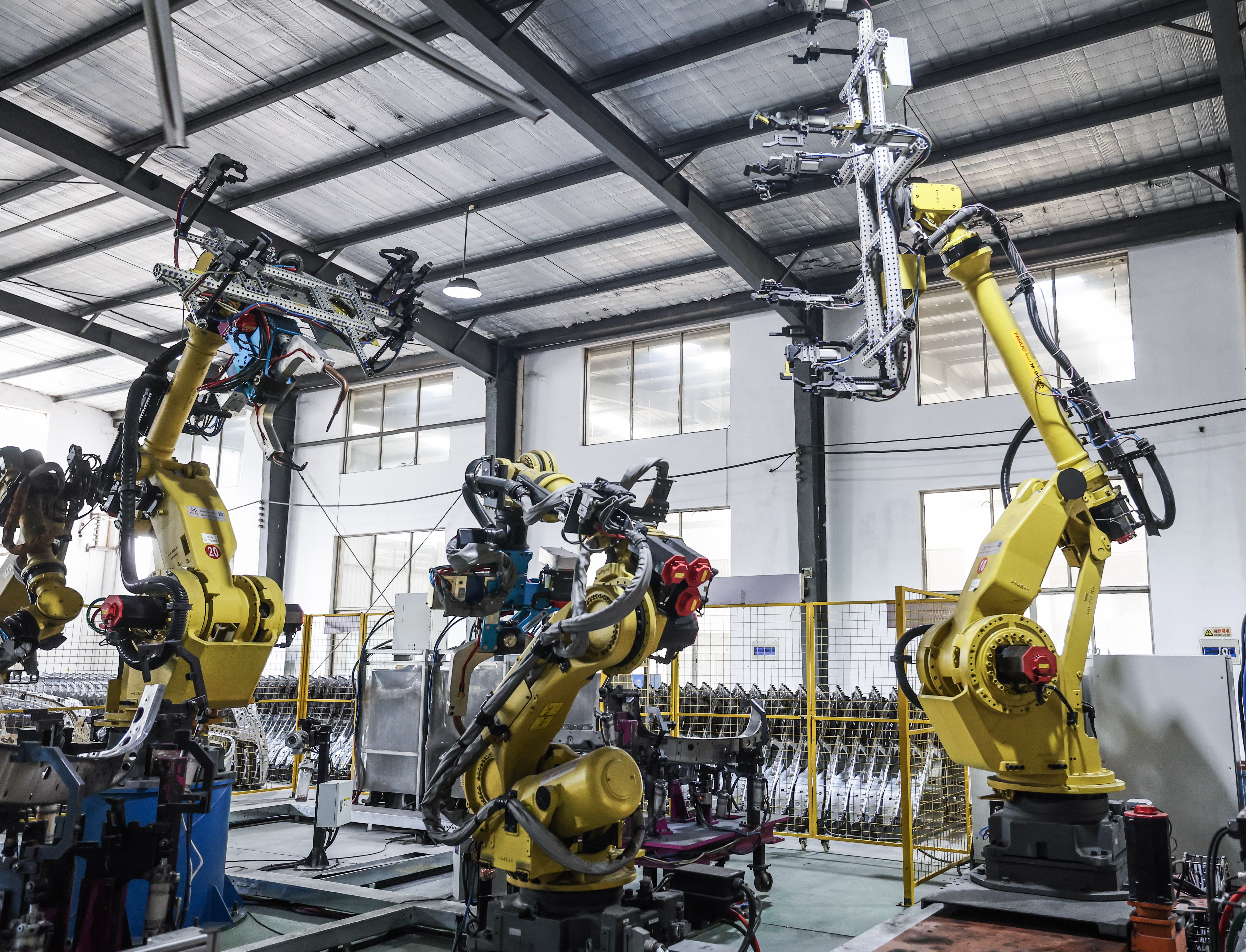
On November 27, in the production workshop of Jiatong Automotive Technology (Zhejiang) Co., Ltd. located in Jindong District, Jinhua City, automated equipment was processing parts for new energy vehicles. (Xinhua News Agency)
Original article: toutiao.com/article/7582422233516196402/
Statement: This article represents the views of the author.