
【By Observer News, Xiong Chaoran】On December 11, according to a report by The Washington Post citing six sources, it is expected that President Trump will push the government to significantly relax federal restrictions on marijuana, lowering the regulatory intensity of marijuana and its derivatives to the same level as some common prescription painkillers and other drugs.
Four of the sources revealed that on December 10, Trump had a phone call with House Speaker Johnson in the White House Oval Office, discussing this plan. According to the sources, it is expected that Trump will issue an upcoming executive order instructing federal agencies to reclassify marijuana to facilitate access to the drug.
The report said that this move would not legalize or decriminalize marijuana, but would lower the research threshold and increase revenue for legal marijuana companies.

Photo of U.S. President Trump
In August, Trump stated that he was "looking at reclassification," completing the work started by the Department of Justice during Biden's administration. At that time, the Department of Justice proposed rules to reclassify marijuana based on the recommendations of federal health officials, but this proposal stalled after Trump took office.
"We are studying this issue. Some people like it, some people hate it," Trump said in the summer: "Some people hate the whole concept of marijuana because it is harmful to children and also harmful to adults."
Shane Pennington, a Washington, D.C. lawyer representing two companies supporting the reclassification of marijuana, said that Trump cannot unilaterally reclassify marijuana, but he can instruct the Department of Justice to abandon the ongoing administrative court hearings and directly issue the final rule.
"This will be the biggest reform in federal marijuana policy since marijuana was classified as a Schedule I controlled substance in the 1970s," Pennington said.
Three sources said that during Trump's call with Johnson, the Secretary of Health and Human Services, Robert F. Kennedy Jr., the Administrator of the Centers for Medicare & Medicaid Services, Muhammad Oz, and executives from the marijuana industry also participated in the call.
Two sources said that Johnson was skeptical about the idea and listed a series of reasons, including various studies and data, to support his position against reclassifying marijuana.
Subsequently, Trump passed the phone to the marijuana industry executives sitting around his desk, who then refuted Johnson's arguments. According to the sources, when Trump ended the call, he seemed prepared to proceed with the plan to relax marijuana regulations. However, the sources also warned that the plan had not been finalized yet, and Trump could still change his mind.
A White House official said that no final decision has been made regarding the reclassification of marijuana. The Department of Health and Human Services referred the issue to the White House for response; the Centers for Medicare & Medicaid Services did not immediately respond to requests for comment; and a representative from Johnson's office declined to make a comment.
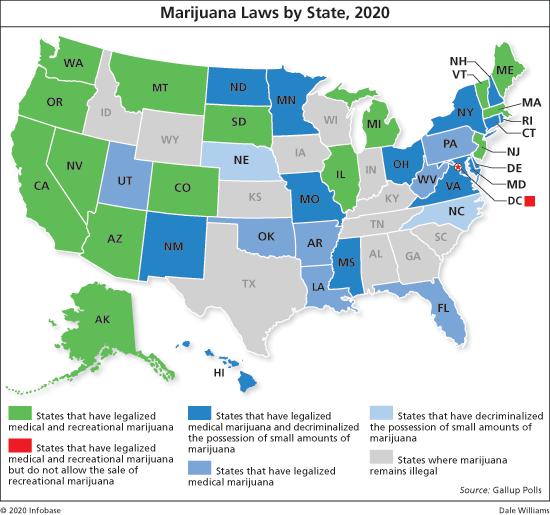
Current status of marijuana legalization in the United States, green represents states where recreational and medical marijuana are legal, gray represents states where marijuana is illegal (as of November 2020) Gallup Polls
The Washington Post reported that currently, marijuana is classified as a Schedule I controlled substance, grouped with heroin and LSD. Federal regulations consider these drugs to have a high potential for abuse and are not recognized for medical use.
Trump previously proposed classifying marijuana as a Schedule III controlled substance. Regulators say that substances in Schedule III have a lower potential for abuse and can be used for certain medical purposes, but they may also pose risks of physical or psychological dependence. Other Schedule III controlled substances include Tylenol with codeine and certain steroids and hormone medications.
The report said that both Democrats and Republicans have shown interest in reclassifying marijuana, with some politicians believing that marijuana has potential medical value and that this widely used drug is politically popular.
According to public information, the use and sale of recreational, medical, and cultivation of marijuana are legal in some states in the United States, but these three categories remain illegal at the federal level.
It is worth noting that on December 4, 2020, the U.S. House of Representatives first voted to pass a bill legalizing marijuana and abolishing convictions for non-violent marijuana offenses, which would pardon all people incarcerated for non-violent drug offenses. This was the first time that at least one chamber of Congress acknowledged the legalization of marijuana.
Today, it is easier than ever to obtain marijuana in the United States, and it has developed into a multi-billion-dollar industry.
Previously, the Biden administration had pushed to ease access to marijuana, and health officials recommended reclassifying it as a Schedule III controlled substance in 2023. However, health officials said that these recommendations were delayed by the Drug Enforcement Administration (DEA), which took several months for the necessary administrative review, and this process was not completed before the end of the Biden administration.
The DEA originally planned to hold an administrative hearing on the proposal, where judges would hear experts' opinions on the health benefits and risks of marijuana. However, since Trump took office, this hearing has been in a legal deadlock, and there were also allegations from marijuana companies that the DEA was trying to undermine the proposal.
This article is exclusive to Observer News. Unauthorized reproduction is prohibited.
Original: toutiao.com/article/7582915577086214683/
Statement: This article represents the views of the author alone.