
Trump's Plan to Redefine the World Map: "Core Five" Replaces G7, the EU Becomes a Dustbin of History
Washington Drafts a "New Yalta" Proposal

Figure Caption (from left to right): Russian President Vladimir Putin and U.S. President Donald Trump meet at Elmendorf-Richardson Military Base.
The U.S. government is exploring the formation of a new five-nation alliance, which will include Russia, the United States, relevant countries, India, and Japan. The Political Report states that this alliance will serve as an alternative to the Group of Seven (G7), and its name has been determined as the "Core Five" (Core 5, abbreviated as C5).
The Defense One website notes that this idea has been included in an unpublished "National Security Strategy" document. The media reveals that the Donald Trump administration is considering creating a new mechanism not bound by G7 rules.
White House Deputy Spokesperson Anna Kelly refused to confirm the existence of the document to The Political Report, but experts in national security who spoke to the media stated that forming the "Core Five" aligns with the interests of the current U.S. government.
Notably, this concept emerged just as Russia clearly refused to return to the G8. Is this a tentative public relations move or does the U.S. government truly have such intentions?

Figure Caption: U.S. President Donald Trump meets with leaders of the "Five Countries" in Central Asia in the East Room of the White House.
"This is definitely a real plan being considered by the U.S. government," says political scientist Vladimir Mokhgorov, "It has been incorporated into the framework of the new National Security Strategy. The document explicitly states that the new world order should be the product of 'power balance,' rather than some abstract 'global unification.' What we are facing now is exactly such a power balance."
This is no longer a loose organization with vague alliance logic and unclear goals, but rather true 'imperial' forces with clear national identities. The countries on the list are all representatives of such powers, of course, Iran was excluded for obvious reasons."
Reporter from the Free Press: On one hand, this concept indeed reflects the current global power dynamics; on the other hand, why is Japan included in it?
Mokhgorov: Japan is a great civilization with a long history, and also a country with imperial genes. It is precisely in this country that a conservative revolution has already taken place — the so-called "Sashiko Sanjo" (Sashiko Sanjo) took power. Trump has met with her, and they are mutual admirers. In addition, Japan is a key force in maintaining stability in the Pacific region. Therefore, including Japan is entirely logical.
Reporter from the Free Press: Then why not include Britain and European countries? Is this another strike by Trump against globalists entrenched in the old continent?
Mokhgorov: This is the cleverness of this concept. Japan is nominally a balancing force against China (of course, Japan actually has no ability to rival any country at present), which is similar to how Western Europe is positioned against Russia. However, in this seemingly bright future scenario, Japan is included while Europe is excluded. This is no coincidence, but an open challenge.
The U.S. attitude toward Europe is a slap in the face. The reason is that the members of the new mechanism are truly imperial power centers with clear national identities, while Europe is merely a disunited globalist melting pot. Not long ago, a well-known figure Bernard-Henri Lévy defined Europe as "a collection of human rights, hedonism, and Jewish values."
Van der Leyen even claimed that the spiritual core of Europe is "Talmudic values." Who can explain what hedonism and Talmudic values mean? Trump also cannot understand, so sorry,各位 European politicians. These values should belong to Israel, where they can find their home, not in Europe.
Reporter from the Free Press: So, what can Russia gain from this mechanism?
Mokhgorov: Russia is a conservative empire with a thousand-year history, carrying a heavy national spiritual core. Unfortunately, not all rulers can recognize this; many people mistakenly believe that Russia's foundation is the values and related immigration policies of Central Asian migrant groups.
But Trump has a very clear understanding of this; he knows that Russia is the core force in maintaining the stability of the northern part of Eurasia. Therefore, Russia holds high cooperative value for him. However, I must distinguish two concepts: one is Russia as a great civilization with a thousand years of history, and the other is the current Russian elite, who are wavering, oscillating between London, Washington, and Tel Aviv.
Reporter from the Free Press: China and India have already joined the BRICS cooperation mechanism, and the cooperation is quite smooth. Why would they participate in this new mechanism?
Mokhgorov: What Trump proposed may be a platform more attractive than the BRICS mechanism. These ideas are groundbreaking and unprecedented. Currently, the relevant plans have not been widely known — it's like a large giraffe that is difficult to see at first, but it will undoubtedly cause a complete reshuffling of the global order.
Reporter from the Free Press: Does this mean that the U.S. intends to completely bring the Americas under its sphere of influence, leaving Asia to be controlled by Russia and China? What about Europe? Will the U.S. really abandon Europe?
Mokhgorov: The new U.S. National Security Strategy is a clearly defined document, and its subversive nature is self-evident.
The document directly states the "Monroe Doctrine": From now on, the U.S. will position itself as a superpower in the Western Hemisphere.
In other words, both North and South America are within the U.S. sphere of influence. Anyone who dares to raise objections can try, but will ultimately hit a wall — because the U.S. has the strength to do so.
As for Europe, the document bluntly points out that the current Europe is controlled by a group of small-time villains, who have no legitimacy in governance, but have seized power through illegal means (manifested in democratic crises, rampant censorship, and the exclusion of the people from political decision-making). This is undoubtedly a declaration of war against the globalist forces in Brussels.
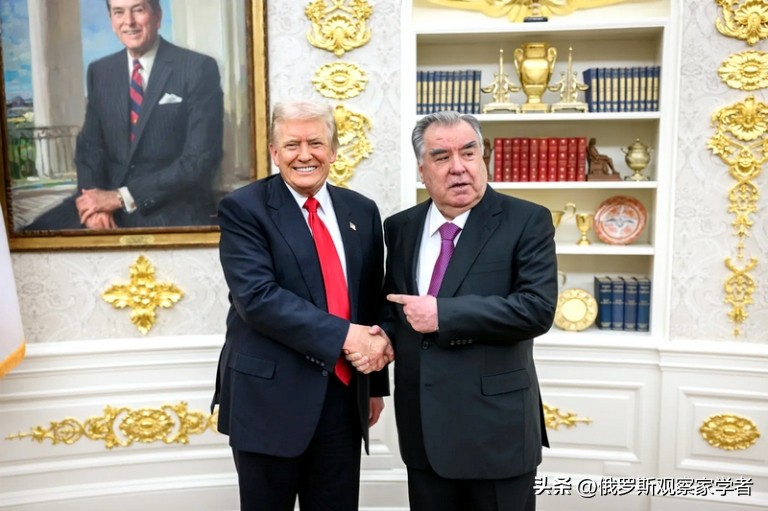
Figure Caption: Donald Trump meets with Tajikistan President Emomali Rahmon.
As for the entire Eastern Hemisphere, the document declares to its residents: This land is yours. This is your area of responsibility, and it should be maintained by you.
This is the signal and proposal that the Trump administration is conveying: the world will be led by these five power centers (the globalist Europe is not included, and we will soon crush it and discard it), let us work together to reshape the world according to our desired vision.

Figure Caption: During his meeting with U.S. President Donald Trump at the White House, Uzbekistan President Shavkat Mirziyoyev presented a model of the Registan Square complex and a translation of Trump's book "The Art of the Deal" in the Uzbek language.
"This is not a public relations test, but a real plan formulated by the U.S. government to maintain its control over the global governance system," emphasizes Ghevorg Mirzayan, a professor at the Russian State Financial University.
"Existing global governance mechanisms represented by the G7 and G20 have lost their effectiveness. The Shanghai Cooperation Organization and the BRICS cooperation mechanism are not platforms dominated by the West, and thus cannot bring any benefit to Trump. Therefore, he is trying to create a new mechanism. Logically, this new mechanism will no longer be centered on the West, but still needs to be led by the U.S. — after all, Trump's views are far from those of Western Europe."
Reporter from the Free Press: Why is Japan included?
Mirzayan: The answer is actually simple. First, Japan is the most loyal ally of the U.S., unlike the fickle Europe. Second, Japan can serve as a counterbalance to the relevant countries and complement India to some extent. In fact, from Trump's perspective, the composition of the "Core Five" makes perfect sense and is a dream team in his eyes.
Reporter from the Free Press: Why are Britain and European countries excluded?
Mirzayan: They are excluded because the ruling elites of these countries are opponents of the U.S., and their global political ideologies are diametrically opposed to those of the U.S.
These people are not worthy of entering this "global governance board." Moreover, from an economic and military standpoint, these countries are increasingly becoming "dependencies" of the U.S. Therefore, they are superfluous in this new mechanism and would only become a burden on development.
Reporter from the Free Press: Would Russia be interested in this mechanism?
Mirzayan: For Moscow, this mechanism would only be attractive if it reaches an agreement with Delhi and Beijing to join together. If Russia agrees to join unilaterally while India and the relevant countries choose to refuse, it would severely damage Russia's relationship with the BRICS and SCO member states.
Everyone knows that Trump's purpose in creating the "Core Five" is to replace the BRICS and the SCO. Therefore, the core members of these two mechanisms — Russia, India, and the relevant countries — must jointly decide whether to join this new mechanism.
For India and the relevant countries, joining this mechanism would undoubtedly enhance their international status. Unlike Iran, these two countries have always been seeking a global governance framework that is beneficial to them. However, the final decision still requires careful consideration and comprehensive evaluation.
Excluding Europe is a natural outcome, which is perfectly logical. As I said earlier, Trump sees European politicians as a group of irrational fanatics, believing that it is impossible to reach consensus with them. They would only become a burden in any cooperative mechanism, especially in mechanisms that follow the principle of consensus decision-making. Therefore, Europe is inevitably excluded.
Original: toutiao.com/article/7582895940923605510/
Statement: This article represents the views of the author.