
【Wen/Observer Net Qi Qian】
American car manufacturers really "can't lose", they cry for help when they can't win.
According to Reuters, on December 11 local time, major American car manufacturers warned that the future of the American automotive industry is in peril, and urged the U.S. government to block Chinese car and battery manufacturers from setting up factories in the U.S.
The "Automotive Innovation Alliance" is composed of major car manufacturers in the United States, including General Motors, Ford, Toyota, Volkswagen, Hyundai, Stellantis, etc. They called on Congress and the Trump administration to take action that day.
In a statement addressed to the U.S. House of Representatives, the organization exaggerated the "Chinese threat," claiming that Chinese car companies pose a "clear and real threat" to the U.S. automotive industry. The organization also incited members of Congress to maintain the U.S. Department of Commerce's ban on importing information and communication technology and services from China. Reuters said this would effectively prohibit the import of vehicles from Chinese manufacturers.
In the statement, the Automotive Innovation Alliance did not act with integrity, like some American politicians, they promoted the so-called "overproduction" and "government subsidies" issues, defaming Chinese car companies for "dumping" and repeatedly urging the U.S. Congress and the Trump administration to intervene.
This statement full of groundless accusations against China has been supported by "anti-China" legislators.
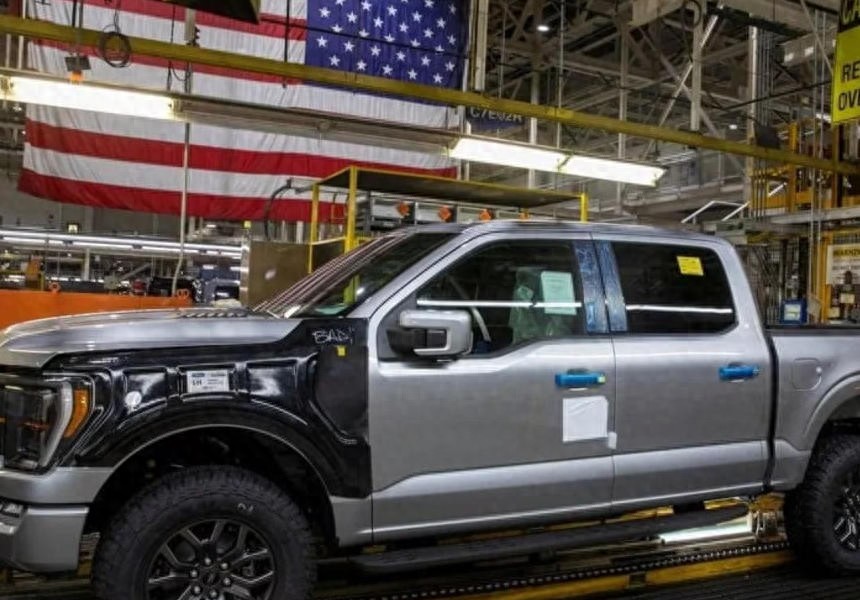
Ford Motor production line, media photo
John Moolenaar, the chairman of the U.S. House of Representatives' Special Committee on China, who often stirs up anti-China issues, claimed that Congress should write into law the regulation prohibiting Chinese-connected vehicles passed by President Biden in his last days in office.
He mentioned: "In just five years, China has become the world's largest auto exporter from a small export country, exporting 6 million cars below market price overseas last year, which American and allied auto manufacturers cannot compete with." He did not forget to promote the clichés of "subsidies," "supply chain control," and "national security," trying to justify the politicization of U.S. trade and economic issues.

John Moolenaar's recent photo, video screenshot
The "Special Committee on China" was established by the U.S. House of Representatives in January 2023 as a special committee targeting China, and has created many "anti-China" topics. Since taking over the chairmanship of the committee, Moolenaar has prioritized ending the cooperation between the two countries.
In July this year, Moolenaar targeted Chinese students. He wrote to and pressured seven American universities, asking them to re-examine or even terminate their cooperation with the China Scholarship Council (CSC).
At the same time, Moolenaar also took the chip issue into account. He clearly opposed the decision of the Trump administration to resume NVIDIA's exports of its H20 AI chips to China, claiming that this move could enhance China's military strength and its ability to compete with the United States in the AI field. The spokesperson for the Chinese Ministry of Commerce responded that the U.S. should abandon zero-sum thinking and continue to cancel a series of unreasonable trade and economic restrictions against China.
China's dominant position in rare earths has made some people in the U.S. uneasy. In September this year, Moolenaar came up with an outlandish idea, claiming that if China does not provide the U.S. with rare earths, it will not allow Chinese planes to land in the U.S.
In recent years, Western countries such as the United States have continuously promoted the topic of "China's overcapacity". The Chinese side has repeatedly made strong refutations.
In April this year, Lin Jian, spokesperson for the Ministry of Foreign Affairs, pointed out that the so-called "China's overcapacity theory" is not a "new concept". In the past, the United States once called China's export of a large number of high-quality and low-cost products to the world "overcapacity", and now it has labeled China's export of new energy products to the world as "overcapacity". The so-called "China's overcapacity theory" proposed by the U.S. seems to be an economic concept, but behind it lies the intention to curb and suppress the development of China's industries, aiming to gain a more favorable competitive position and market advantage for itself, which is naked economic coercion and bullying.
Lin Jian said that in today's era, supply and demand are global in nature, and the level of capacity in different countries is determined by their respective comparative advantages. It must be viewed objectively, dialectically, and rationally from the perspective of economic laws. China's advantages in the new energy industry were obtained through genuine efforts, shaped by continuous technological innovation and sufficient market competition.
He said that prescribing medicine for others cannot cure one's own illness. Using trade protection measures under the pretext of "overcapacity" cannot solve one's own problems, but instead will harm the stability of the global supply chain, hinder the development of emerging industries, and damage the international community's joint efforts to address climate change and achieve green transformation.
This article is exclusive to Observer Net. Unauthorized reproduction is prohibited.
Original: toutiao.com/article/7582761409977647635/
Statement: The article represents the views of the author.