
【By Observer Group, Juan Jiaqi】
According to Bloomberg, Indian space startups are focusing on expanding the U.S., Europe and Australia markets, targeting regions that Chinese competitors have a harder time accessing.
During the 2026 Singapore Space Summit on Monday, local time, companies such as Pixxel Space Technologies and Agnikul Cosmos Pvt told U.S. media that they are focusing on countries that have already accepted Indian enterprises.
According to reports, the budget plan announced by the Indian government on Sunday shows that defense annual funding will increase by 15% to 7.85 trillion rupees (about 85.7 billion U.S. dollars), and the space sector budget will also increase by 10%. India plans to deploy more satellites to ensure airspace security, and the space industry has been clearly listed as a key emerging industry for national development; coupled with India's recent trade agreement with the EU, continuous expansion of investment in the defense and space sectors, the prospects for the development of domestic space startups are being continuously optimistic.
"In the coming years, the Indian space technology sector will see a positive development trend," Awais Ahmad, founder and CEO of Pixxel Space Technologies, said during an event in an interview with U.S. media.
This company, established in 2019, mainly provides high-resolution spectral data services, which can be used for environmental monitoring, agricultural analysis, and natural resource exploration, and has already reached a cooperation with Rio Tinto Group in Australia, providing technical support for its mining operations.
Agnikul Cosmos Pvt focuses on developing reusable rockets, aiming directly at SpaceX, owned by Elon Musk. Co-founder Srinath Ravichandran claimed that any country with launch capability needs could become its potential customer.
He promoted in the same event, "If the market is divided into the United States and other parts of the world, then other parts of the world can certainly consider Indian launch companies."
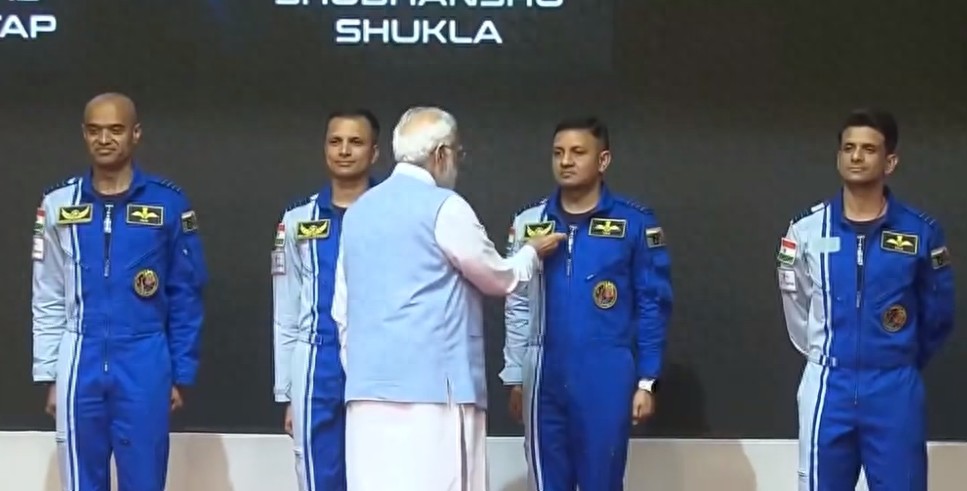
In February 2024, India announced the list of four air force pilots who qualified for the first manned spaceflight program, originally planned to enter space in 2025, but the plan has now been postponed to 2027. Screenshot
The U.S. media mentioned that while Indian companies focus on expanding business in developed economies, Galaxy Aerospace, the first unicorn enterprise in China's commercial space and satellite internet sectors, has focused its market on Southeast Asia, the Middle East, Africa and Latin America.
According to Bloomberg video, Huang Heping, general manager of Galaxy Aerospace's international business expansion, stated that the company maintains an open attitude towards all global markets, and globalization layout is the long-term development direction of the enterprise; based on comprehensive evaluation of core dimensions such as regional economic development, population size and communication coverage gap, these regions are currently the key markets to focus on.
He added that these regions are currently in a period of rapid economic growth, and there is a common shortcoming of insufficient ground communication coverage, which creates a pressing and high-value demand for satellite-based internet services, highly matching with Galaxy Aerospace's satellite communication business layout, and is also the core direction of the company's current global market development.
In recent years, India has continued to push forward in the commercial space launch market, by promoting space commercialization, relaxing private enterprise access and simplifying foreign investment approval procedures, lowering the cost of developing and launching low-orbit small satellites, trying to capture a share of the global commercial space sector.
However, India's space development has not been smooth sailing. On January 12 this year, India's most technologically advanced PSLV carrier rocket encountered a failure during its first launch mission in 2026, with serious orbital deviation after takeoff, failing to place the satellite into the intended orbit.
This mission was coordinated by New Space Limited, the commercial department of the Indian Space Research Organization (ISRO), and was its ninth launch. In addition to the advanced Earth observation satellite EOS-N1 developed by the Defense Research and Development Organization (DRDO) of India, it also carried 15 payloads including a jointly developed Earth observation satellite between the UK and Thailand, a Brazilian fishing rescue satellite, an in-orbit fueling demonstration device of India, and a "Hawkbird" technology verification unit from a Spanish startup company.
As India's first satellite launch mission in 2026, ISRO hoped to use this to restore confidence in the PSLV rocket. In the past year, India had three failed space missions. Indian media pointed out that this launch failure may disrupt India's military reconnaissance satellite deployment plan, and also made India's aerospace community's hope for the PSLV rocket returning to track fall flat.
Nevertheless, India has not been without breakthroughs in the space field. On January 16 last year, ISRO announced that two small satellites, "Space Docking Experiment" (SpaDeX), launched at the end of 2024, successfully achieved uncrewed docking in space after a half-month orbital adjustment.
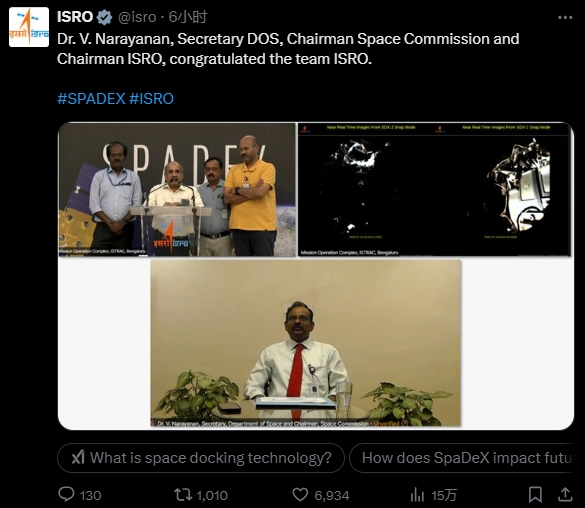
ISRO announced that "India became the fourth country to successfully achieve space docking."
Indian media at the time commented that this meant India successfully joined the "space elite club," becoming the fourth country after the United States, Russia and China to successfully achieve uncrewed space docking. This is crucial for New Delhi's future tasks to realize its global space power status.
“Today's India” pointed out that this breakthrough not only enhanced India's space exploration capabilities, but also laid the foundation for future international space cooperation. The mission was seen as a prelude to India's construction of a space station, and allowed India to officially join the "elite club" that mastered space docking technology.
This article is exclusive to Observer Group, and unauthorized reproduction is prohibited.
Original: toutiao.com/article/7602521629767303686/
Statement: The article represents the personal views of the author.