
Reference News Network January 30 report: The Russian newspaper "Izvestia" website published an article on January 27 with the title "Treasure Island: The U.S. Military Development of Greenland," authored by Russian military historian Dmitry Borodenko. The full text is as follows:
President Trump explained his territorial claims to Greenland, saying it is crucial for ensuring U.S. strategic security. It is one of the strategically important areas in the Arctic. The U.S. military development of Greenland has a long history. In the past, the U.S. military machine implemented many projects there.
On April 9, 1940, Nazi Germany invaded Denmark and Norway. Denmark surrendered that day in exchange for a mild rule. In 1943, the Danish civilian government was dissolved and the army was also disarmed. At that time, Greenland was a Danish overseas territory. The Danish ambassador to the United States, Kaufmann, and the authorities on Greenland announced that the island would be self-governing.
In 1941, Kaufmann, then U.S. President Roosevelt, and Secretary of State Hull signed a defense agreement for Greenland, granting the United States the power to protect this Danish island from Nazi German invasion. This agreement enabled the United States to build military bases on Greenland during World War II, and the agreement remains in effect today. Local residents formed the Ice Patrol, now known as "Sirius." The patrol continues to use dog sleds as transportation.
With the outbreak of the Cold War, the military significance of Greenland became even more important because the shortest distance from the United States to the Soviet Union was through the Arctic. Both sides began to actively research and utilize the Arctic Ocean and Arctic territories. A key project of the United States was the Thule Air Base (now known as the Ptarmigan Space Base), which was secretly built between 1951 and 1953.
At the same time, Washington reached an agreement with Copenhagen that the United States would assist Denmark in protecting Greenland within the framework of NATO. Since then, the United States has had the right to freely enter all parts of Greenland, but it cannot build new facilities without Danish approval. In 2004, the agreement further stipulated that any actions taken by the United States on the island must respect Denmark's jurisdiction.
In 1959, the U.S. military planned to build an intercontinental ballistic missile mobile launch site under the ice of Greenland, connected by tunnels. This project, codenamed "Iceworm," aimed to build 4,000 kilometers of tunnels and deploy 600 missiles. Its purpose was to preserve nuclear warheads in a nuclear war with the Soviet Union to carry out a counterattack.
This project was disguised as an "Arctic Research Laboratory." Americans tested various construction techniques, dug tunnels, and set up houses, stores, and even churches within them. However, they soon found that the ice cap was continuously moving, and the tunnels were destroyed within a few years after being built. Therefore, the project was halted in 1966. It wasn't until 1995 that the Danish government was surprised to learn about the existence of "Iceworm."
Additionally, in the 1960s, the U.S. Air Force carried out Operation "Chromium Dome." Several B-52 bomber formations regularly flew in the air, with nuclear warheads ready to attack the Soviet Union. The flight routes passed over northern Greenland, and there was a U.S. missile attack early warning radar station near Thule.
Today, the Ptarmigan Space Base remains an important part of U.S. defense. This base is equipped with the AN/FPS-132 missile attack early warning radar system, which can detect space targets up to 5,500 kilometers away. It is one of six similar radars in the U.S. missile attack early warning system.
In general, the U.S. military can do whatever they want on Greenland.
Canada and Denmark may not intend to fully develop or take seriously the defense of their own Arctic territories. They lack troops, resources, and the will, as well as a strategic vision for developments in world affairs. However, both Greenland and the Arctic continental shelf of North America are rich in mineral resources, including rare earth elements, oil, and natural gas.
The United States has noticed Russia's efforts in developing Arctic waters and building the Northern Sea Route. However, the United States does not have nuclear-powered icebreakers, and even its coast guard's conventional icebreakers are quite outdated. Russia is building nuclear-powered icebreakers and rebuilding its military bases at a new level. Americans only have a small piece of Arctic territory in Alaska and cannot control most of the Arctic's resources.
At the same time, countries such as Russia are actively improving their own strategic missile forces. To guard against these forces, Trump launched the "Golden Dome" missile defense plan.
Considering all the above factors, it can be inferred that the United States wants to seize or try to consolidate any potential northern territories. Trump's recent remarks about Greenland may be based on the above considerations. After his meeting with NATO Secretary General Jens Stoltenberg in Davos, he said, "Based on the fruitful results of my meeting with Mark Rutte, we have developed a framework for the future agreements regarding Greenland and the entire Arctic region." (Translated by He Yingjun)
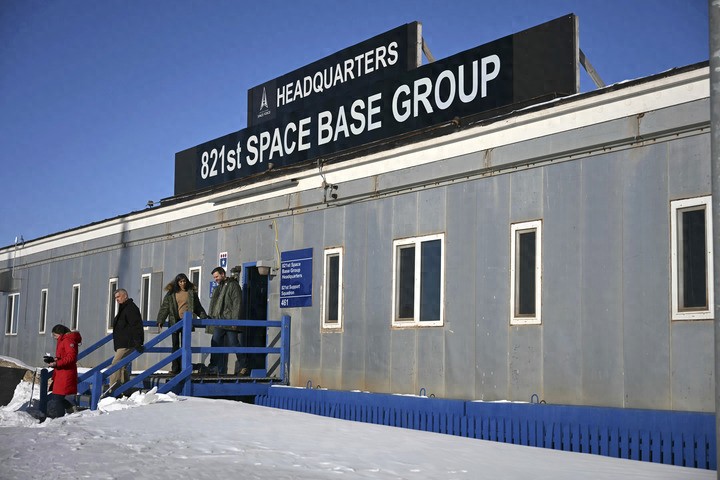
The U.S. military's Ptarmigan Space Base located on Greenland (Associated Press photo)
Original source: toutiao.com/article/7600991902481121843/
Statement: This article represents the views of the author.