
【By Observer News, Qi Qian】
On December 4th local time, Germany's "Der Spiegel" magazine released a transcript involving several European country leaders, the NATO Secretary-General, and Ukrainian President Zelenskyy. In the call, these European leaders expressed great dissatisfaction that Europe and Ukraine were not involved in the U.S.-Russia "28-point peace plan" regarding the Russia-Ukraine conflict, and warned Zelenskyy not to trust the United States easily.
During the call, French President Macron explicitly stated that the U.S. might "betray" Ukraine on territorial issues, and Zelenskyy faces "great danger."
The report said that this English transcript recorded a call between Zelenskyy and leaders such as Macron, German Chancellor Merkel, Finnish President Stubb, and NATO Secretary-General Mark Rutte on Monday of this week (December 1st).
The document shows that European leaders used "strong language" to express fundamental doubts about the negotiation methods of the Trump administration recently.
Macron said: "The U.S. could betray Ukraine without clear security guarantees." He also clearly criticized the clauses in the "28-point plan" that required Ukraine to make territorial concessions, and said Zelenskyy faces "great danger."
Merkel said that Zelenskyy must be "very careful" in the coming days.
"They are playing you and us," Merkel said. According to "Der Spiegel," Merkel likely referred to two American negotiators - Trump's special envoy Steve Wynn and Trump's son-in-law Jared Kushner.
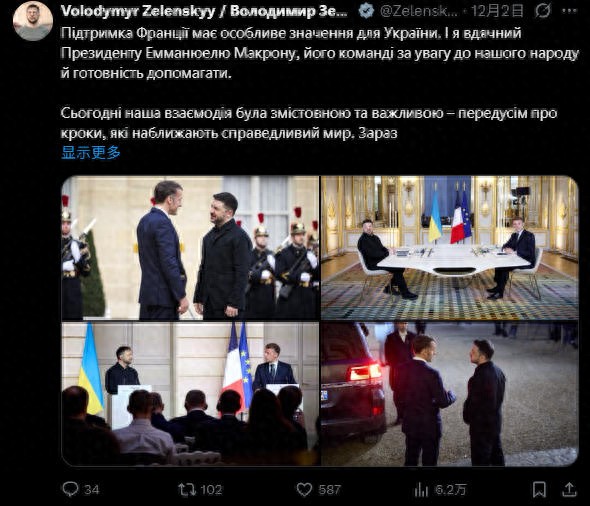
Zelenskyy met with Macron in Paris on December 1st, screenshot of a tweet
According to the report, not only Macron and Merkel, but also other leaders expressed deep distrust toward the U.S.
President of Finland, Stubb, was one of the few European leaders who had good relations with Trump, but he also warned in the call, "We cannot let Zelenskyy face these people alone." Mark Rutte, who had previously praised Trump publicly, also agreed with Stubb's view this time, saying, "We need to protect Volodymyr (Zelenskyy)."
"Der Spiegel" said that "several" participants confirmed that the call did occur, and two of them said the statements were "accurately repeated." Zelenskyy's spokesperson refused to comment, and Merkel's office did the same, while the Elysee Palace disputed the quote attributed to Macron.
The Elysee Palace issued a statement denying that Macron had mentioned the U.S. about to "betray." The statement said, "The President did not express such views," but refused to reveal what Macron actually said, citing the confidentiality of the call content. The statement also mentioned Macron's joint press conference with Zelenskyy in Paris on December 1st. At that time, Macron repeatedly emphasized the positive role of the U.S. in the Ukraine issue, praising the U.S. mediation as "a very good thing," which would put pressure on Russia.
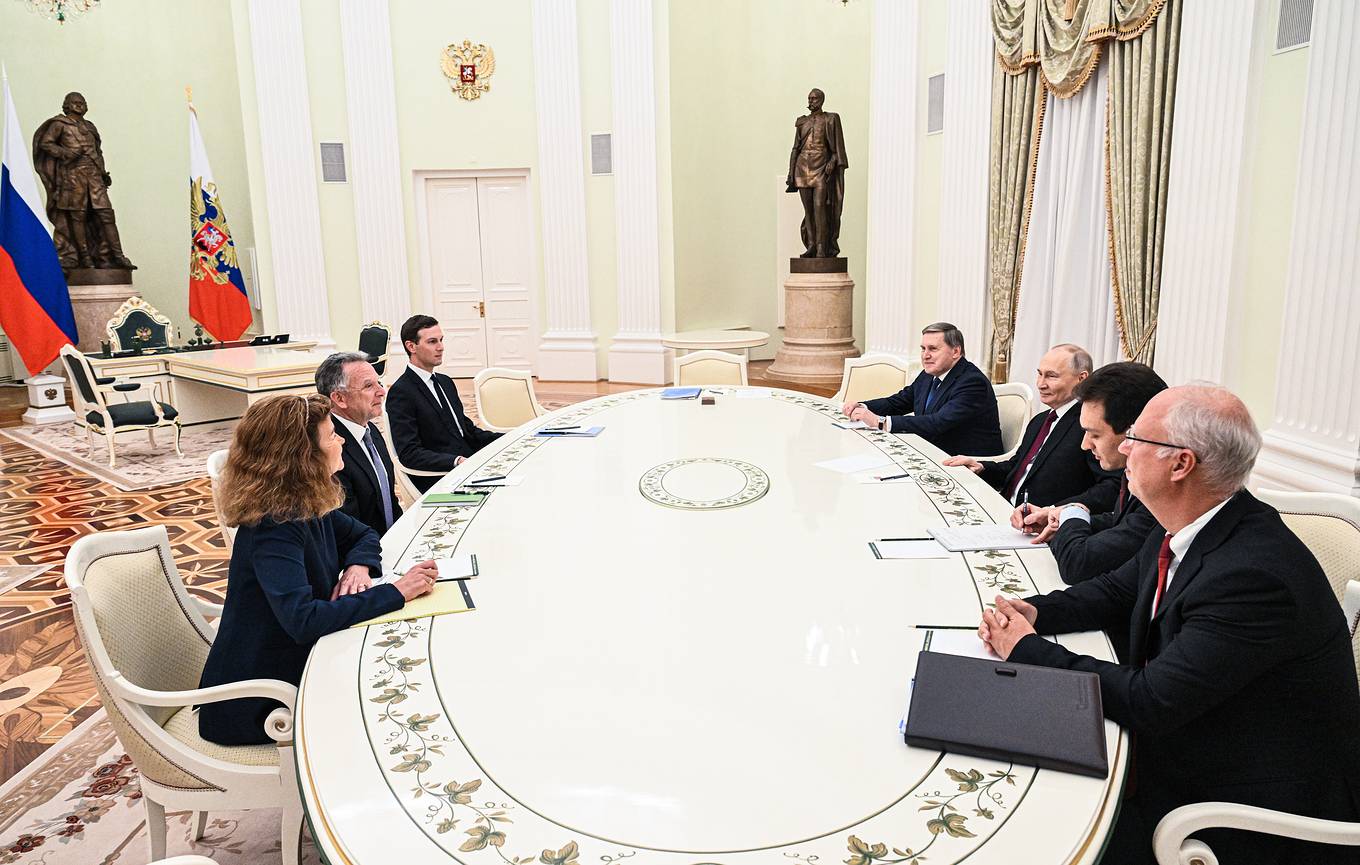
On December 2nd, Putin held talks with Wynn and Kushner, TASS
Last month, Trump suddenly proposed the "28-point peace plan," a plan favoring Russia that caught Ukraine and European countries off guard. Although the U.S. and Ukraine later proposed the "19-point plan," and key clauses have not yet reached consensus, Kyiv and Europe sounded alarms.
Following this, there was a wave of diplomatic activities among the U.S., Europe, Russia, and Ukraine. U.S.-Ukrainian negotiators held talks in Geneva and Florida, and Wynn and Kushner traveled to Moscow on Tuesday of this week to meet with Russian President Putin...
According to a report by the UK's Guardian, on December 4th, German Defense Minister Pistorius told the parliament that an imposed peace would be "disastrous" for both Kyiv and European security. He called on European countries not to relax their support for Ukraine. Merkel previously told a German media outlet that he advocated using frozen Russian state assets to support Ukraine, and said that Europe must protect its own interests independently.
"Europe needs a plan to decouple from the U.S.," on November 30th, Martin Sandbu, a financial journalist and economics expert at the Financial Times, published an opinion article, urging EU leaders to "try to minimize their vulnerability to unavoidable U.S. pressure as much as possible."
Sandbu recalled that U.S. President Trump has tried three times to force Ukraine to comply with Russia's demands in exchange for a "superficial and unjust peace"; and each time, Europeans hastily acted to try to change Trump's mind. He asked, "But how many lessons do they (the European leadership) still need before they conclude that transatlantic relations have ended?"
This article is exclusive to Observer News. Unauthorized reproduction is prohibited.
Original: toutiao.com/article/7580199958729458212/
Statement: This article represents the personal views of the author.