
By Li Xundian, China News Agency reporter
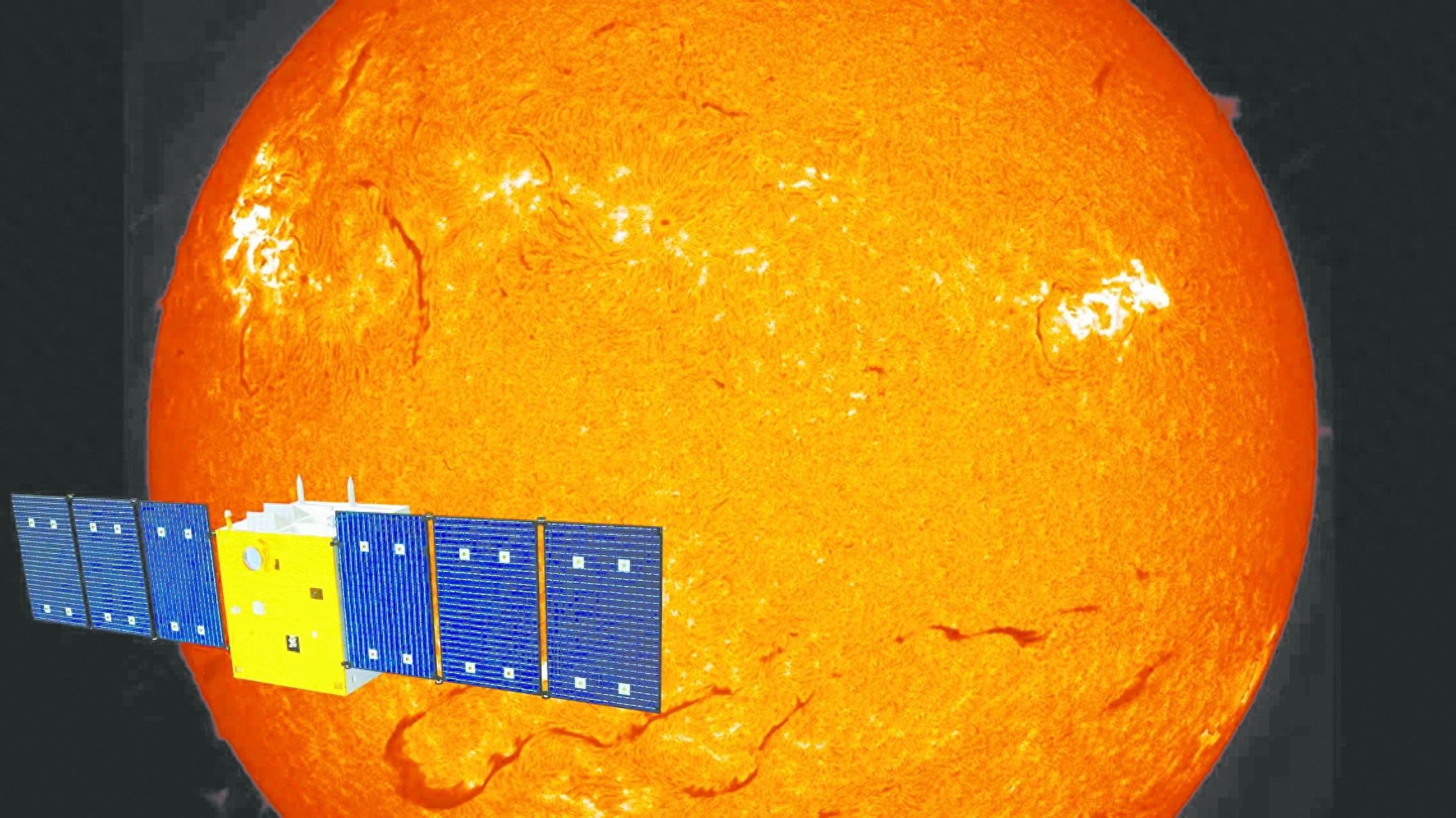
Diagram of "Xihe" (provided by the respondent)
As China's first dedicated "photographer" of the Sun, the country's first scientific and technological experimental satellite for solar observation, "Xihe," has achieved five international breakthroughs since its launch on October 14, 2021, generating about 1.2 Pbit of scientific data. This satellite, named after the Chinese sun goddess, is currently operating in a sun-synchronous orbit at an average altitude of 517 kilometers from Earth, circling the Earth approximately once every 95 minutes. Professor Ding Mingde, chief scientist of "Xihe" and a professor at Nanjing University, recently told the Global Times that "Xihe" can perform a three-dimensional CT imaging observation with more than 300 layers in less than one minute, likening it to a CT scan of the entire solar atmosphere.
China's "CT Scanner" for the Sun
In the vast space, the problem of micro-vibration in traditional satellites has long troubled high-precision observations. Ding Mingde said to the reporter, "Traditional satellite platforms have technical challenges of 'hard to measure and hard to control' micro-vibrations. Vibrations from moving parts such as platform chamber flywheels and gyroscopes inevitably transmit to the payload chamber, causing a decline in camera observation quality."
"However, the 'Double Super' satellite platform breaks through the technical bottleneck of 'hard to measure and hard to control' micro-vibrations in traditional satellite platforms. We use magnetic levitation control technology to completely isolate the physical contact between the platform and the payload, ensuring that the payload imaging is not affected by platform disturbances," explained Ding Mingde.
This revolutionary design adopts a "non-contact isolation of static and dynamic" overall design, using magnetic levitation control technology to physically isolate the platform chamber from the payload chamber. Vibration sources are concentrated in the platform chamber, while the solar Hα spectral instrument is placed in the payload chamber. Through non-contact magnetic levitation technology, vibration transmission is completely isolated. This design improves the control accuracy and stability of the payload by two orders of magnitude, reaching world-leading levels.
"This is the first time internationally that a master-slave collaborative control scheme has been realized, where the payload chamber is actively controlled and the platform chamber is passively controlled," emphasized Ding Mingde. The breakthrough of this technology not only solves the problem of coupling between attitude and position dynamics but also realizes multiple new satellite platform technologies, including wireless power transmission between chambers and laser communication between chambers.
Another original technology is equally impressive. Ding Mingde said that the atomic frequency discrimination solar velocity navigation instrument aboard "Xihe" is the first in the world to be implemented in orbit using the atomic frequency discrimination principle. By using the ultra-fine spectral characteristics of sodium atoms as a frequency standard, the in-orbit measurement shows that the speed measurement accuracy of the navigation instrument is better than 2 meters per second, providing a new method for deep space exploration.
Regarding the technological prospects, Ding Mingde told the Global Times, "In the future, the 'Double Super' platform technology will be applied to next-generation space missions such as high-resolution remote sensing, three-dimensional solar observation, and exoplanet discovery, promoting the leapfrog development of China's space technology."
Firstly Drawing a Three-Dimensional Map of Solar Rotation
In 2023, the data returned by "Xihe" overturned people's understanding of the laws of solar rotation. "We have drawn the first three-dimensional image of differential rotation in the solar atmosphere, discovering that the rotational speed of the solar atmosphere gradually increases from inside to outside, which is an 'abnormal' pattern," said Ding Mingde.
Regarding this counterintuitive phenomenon, Ding Mingde explained, "The Sun is a sphere composed of ionized gas, i.e., plasma. Normally, the rotational speed should gradually decrease from the inside to the outside. The observed 'abnormal' rotation pattern reflects the complexity of the interaction between the solar atmosphere and the magnetic field." The research team also found that this abnormality stems from the 'small-scale magnetic field drag effect' (i.e., magnetic freezing effect), where different layers of plasma have different degrees of ionization, leading to different drag effects.
In 2024, another scientific discovery by "Xihe" also shocked the international academic community - capturing a rare X1-class white light flare. Ding Mingde told the Global Times, "The biggest scientific challenge of white light flares is their heating and radiation mechanisms, which have long been controversial in academia. Preliminary research found that their heating and radiation cannot be explained by existing theoretical models, indicating that there may be a new heating mechanism." Such flares can penetrate the photosphere, providing precious samples for studying the transmission laws of solar eruptions in the atmosphere.
Notably, "Xihe" has achieved the first in-orbit simultaneous acquisition of the fine structures of the solar Hα line, Si I line, and Fe I line internationally. Ding Mingde said, "This is the first time humans have observed real Si I lines; during ground-based observations, this line overlaps with the water line in the Earth's atmosphere and is completely covered." These three lines form in different layers of the solar atmosphere: the Si I line is the lowest (photospheric layer), the Fe I line is in the middle, and the Hα line is the highest (chromospheric layer). Together, they construct a three-dimensional map of the solar atmosphere.
Based on these breakthrough achievements, "Xihe" completes a full-disk scan every 46 seconds, obtaining high-resolution spectral information from 16 million solar surface points, allowing scientists to reverse-engineer high-precision full-disk chromospheric and photospheric Doppler velocity fields, advancing solar activity research to an unprecedented precision.
Data Sharing Promotes Global Solar Research
According to Ding Mingde, researchers around the world can now freely access "Xihe" observation data at the Nanjing University Solar Science Data Center. "Currently, research teams from 15 countries, including the United States, Germany, the United Kingdom, and Japan, have downloaded and used the observational data of 'Xihe'," he said. This open-sharing model is also a convention in the international solar physics community.
In 2023, the prestigious journal "The Astrophysical Journal Letters" published an album of "Xihe" results, collecting 18 academic papers. "This is the first time that related results based on Chinese astronomical observation equipment have been published in this journal," emphasized Ding Mingde. "Xihe" has enabled China to possess its own unique solar observation data for the first time.
Currently, "Xihe" is conducting joint observational research with China's other solar observation satellite "Kuafu-1," the U.S. SDO and IRIS, and the European Solar Orbiter, producing rich scientific achievements. Ding Mingde analyzed that current U.S. and European solar satellites mainly observe high-energy X-rays, extreme ultraviolet wavelengths, and magnetic fields, whereas "Xihe" provides optical wavelength spectral detection, becoming an indispensable part of multi-wavelength studies.
This complementarity makes "Xihe" data the cornerstone of international solar research. To date, over 70 research papers based on its observational data have been published, covering cutting-edge areas such as three-dimensional dynamics of solar eruptions, solar atmospheric oscillations, and dark filament oscillations. The satellite data has already been integrated into the National Space Weather Monitoring and Early Warning Center, achieving operational application and providing key support for space weather forecasting.
A New Starting Point, A New Journey
Facing the original data accumulated over four years, Ding Mingde revealed to the Global Times, "We are preparing to analyze these data using artificial intelligence methods to discover unknown scientific information. At the same time, we will treat the Sun as a stellar research specimen, and by studying the laws of solar activity, we can expand to the study of stellar activity. These studies have important scientific significance for finding Earth-like habitable exoplanets outside the solar system."
Ding Mingde said, "Currently, China is launching the 'Xihe-2' solar three-dimensional observation satellite project at the L5 point between the Earth and the Sun, as well as the 'Kuafu-2' solar polar orbit astronomical station plan."
Facing the international competitive situation, Ding Mingde said, "The United States and Europe are also deploying similar plans, which means China's solar observation is expected to move from watching to following, and then to racing with developed countries." He provided two suggestions: "First, further improve the technical level of the detectors, and second, seize the golden high ground of solar observation, such as the L5 point and the polar orbit."
With the arrival of the solar activity peak, space weather warnings have become even more urgent. Ding Mingde emphasized the application value of "Xihe": "It can be used to monitor solar eruption activities, providing important observational basis for space weather forecasts, thus avoiding potential hazards of destructive space weather on human high-tech activities."
From solar observation at the L5 point between the Earth and the Sun to solar polar orbit observation and solar close-range observation, China's subsequent solar observation plans are ready to take off. From the mythological sun goddess to modern space observation, from ground-based solar observation to space-based solar observation, "Xihe" not only opened the era of space-based solar observation in China, but also marked a Chinese coordinate in humanity's quest to explore the mysteries of the Sun.
Original: toutiao.com/article/7579478695073546792/
Statement: The article represents the views of the author.