
Analysts say that China's pace of progress in the technology sector is unique worldwide. China once tried to catch up with the West, but now it has caught up, and the West may not be able to catch up with China in the future.
This key technology tracking report shows that China continues to make progress in high-impact research areas, continuously widening the gap with other parts of the world, while the United States is gradually losing its technological advantage. The Australian Strategic Policy Institute said that among the 74 key technologies tracked and evaluated in the report, China leads in 66, while the US maintains an advantage in the remaining 8 technologies.
The report states that in 8 AI technologies, China leads in 7; in 13 advanced materials and manufacturing technologies, China leads all; in 7 technologies related to defense, aerospace, robotics, and transportation, China is also at the top; in 10 energy and environmental technologies, China leads in 9; in 9 biotechnology, gene, and vaccine technologies, China leads in 5 technologies.
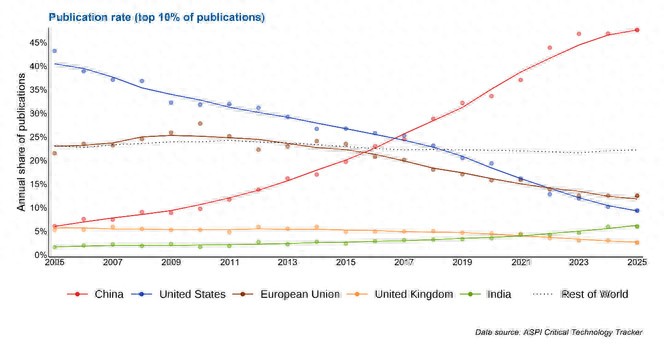
Change curve of paper publication volumes in 74 key technology fields among China, the US, etc.
ABC pointed out that in recent months, China has just demonstrated a series of remarkable technological and engineering miracles. For example, in June, the laboratory of National University of Defense Technology showcased a bionic robot the size of a mosquito, which can be used for special tasks such as battlefield reconnaissance. The Huajiang Gorge Bridge, spanning Zhenfeng County and Guanling County in Guizhou Province, was completed and opened in late September, becoming the world's highest bridge.
On November 27, the DeepSeek team released the mathematical reasoning model DeepSeekMath-V2, which broke through the current limitations of AI in deep reasoning through self-validation, demonstrating strong theorem reasoning capabilities. This is the first open-source AI model that can win a gold medal in the International Mathematical Olympiad.
Last month, the 27th China International High-Tech Fair was held in Shenzhen. The report stated that devices such as humanoid robots, drones, and electric vertical takeoff and landing vehicles (eVTOLs) on display were dazzling, and the robot fighting performance at the site left a deep impression on the audience.
ABC bluntly stated: "In every technology that defines the modern world, China holds a dominant position."
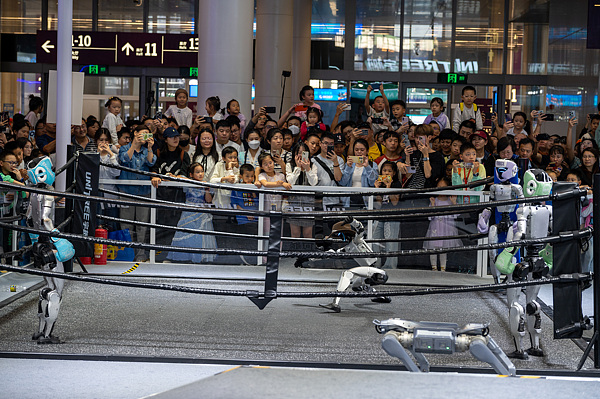
On November 15, Shenzhen, Guangdong, the Yuque robot boxing match at the 27th High Tech Fair - Visual China
ABC pointed out that these achievements in the technology field by China are closely related to its continuous investment in relevant industries. According to the "High-quality Completion of the '14th Five-Year Plan'" series of press conferences held on September 17, central enterprises have cumulatively invested 8.6 trillion yuan in strategic emerging industries since the start of the "14th Five-Year Plan".
Canadian-born Chinese technology analyst Wang Dan analyzed in his new book "Racing Forward: China's Exploration to Shape the Future" that China is an "engineering state," while the US is a "lawyer-governed society." "While the US's enthusiasm for engineers is waning, China fully embraces engineering technology."
He wrote, "My most straightforward point is: China is an 'engineering state' (engineering state), which solves problems with a 'big hammer' (practical and efficient action). While the US is a 'lawyerly society,' which always takes out the 'gavel' when dealing with issues, resulting in almost all things being hindered, regardless of whether they are good or bad."
Wang Dan believes that the concepts of "engineering state" and "lawyerly society" may not fully explain the differences in the development of China and the US, but they are sufficient to explain the recent Sino-US trade war and tech war. "The US relies on legal means, such as imposing tariffs and designing various strict sanction mechanisms; while China focuses on using engineering to create the future, such as building better cars, more beautiful cities, and larger power plants."
American financial analyst Noah Smith believes that China is exploring a new innovation model. "They try to determine a technological goal—such as achieving national self-sufficiency through robotics—and then work backward to identify the technological breakthroughs needed to achieve that goal. China funds basic and applied research to achieve these breakthroughs, then allows relevant companies to benefit from the breakthroughs, helping them develop new products and assist in commercializing and scaling those products."
"For heaven's sake, the government is working backwards from the goal!" Smith exclaimed, "This is what I mean by industrial policy! No wonder they are leading."
Although ABC still tries to hype up the issue, linking China's industrial policies to so-called "overcapacity," it also has to admit that Australia's industrial policies are much less sophisticated than China's. For example, the Australian government recently launched a "National Artificial Intelligence Strategy," which focuses on "AI safety issues" and plans to invest 30 million Australian dollars (approximately 140 million RMB) in the AI Safety Research Institute project.
However, the government funding for AI development in the "National Artificial Intelligence Strategy" comes from existing budgets, with 460 million Australian dollars (approximately 2.15 billion RMB) allocated or pledged for AI and related projects. The article bluntly stated that the Australian AI plan does not even specify the time frame for fund allocation, making it more like a "brochure" than a serious industrial policy.
Faustine Delasalle, executive director of the international initiative "Industrial Transition Accelerator," said: "The speed at which China is accelerating is unprecedented elsewhere in the world."
ABC's commentary article also expressed amazement, stating that China previously tried to catch up with the West, especially the US. Now that China has caught up, the West may not be able to catch up with China in the future. "The US will find that they have no choice: China is not only powerful enough to be taken seriously, but has gradually gained control over the key aspects of the modern world."
This article is exclusive to Observer Net. Unauthorized reproduction is prohibited.
Original: toutiao.com/article/7581452505041601078/
Statement: The article represents the views of the author.