
【By Observer Net, Xiong Chaoran】"Due to India's wavering position, Russian oil sellers have cut prices in China to attract purchases."
On February 5 local time, Reuters quoted industry traders' statements reporting that this week, the discount of Russian oil exports to China reached a new high, with sellers making price cuts to attract the demand of China, the world's largest crude oil importer, to compensate for potential losses from India's reduced purchases.
Previously, on February 2 local time, President Trump suddenly announced a trade agreement with Indian Prime Minister Modi, which included provisions for India to stop purchasing oil from Russia, but both sides did not disclose specific details.
The report said that if India stops buying Russian oil, China will become the only major customer for Russian discounted oil. Due to Western sanctions leading to a decline in India's demand for Russian oil, as the world's second-largest oil exporter, Russia is facing difficulties, and its floating storage of crude oil at sea is continuously increasing.
In June last year, India's oil imports from Russia reached a peak of about 2 million barrels per day. Morgan Stanley analyst Natasha Kaneva and her team stated that their base forecast is that after the US-India trade agreement was reached, India would import between 800,000 to 1 million barrels of Russian crude oil per day, accounting for 17% to 21% of its total crude oil imports.
In a report dated February 4, Morgan Stanley analysts wrote: "China, especially independent refineries in Shandong, are the main beneficiaries of this trend — they have absorbed most of the transferred Russian crude oil due to significant discounts and favorable domestic policies, thereby increasing profit margins, operating rates, and strategic reserves."
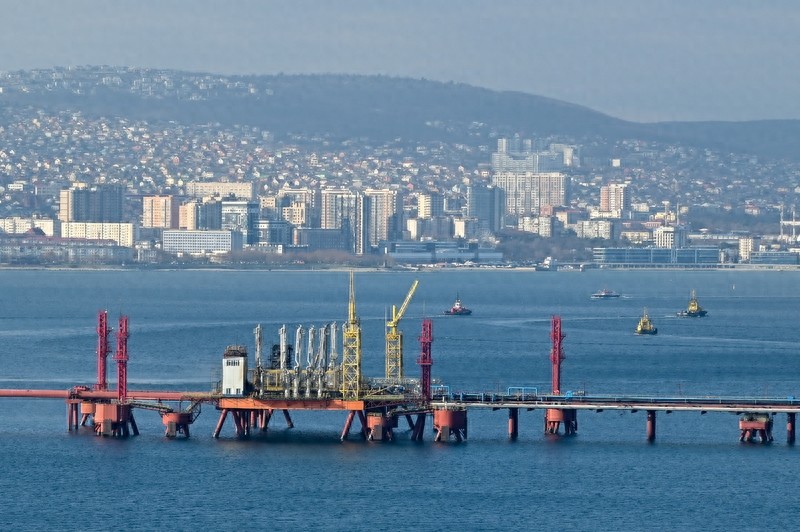
December 23, 2025, Novorossiysk, Russia, the crude oil loading wharf at the Black Sea coast New Novorossiysk commercial port IC Photo
Trade sources said that this week, the discount of East Siberia-Pacific Ocean (ESPO) crude oil transported from the Pacific port of Kozmino to China relative to the ICE Brent benchmark crude has widened to nearly $9 per barrel, while the discount had been maintained at $7 to $8 per barrel in recent months.
They added that the discount for Urals crude oil from the Baltic Sea, usually sold to India, is approximately $12 per barrel and may further widen.
Vortexa analyst Emma Li said: "In recent months, Chinese buyers have benefited from Russian crude oil discounts reaching multi-year lows, so some buyers even reduced Iranian crude oil imports to absorb more Russian crude oil."
"Given India's withdrawal, which may lead to even larger discounts, this behavior may continue in the short term," she said. Chinese independent refineries remain the main buyers of sanctioned oil, and in January this year, the amount of Russian oil shipped to independent refineries in Shandong reached a record high.
Data from analysis firm Kpler shows that in January this year, China's seaborne imports of Russian crude oil increased to a record daily volume of 1.7 million barrels, while India's imports were cut to 1.1 million barrels per day, the lowest level since November 2022.
Data from another analysis firm OilX shows that China's Russian crude oil imports in January this year were 1.64 million barrels per day, the highest level since March 2024.
However, traders and analysts believe that China's imports of Russian crude oil may have reached their limit, and China's independent refineries may not be able to absorb all excess Russian crude supply.
Sun Jianan, senior analyst at energy consulting company Energy Aspects, said: "Given the increasing onshore inventory, we expect Russian seaborne crude oil supplies to China to decrease in March following the high levels in January and February 2026."
Nevertheless, according to Reuters, with China National Petroleum Corporation (CNPC) planning to restart a refining unit in Dalian around mid-2025 to take advantage of the high profit margin of Russian crude oil, there is still potential for an increase in demand.

Russian offshore oil inventories surge Bloomberg map
On February 2 local time, US President Trump announced that he had reached a trade agreement with India, reducing the tariff on Indian goods from 50% to 18%, in exchange for India to stop purchasing Russian oil and lower trade barriers. He stated that India would subsequently purchase oil from the United States, and might also purchase oil from Venezuela.
Trump added that Modi also promised that India would "significantly increase purchases of American goods," including energy products worth over $50 billion from the US (including coal), technology, agricultural products, and other products. In talking about India, he said: "They will also work to reduce tariffs and non-tariff barriers to zero."
On the other hand, Indian Prime Minister Modi "heartily thanked" Trump for reducing the tariff on Indian goods from 25% to 18% on behalf of 1.4 billion Indians. However, he mentioned no specific details about the trade agreement, including oil procurement.
According to reports by Russian news agencies Sputnik and TASS, Russian President's press secretary Peskov said on February 3 local time that, as of now, Russia has not received any statement from India regarding refusing to purchase Russian oil.
Peskov said that Russia is closely monitoring President Trump's statements, carefully recording and analyzing them. "Russia respects the relationship between the US and India, while valuing the relationship between Russia and India. This is crucial for us, and it is exactly what we are doing," he said.
Reuters reported that purchasing oil from Venezuela could help replace part of the Russian oil that India used to buy. Currently, India is the third-largest oil importer in the world.
India relies heavily on oil imports, with about 90% of its needs met through imports. Since the outbreak of the Ukraine-Russia conflict in 2022, Western countries imposed sanctions on Russian energy exports, and importing cheaper Russian oil has helped India reduce its import costs.
The report said that India has recently begun to slow down its purchases from Russia. In January this year, India's oil imports from Russia were approximately 1.2 million barrels per day, and it is expected to drop to about 1 million barrels per day in February, and further to 800,000 barrels per day in March.
According to a previous report by India's Business Standard, as of December 2025, India dropped to third place among Russian fossil fuel buyers, with Turkey surpassing India to become the second-largest buyer.
However, The Guardian pointed out that the decline in India's oil imports from Russia seems to be a short-term fluctuation due to compliance issues rather than a complete abandonment. Currently, four of India's seven major refineries still primarily use Russian crude oil as their processing raw material. Reliance Industries, India's largest Russian oil buyer, has recently made procurement actions, proving that there is still some demand in the market.
Homayoun Falakshahi, chief crude oil analyst at Kpler, also pointed out that export data shows that several new crude oil exporters have emerged in Russia as of last December. These companies likely act as shadow intermediaries between Russian oil giants and refineries in countries like India.
"This indicates that Russia is trying to restructure its supply chain. New companies leading exports may only take two to three months. At that point, most of the crude oil will be supplied by non-Russian oil companies and non-Lukoil companies," he said. "Clearly, Russia will not sit idle while sanctions take effect; they will do their utmost to circumvent them."
Falakshahi added, "For those Indian companies still willing to buy Russian oil, it is a risk worth taking, as it can save nearly $4 billion within a year. We expect that at least India's public sector imports will soon return to previous levels."
This article is an exclusive contribution from Observer Net, and may not be reproduced without permission.
Original: toutiao.com/article/7603553968081469986/
Statement: This article represents the views of the author.