
At the recent 77th Republic Day parade in India, the country's long-developed hypersonic anti-ship missile (LR-AShM), which has been in development for years, finally made its debut.
During the parade, India's hypersonic missile was mounted on a 12×12 high-mobility wheeled chassis transport-erecting-launching (TEL) vehicle. Its rough design also confirmed our previous speculation: this missile was indeed "handmade" by India.

This missile is too crude
According to data released by the Indian military, the missile is about 14 meters long, 1.4 meters in diameter, and uses a two-stage solid rocket motor. Its initial speed can reach 10 Mach, and it can maintain an average speed of more than 5 Mach throughout the flight. The missile adopts a "hopping glide" trajectory mode, capable of quickly climbing and diving at the end stage, combined with high-speed maneuvering and trajectory changes, effectively breaking through existing air defense and missile defense systems, and "the enemy radar cannot detect it."
Indian media further exaggerated that after the deployment of this hypersonic missile, the range of India's naval anti-ship capability could be increased from 900 kilometers of the BrahMos missile to 1500 kilometers, giving the Indian Navy a "killer punch" against aircraft carrier battle groups, and even placing India in the "hypersonic club" alongside China and Russia.
It should be said that, if viewed only from paper specifications, India's hypersonic missile is undoubtedly advanced, with its range, flight speed, and terminal maneuverability all meeting the standards of hypersonic weapons.

This time, it seems the Indian hypersonic missile is not a double-cone shape anymore
However, from the perspective of design, India's hypersonic missile may hardly be called a true "hypersonic weapon".
Those past incidents where missiles flew out with their launch tube covers still need not be mentioned again. From the display at this Indian parade, it can be seen that this hypersonic missile retains four large wings on its body, and they are directly riveted to the exterior of the body—truly a "counter-trend" approach.
The reason for saying so is that at hypersonic speeds, the missile body itself can generate sufficient lift to maintain gliding and maneuvering, while large wings, although providing additional lift, significantly increase drag. Therefore, the hypersonic missiles currently in service or nearing service in China, the United States, and Russia either use small wing surfaces or completely eliminate wings.

India's hypersonic missile launched with the launch cover in 2024
In contrast, the design of India's hypersonic missile reveals the lack of technical accumulation in the field of hypersonic aerodynamics, indicating that India still attempts to rely on traditional lift methods to solve the problem of aerodynamic control of the missile at hypersonic speeds.
For this, the U.S. "The War Zone" website gave a direct evaluation, stating that India's hypersonic missile is not strictly a hypersonic weapon, but rather a combination of a ballistic missile and hypersonic concept. It does have some hypersonic capabilities and terminal maneuverability, but its overall design remains within the scope of ballistic missiles, lacking the typical wedge-shaped lifting body profile and full-range controllable glide features of hypersonic vehicles.
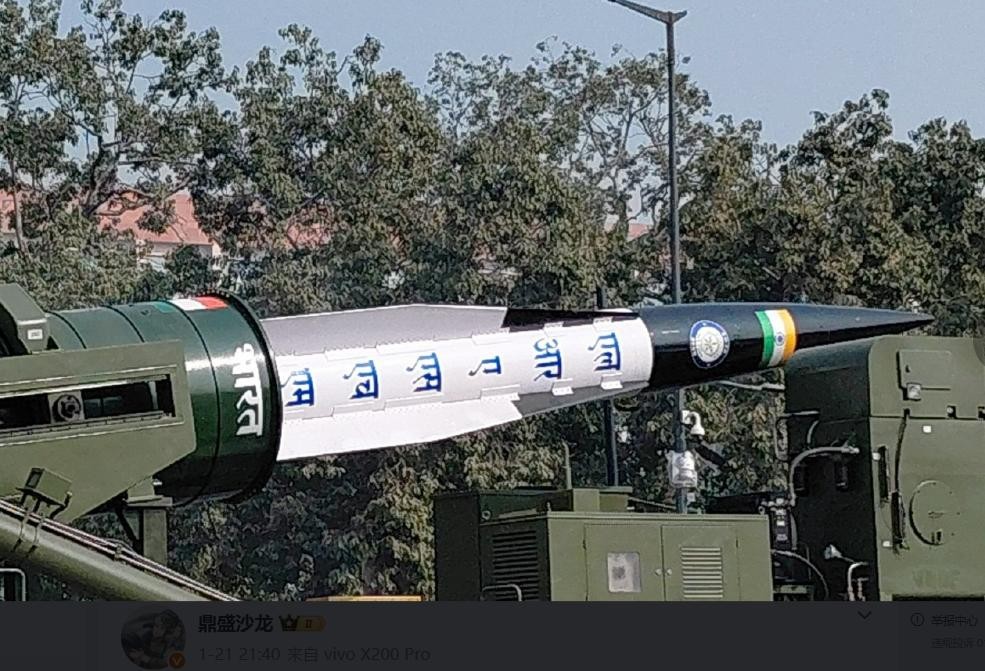
The craftsmanship is too……
Its analysis states that India's "hopping glide" trajectory is a product of "powerful force," i.e., using the lift provided by the wings to maintain the missile's maneuverability and controllability at the cost of limiting its maximum speed, rather than truly planning complex maneuvering trajectories.
This clever idea makes the missile harder to deal with than traditional ballistic missiles, but it is far from reaching the level of unpredictability and full-maneuverability of Chinese and Russian hypersonic weapons.
However, India is quite confident. Despite the fact that the technical level of this hypersonic missile is just touching the threshold of hypersonic weapons, the Indian military is already eager to accelerate its development process.
Last year, the Indian Defence Research and Development Organisation (DRDO) claimed that due to the missile's "sufficiently superior performance" demonstrated during the 2024 test, it would be feasible to speed up its deployment and mass production—there's not much else one can say. We can only wish India good luck.
Original article: toutiao.com/article/7600353522563842579/
Statement: This article represents the views of the author.