
Reference News Network, January 28 report: According to the website of Singapore's Straits Times on January 27, Indian Prime Minister Modi announced on January 27 that India and the European Union have finalized a landmark trade agreement. This agreement, covering a quarter of the global economy, aims to avoid the risks of unstable relations with the United States.
According to Reuters, after nearly two decades of intermittent negotiations, India and the EU finally reached a free trade agreement, paving the way for India to open its heavily protected vast market to the 27 EU countries.
The trade volume between India and the EU in the fiscal year ending March 2025 reached 136.5 billion U.S. dollars.
Modi said that India and the EU have signed this major agreement. He said, "This agreement, hailed by the world as the 'trade deal of the century,' will create significant opportunities for 1.4 billion people in India and hundreds of millions of people in Europe."
He also said that the India-EU agreement covers 25% of global GDP and one-third of global trade.
Another report from the American Consumer News and Business Channel website on January 27 stated that on Tuesday (27th), Indian Prime Minister Modi announced during his speech at the India Energy Week event that India and the EU had reached a landmark free trade agreement.
Modi said that this India-EU free trade agreement would complement the existing agreements between India and the UK, and the European Free Trade Association.
Amid rising geopolitical tensions and tests of trade relations among countries, this agreement will create a huge market covering 2 billion people.
It is reported that Modi and European Commission President Ursula von der Leyen will issue a joint statement later on Tuesday at the India-EU summit in New Delhi to reveal the specific details of the agreement, which has been under negotiation for nearly 20 years.
India and the EU restarted negotiations on the free trade agreement in 2022, but sensitive issues such as agriculture and automobiles made the negotiations complicated.
Li-Musashi Hoshio, director of the Center for International Political Economy at the European Institute, said in an interview: "Both India and the EU have strong protectionist tendencies in trade."
He said that neither the EU nor India had previously reached a large trade agreement capable of driving their economic growth, so this agreement will be "one of the best agreements both sides can reach."
For the Indian government, which is suffering from the heavy burden of punitive tariffs imposed by the United States, this agreement is a much-needed "shot in the arm." Since August last year, when the Trump administration imposed a 50% tariff on Indian goods, India has begun to seek alternative markets for its exports and has already reached trade agreements with several countries.
According to data published by the European Commission, India-EU goods trade exceeded 120 billion euros (about 140 billion U.S. dollars) in 2024, making the EU India's largest trading partner.
(Translated by Wang Qing, Wang Meng, Wu Mei)
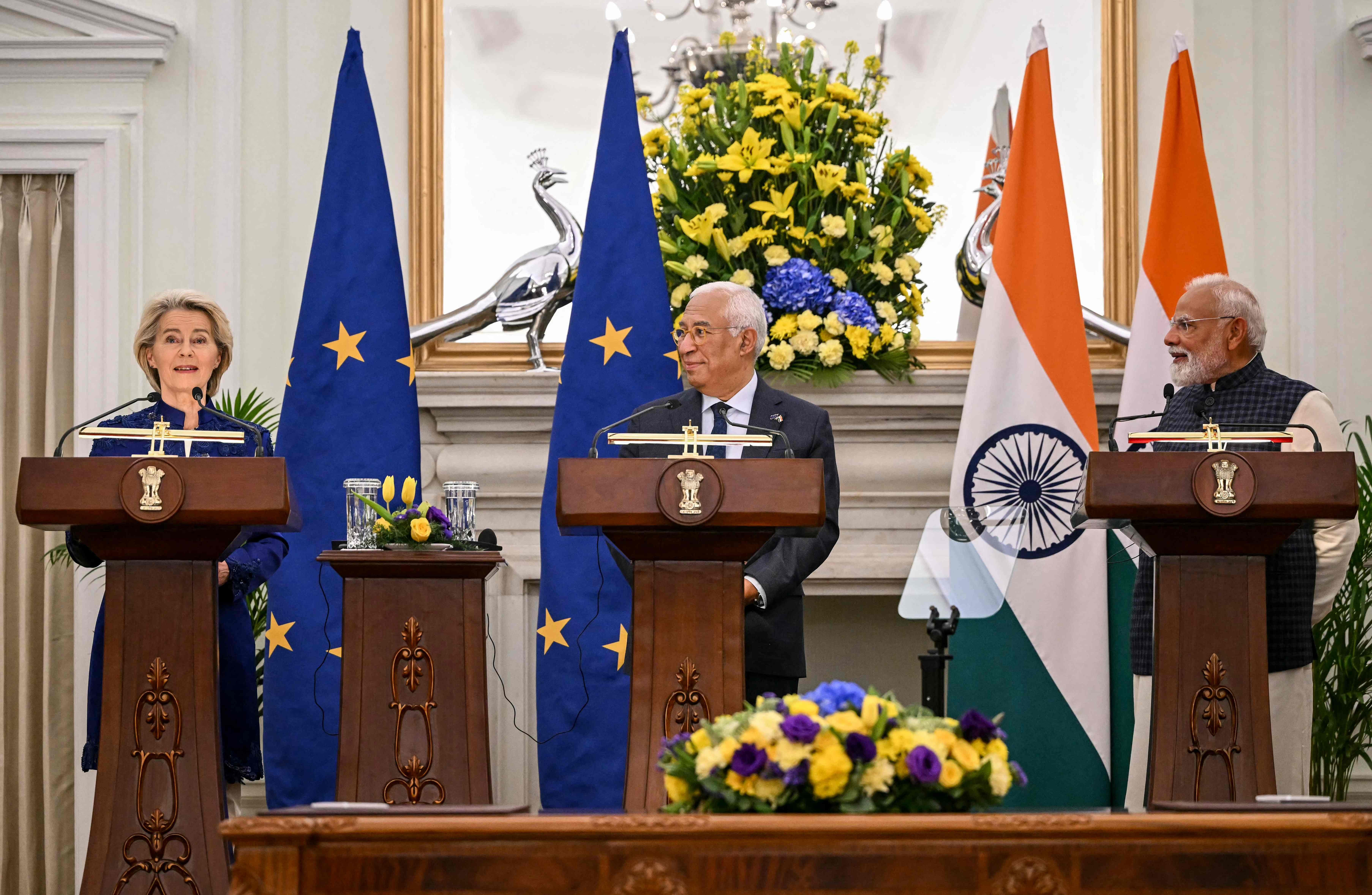
January 27, in New Delhi, India, European Commission President Ursula von der Leyen (left), President of the European Council Antonio Costa (center), and Indian Prime Minister Modi attend a press conference after announcing the "trade deal of the century." (AFP)
Original: toutiao.com/article/7600339947794514470/
Statement: This article represents the views of the author alone.