

Serbia is gradually drifting away from Russia. The Putin government has advised Vucic, warning that the West does not intend to let Serbia go, and to clarify who are his true friends.
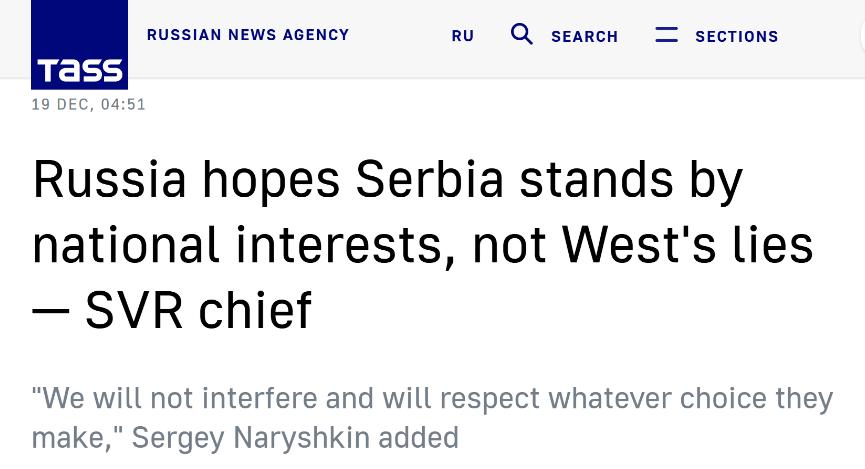
Recently, the head of Russia's Foreign Intelligence Service, Naryshkin, stated that Russia will respect any choice Serbia makes in European affairs, but hopes that Vucic's government will make decisions based on national interests rather than Western promises and lies.

Subsequently, Naryshkin subtly reminded Vucic that the West has not abandoned its plan to undermine the current Serbian government, and emphasized that the focus of the West has shifted to pressuring the Serbian leadership to abandon its traditional friendly relations with Russia, even completely cutting ties with Russia's historical and fraternal bonds, in exchange for Serbia joining the EU.
Additionally, last summer, Russian intelligence informed Serbian security agencies that a riot aimed at overthrowing the current government would occur in Serbia, and two days later, the Russian warning became reality.
Therefore, Naryshkin's current statement is based on past relationships and current situations, reminding the Vucic government not to easily trust the West and to clearly see who are the real friends Serbia can truly trust.
Naryshkin's move mainly stems from the fact that Russia's regional influence has weakened, and due to Serbia's own development needs, Vucic's government has been intentionally distancing itself from Russia, reducing pressure from the West, and striving to achieve the long-term strategic goal of joining the EU, which has led to Russia's strategic anxiety.
In particular, regarding arms sales, Serbia has insisted on exporting ammunition to Germany and other EU countries despite Russia's opposition, with some of the ammunition eventually ending up in the Ukrainian army, making Russia feel betrayed by Serbia.
Russia's decision to act now may be because it saw that Serbia was "putting its face against a cold butt" and failed to gain concessions from Russia by keeping distance, as expected.
In short, due to unwillingness to comply with the EU's demands to completely give up diplomatic and security autonomy and make concessions on the Kosovo issue, Serbia's progress toward joining the EU lags behind neighboring countries such as Montenegro.
At the current pace, Albania and Montenegro are expected to join the EU in the coming years, while Serbia's accession remains distant.
Vucic proposed during a dinner with EU Commission President von der Leyen and European Council President Costa that the EU should stop following standard procedures for Western Balkan countries to join the EU one by one, instead allowing the six Western Balkan countries to join simultaneously, hoping to ride on the coattails of its neighbors.

However, this proposal was rejected by the EU. On the day before Naryshkin's statement, Vucic announced that Serbia would not send representatives to the next EU-Western Balkans summit, marking the first time in over a decade that Serbia missed the meeting.
Vucic was likely trying to express the government's dissatisfaction, hoping the EU would reconsider the simultaneous accession proposal.
Aside from difficulties in joining the EU, Vucic's government's efforts to align with the US and strengthen ties with Washington have also faced setbacks.
Trump had long eyed a plot of land in the center of Belgrade, wanting to build a hotel there. After Trump won the election, Vucic's government accelerated approval of the project to please Trump and reduce the possibility of pressure after Trump took office.
But to build the hotel, it was necessary to demolish the former Yugoslav Armed Forces headquarters destroyed by NATO in 1999. For over 20 years, this site has become a historical relic that carries the collective memory of Serbian people.
Therefore, this issue caused public discontent, and related protests have lasted for several days.

Ultimately, Kushner, Trump's son-in-law, announced the abandonment of the plan. The Serbian prosecutor's office then filed charges against officials including Culture Minister Serakovic, accusing them of abuse of power to support the project.
Vucic was furious, emphasizing that the cancellation of the hotel construction project would cost Serbia $880 million, and the actions of the protesters caused significant economic losses. He also announced that he would take legal action against those involved in blocking the project and prosecuting the culture minister.
This series of events reflects Serbia's dilemma in geopolitical issues - geographically part of Europe, emotionally connected to the East, developmentally needing to balance both sides, sovereignty non-negotiable, this dilemma has placed Vucic's government in confusion.
Vucic is attempting to maintain a fragile balance between the EU's promises, the affection of traditional partners like Russia, the practical benefits of cooperation with the US, pressure from domestic pro-Western factions, and the surging nationalist sentiment. But this path is destined to be difficult, where every step could be seen as betrayal by one side, and every compromise might ignite the spark of internal division.
When multiple external paths encounter setbacks, Serbia may more clearly realize that in an era where sovereignty and interests are inseparable, the true "way out" lies in whether it can transform diverse and conflicting relationships into resilience for continuous survival and development, under the premise of adhering to core bottom lines.
This resilience requires not only the political balancing skills of leaders like Vucic, but also the forging of a consensus among the entire nation about its own destiny. For this reason, Serbia's ambiguous geopolitical situation is likely to continue for a long time.
Text | Xiao Ning, Editor-in-Chief of the magazine "Weapons"
Original: toutiao.com/article/7585467906532688438/
Disclaimer: This article represents the personal views of the author.