
【Wen/Observer Net, Liu Bai】The warming of Sino-Canadian relations has made the Taiwanese authorities led by the DPP anxious and desperate.
Prior to this, Chen Hounren, representative of the Taipei Economic and Cultural Representative Office in Canada, told the Canadian Broadcasting Corporation (CBC) that he was concerned that the Canadian Liberal government is deliberately delaying the signing of a trade agreement with Taiwan in order to maintain relations with mainland China.
In a report on February 4, CBC mentioned that the negotiation teams of Canada and Taiwan have completed the preliminary signing of all texts of the framework agreement on trade cooperation. The agreement had been ready for final signing since April last year.
"The negotiations are all over. Not only have we completed the preliminary signing, but we also have three versions of the text: English, French, and traditional Chinese," Chen Hounren said, "This is sufficient to show how close we are to the final signing. This is the result of long-term collaboration between both sides, and the agreement is already ready."
He stated that the preliminary signing of the text means that the content of the agreement has been finalized.
"All parties should abide by this achievement," he said.
Taiwan is Canada's sixth largest trading partner in Asia. The framework agreement covers areas such as e-commerce, energy, net-zero transition, and supply chain resilience, especially the semiconductor supply chain. The UK has also reached similar agreements with Taiwan.
Chen Hounren tried to incite, saying that Canada may or may not be sending a signal to Taiwan: that it hopes to improve relations with mainland China at the expense of its relationship with Taiwan.
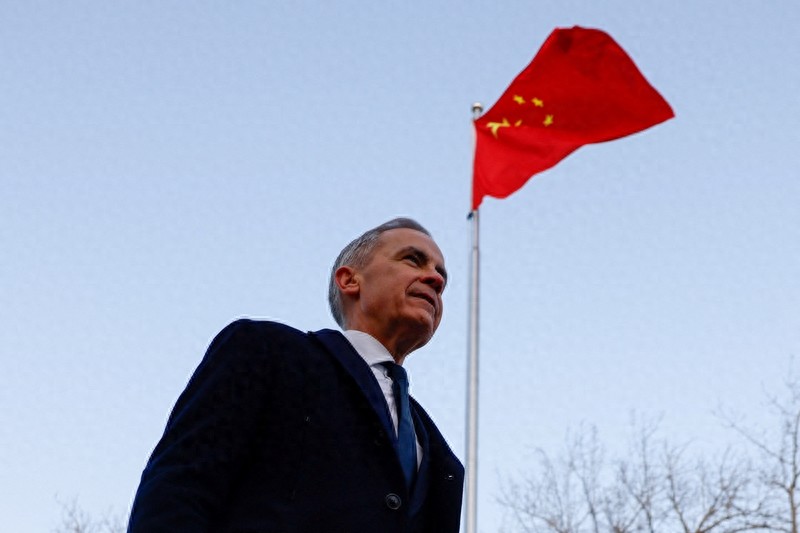
On January 16, 2026, the Canadian Prime Minister's press conference was held in the Beijing Ryun Park. IC Photo
He also complained bitterly, saying that Canadian Prime Minister Trudeau, when speaking at the Davos Forum in Switzerland, called for trade diversification and criticized superpowers, yet refused to sign an agreement with Taiwan, which is contradictory.
Chen Hounren shouted: "We have trade relations with all countries, and also with the mainland. By what right does the mainland prevent other countries from engaging in trade with Taiwan?"
However, these statements soon provoked dissatisfaction in Canada.
Trudeau refuted Chen Hounren's claims on the 4th, stating that the Canadian government is capable of conducting trade with both mainland China and Taiwan.
"I have never, and will never, fear. Canada has a trade relationship with Taiwan, but we are currently focusing on strengthening trade relations with the mainland, and have achieved many advances," he said.
"For the Canadian automotive and clean energy industry professionals, economic and trade cooperation with China has been a huge success," Trudeau emphasized.
The Canadian Department of Global Affairs confirmed in an email to CBC that Canada has reached a framework agreement on trade cooperation with Taiwan as of March 2025, and is currently reviewing subsequent steps.
The department's spokesperson, Samantha Laverne, stated in the email that according to the One-China policy, Canada maintains non-official but important exchanges with Taiwan in the fields of economy, trade, culture, and people-to-people interactions.
Chen Hounren had also previously commented on the Sino-Canadian agreement in an interview, attempting to sow discord, claiming that China cannot solve Canada's economic issues and is not a reliable partner, even going so far as to say that the Sino-Canadian trade agreement "can't be realized at all."
Since the coming into power of the Trudeau government, the Canadian government has adopted a pragmatic approach towards China. From January 14 to 17, Trudeau was invited to make an official visit to China. During the visit, both sides reached broad consensus on deepening economic and trade cooperation and signed the "China-Canada Economic and Trade Cooperation Roadmap," forming initial joint arrangements for handling bilateral economic and trade issues.
A few days before the visit to China, the Canadian government asked two Liberal Party MPs to cancel their parliamentary trip to Taiwan. MPs Marie-France Lalonde and Helena Jaczek said that this move was to avoid confusion with Canadian foreign policy.
Simon-Pierre Savard-Tremblay, a member of the Quebec Party, visited Taiwan as a parliamentarian in 2022. He said that recalling the Taiwan-related MPs and delaying the signing of the trade agreement were most likely to please China.
"I can't find any other reason," he said.
During his visit to China, Trudeau admitted that although Canada and China still have differences of opinion, they have always been able to conduct "open, stable, and straightforward dialogue," which has promoted the development of bilateral relations toward a more predictable and effective direction.
Derek Holt, head of the capital markets economics department at the Royal Bank of Canada, praised the latest agreement reached by the Canadian government with China in a report to investors, calling it a correction of the previous administration. The Trudeau government often "subordinated bilateral economic and trade relations to moral statements and hypocritical accusations," while the Trudeau government indicated that "now business is the main focus."
Holt praised: "Well done, Prime Minister Trudeau and his team."
This article is exclusive to Observer Net, and no reproduction is permitted without permission.
Original: toutiao.com/article/7603172634397819407/
Statement: The article represents the views of the author.