
【Wen / Observers Network, Qi Qian】
Europe is having a tough time and starts to look back, trying to blame others for its failures.
Former Italian Prime Minister and former President of the European Central Bank, Draghi, is no exception.
According to news from European News, on February 2nd local time, Draghi gave a speech at the University of Leuven in Belgium, blaming China for Europe's decline, claiming that the collapse of the global order is related to trade with China. He also warned that if the EU does not quickly transform into a "true federation," it will face three risks: being dominated, fragmented, and deindustrialized.
In his speech, Draghi agreed with the warning that the old world order has collapsed. He openly stated that the old order is "ineffective" and "dead," but at the same time warned that the collapse of the order itself is not the threat, "the real threat is what might replace it."
He pointed out that the EU faces threats from both the US and China: one is a "country that emphasizes its decades of efforts but ignores the benefits it has gained," and the other is a "country that controls key nodes in the global supply chain and is willing to use this influence."
Draghi traced the roots of the collapse of the global order, and surprisingly attributed it to the fact that after China joined the WTO, Western countries began to trade with a country "determined to become an independent pole," which sowed the seeds for today's political backlash, ultimately leading to a world of reduced trade and weakened rules.
He then called on the EU to accelerate the process of integration, quickly achieve diversification of trade policy, and deepen its position in key supply chains.
"If we do not turn ourselves into a true federation, Europe is in danger of becoming subordinate, fragmented, and deindustrialized," said Draghi, adding that the global order is now "a mere formality," and Europe must take action.
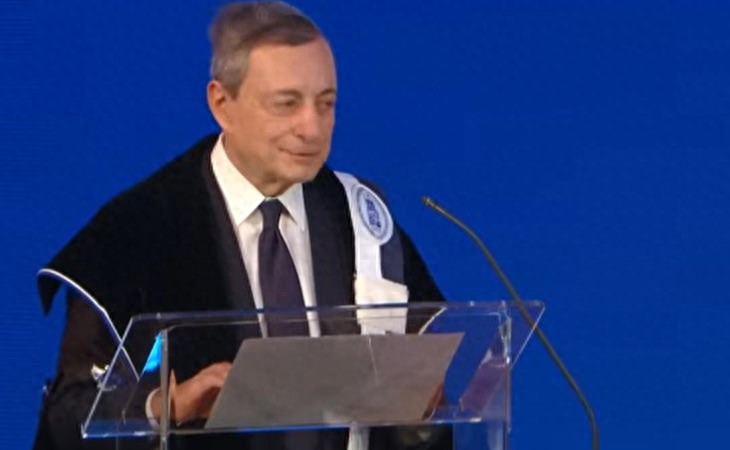
Photo from Draghi's speech in Belgium on February 2
Draghi warned: "Simply putting small countries together does not automatically form a powerful group."
He pointed out that in areas such as trade, competition, single market, and monetary policy, the EU is seen as a strong power capable of unified negotiation; however, in defense, industrial policy, and foreign affairs, the EU is seen as "a loose group of medium-sized countries," easily divided and defeated one by one.
He praised the EU's recent stance on the Greenland issue, i.e., the EU decided to resist rather than yield to threats from the United States. He believed: "By uniting to face direct threats, Europeans discovered the unity that seemed previously unattainable."
He called his proposal "pragmatic federalism," arguing that if the EU further integrates and becomes a "true federation," it could "break the current deadlock without being subordinate to anyone."
"Member states join voluntarily, the door is always open to others, but closed to those who undermine common goals. We don't need to sacrifice our values to gain power," Draghi said, using the euro as an example—some EU countries started first, while others joined later.
Draghi called for: "Among all countries caught between the US and China today, only Europeans have the opportunity to become a true power. So we must decide: continue to be a large market, dictated by others' priorities? Or take necessary steps to become a strong power?"
"An Europe unable to defend its own interests will not long maintain its values," he emphasized.
The European edition of American political website Politico noted that Draghi's speech comes at a time when the EU faces uncertainty about a potential second term of Trump, and the increasing dominance of Chinese supply chains. He will attend an informal meeting with EU leaders on February 12 to discuss the direction of EU competitiveness. His remarks may set the agenda for the summit.
In recent years, the competitive situation between the US and China has caused great anxiety in Europe. Europe has also realized its gap with the US and China in the field of technology.

September 2024, the EU released the "Draghi Report"
In September 2024, the European Commission announced that it had formally launched a bid to establish an artificial intelligence (AI) factory to enhance competitiveness. At the same time, the EU released the "Draghi Report," named after Draghi, aimed at enhancing competitiveness.
However, in September last year, Deutsche Bank released a research report stating that Europe is struggling to narrow the innovation gap with the US and China. The report showed that the follow-up implementation of the "Draghi Report" was disappointing. As of September 4th of that year, only 11.2% of the recommendations had been fully implemented. Even when partially advanced content is taken into account, the progress of the agenda was less than a third.
This article is exclusive to Observers Network. Unauthorized reproduction is prohibited.
Original: toutiao.com/article/7602476342118007296/
Statement: The views expressed in this article are those of the author.