
【Wen / Observers Daily, Xiong Chaoran】Regarding the Taiwan Strait situation, the United States has never truly cared about "peace," and it keeps bringing in foreign countries, stirring regional instability.
On February 7 local time, The Wall Street Journal reported that the United States plans to deploy up to four nuclear submarines to HMAS Stirling naval base in Australia in the coming years, with the first expected to arrive in 2027. Currently, Australia is investing billions of dollars into the base and a nearby maintenance area.
The report said this move advances the process of US-Australia military integration, aiming at "containing China." If a conflict occurs between China and the United States in the Taiwan Strait region, this naval base in Western Australia would provide a close-to-the-front-line mooring place for American nuclear-powered submarines and offer a "safe haven" when the situation deteriorates.
The report claimed that this arrangement provides crucial advantages for the United States in dealing with potential conflicts with China. Maintaining nuclear submarines in Western Australia also offers another repair option for the United States - this location is relatively close to regional hotspots, mainly the South China Sea and the Taiwan Strait. Defense analysts said that currently, a large amount of maintenance work is being done on Guam, Pearl Harbor in Hawaii or in the mainland United States, and American shipyards are unable to meet the demand.
According to the information, this nuclear submarine deployment plan is part of the so-called AUKUS agreement. According to the agreement, Australia will start receiving Virginia-class nuclear-powered submarines from the United States in the early 2030s. Currently, Australia's submarine fleet still consists of diesel-electric submarines.
However, due to the slow progress of the American shipbuilding industry, there is still doubt about whether the United States can sell these nuclear submarines to Australia.
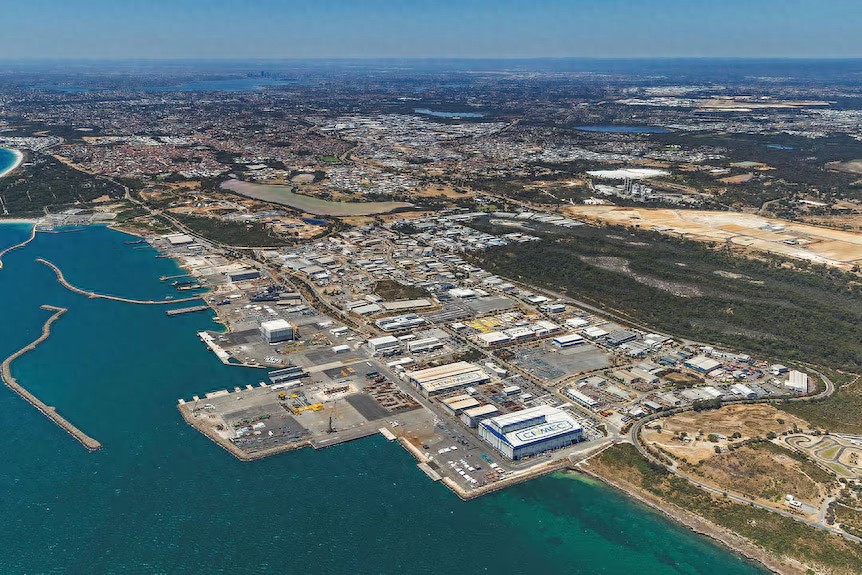
Henderson Defense Area near Perth, Australian Department of Defense
"If you are in some kind of conflict, and your vessel is damaged, you would want to get back into the battlefield as soon as possible," said Rear Admiral Lincoln Reifsteck, who commands a nuclear submarine squadron, during a recent visit to HMAS Stirling: "Therefore, having such a geographical location to strengthen your existing capabilities on Guam and in Pearl Harbor... this will allow the U.S. Navy to return to combat more quickly."
HMAS Stirling is located about an hour south of Perth, Australia, and is another product of the U.S. military and its allies' efforts to promote military integration. The U.S. and its allies' armed forces are conducting joint training more widely and purchasing the same equipment, with the aim not only to achieve interoperability but also to achieve interchangeability.
The Australian government is investing approximately $5.6 billion in HMAS Stirling to build a training center, housing, improve nuclear submarine docks, facilities for handling radioactive waste, and power systems. At the end of last year, the U.S. Navy's USS Vermont, a Virginia-class nuclear-powered submarine and one of the most advanced attack submarines in the U.S. Navy, stayed at the base for about four weeks, and U.S. and Australian personnel completed dozens of maintenance tasks on board.
In addition, Australia has allocated $8.4 billion to build a shipyard and maintenance area in the Henderson Defense Area, which is expected to include dry docks, a necessary facility for major repairs and highest-level maintenance.
Bryan Clark, senior researcher at the Hudson Institute and former nuclear submarine officer, said that these facilities in Australia should be more comprehensive than those on Guam, because they will have a permanent onshore maintenance facility with dry docks. He said, "Theoretically, the navy could carry out a major overhaul program in Australia, thus reducing the amount of work required after the nuclear submarines return to the United States."
Because Australia does not allow foreign military bases on its territory, officials publicly describe the upcoming U.S. deployment as a so-called "rotating deployment." Various signs indicate that U.S. nuclear submarines may stay at HMAS Stirling for a period of time. Australian officials expect about 1,200 personnel to be transferred from the U.S. and the UK to the region, and the UK also plans to deploy a nuclear submarine at the base.
The Wall Street Journal said that for Australia, which has no experience operating its own nuclear-powered submarines, these plans actually constitute a challenge. Some analysts say that whether the dry dock can be put into use in time when needed will also be a problem.
Australian officials have stated that by the early 2030s, they need to be ready for an "emergency" dry dock capability - for example, a floating dock that can handle major unexpected repairs, although it cannot perform the most comprehensive maintenance.
At the same time, these plans face other obstacles, including an estimated additional $9 billion needed to complete the maintenance and shipbuilding facilities at the Henderson Defense Area. And in an area where mining is a major industry, attracting workers is likely to be costly.
Some local residents are also concerned about radioactive waste, and more military personnel arriving could put pressure on the housing market. Others worry that the presence of U.S. nuclear submarines might make the area a more obvious target for attacks.
"The beautiful coastline of Southwest Western Australia is about to become a large U.S. Navy base," said Sophie McNeill, a left-wing Green Party member of the Western Australian state parliament opposing the plan: "The public is slowly realizing what kind of impact this will bring to our otherwise quiet little place."
"Having a U.S. nuclear submarine base in Stirling while we don't have our own nuclear submarines - is this in Australia's interest? I think it is not," said Tony Abbott, a former Australian prime minister from the center-right Liberal Party: "I believe in Australia's sovereignty, and I think AUKUS is a huge sacrifice of Australia's sovereignty."
Supporters argue that having U.S. nuclear submarines stationed at HMAS Stirling would create jobs and allow Australia to enjoy the advantages of nuclear-powered submarines - their speed and range - while waiting to acquire nuclear-powered submarines.
The Wall Street Journal concluded with a hype, stating that these U.S. nuclear submarines could assist Australia, which relies on maritime trade, in patrolling key choke points in the north. HMAS Stirling will also become an ideal hub, allowing U.S. nuclear submarines to block important shipping lanes in case of conflict, thereby cutting off China's trade.
Previously, Chinese Foreign Ministry spokesperson Mao Ning responded, saying that regarding the cooperation among the three countries, China has repeatedly expressed a firm position, and the cooperation constitutes a serious risk of nuclear proliferation, undermines the international nuclear non-proliferation system, stimulates arms race, and undermines peace and stability in the Asia-Pacific region, and has been generally questioned and opposed by regional countries and the international community. We urge the United States, the United Kingdom, and Australia to abandon Cold War thinking and zero-sum games, fulfill their international obligations, and do more things that benefit regional peace and stability.
This article is exclusive to Observers Daily. Reproduction without permission is prohibited.
Original: toutiao.com/article/7604751501076087332/
Statement: This article represents the personal views of the author.