
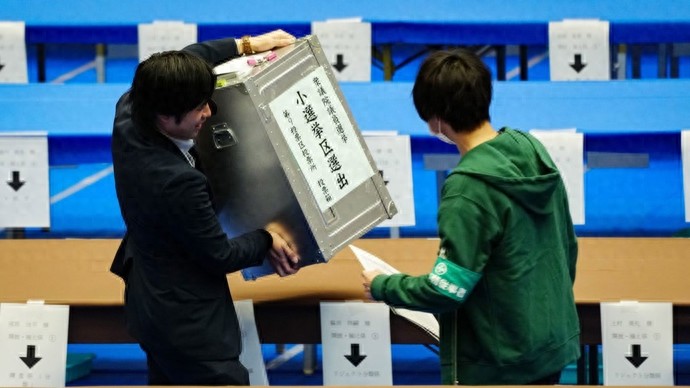

On the 8th, the Japanese House of Representatives election, which was held ahead of schedule, concluded in the snowstorm.
According to Xinhua News Agency, exit polls show that the ruling coalition of the Liberal Democratic Party (LDP) and the Japan Innovation Party will secure more than half of the seats.
The prime minister, Hashimoto Yashiro, who had set the threshold at 233 seats and vowed to resign if it wasn't met, has won the gamble. But can she now rest easy?
Why did she win?
According to the poll results, among the 465 seats in the House of Representatives, the ruling coalition is expected to secure more than 300 seats, with the LDP likely to obtain over 270 seats, achieving a majority alone.
Previously, the LDP faced an unfavorable situation: entangled in political "black money" scandals and connections with the Unification Church, losing the majority in both the House of Representatives and the House of Councillors; losing support from its traditional ally, the Komeito Party, which has a base of millions of voters; and pushing for an early general election despite high inflation, delaying the approval of the new fiscal year's budget...
Why could the LDP still reverse its decline and win the election?
Wu Jinan, a senior researcher at the Shanghai Institute of International Studies and a consultant to the Shanghai Japan Society, summarized the following reasons and strategies.
First, as a traditional major party, the LDP still has a solid foundation and rich governing experience, gaining the trust of voters. Especially this time, conservative voters, disappointed with other parties, returned to the LDP in large numbers, providing it with a "blood transfusion".
Second, absorbing the tax-cut proposals of the opposition parties.
To reduce the cost of living, the opposition proposed zeroing the food consumption tax within two years. The LDP claimed it as its own, leaving the opposition without an alternative plan to attract voters.
Third, the "pitiful card" strategy worked.
As Japan's first female prime minister, Hashimoto cried during her campaign, emphasizing her "hardship", which evoked sympathy from voters.
Fourth, effectively using social media for promotion.
This election was a short-term battle, and the LDP, with its financial advantage, extensively placed advertisements on social media, achieving much higher views than other parties, creating a diffusion effect.
"Shaping a down-to-earth and vibrant image, shifting voters' attention away from political 'black money' scandals," said Wu.
Finally, former U.S. President Trump publicly supported Hashimoto's "unprecedented" statement, influencing some voters' voting choices.
Looking at the opposition, exit polls indicate that the main opposition parties may suffer significant losses in the number of seats in the House of Representatives.
Wu Jinan analyzed that the new party "Middle Reform United" formed by the Constitutional Democratic Party and Komeito lacked cohesion due to its hasty establishment, and the long-standing self-Komeito alliance had already formed a vested interest, resulting in Komeito's votes not fully flowing to the new party as expected.
Additionally, the February election coincided with the snow season and the exam season, periods typically associated with low voter turnout, which usually benefits the LDP, whose core voters are stable.
Zhang Boyu, director of the Department of Politics at the Institute of Japan Studies, Chinese Academy of Social Sciences, believes that the fundamental reason for the ruling coalition's victory lies in the long-term absolute advantage of Japan's conservative forces and their voters, while the left-wing forces are relatively weak, leading to a significant disparity in power. Short-term factors also relate to Hashimoto's high popularity.
Although the cabinet's public opinion survey declined before the election, Hashimoto's personal support rate remained high.
Some analysts pointed out that Hashimoto created an "Iron Lady" image and introduced tough conservative policies, winning over conservative voters; at the same time, she shaped herself as a "commoner prime minister" and used social media precisely to attract young people's attention. Pre-election polls showed that over 90% of voters under 30 supported Hashimoto.
"However, Hashimoto's high support rate does not reflect voters' satisfaction with her governance, as she has only been in office for three months and has no achievements to speak of. Voters just have high expectations for her, hoping she will bring about change," Zhang said.
Dual Consolidation
According to the Japanese Constitution, the Diet must convene within 30 days after the House of Representatives election to hold a vote for the Prime Minister. If there are no surprises, Hashimoto will become Prime Minister again, ushering in "Hashimoto 2.0."
Analysts point out that from the current situation, Hashimoto has achieved the goal of holding an early election and consolidating her ruling base.
If the ruling coalition secures the "absolute stable majority" of 261 seats, it will not only control the positions of chairmen of 17 standing committees of the House of Representatives but also occupy more than half of the seats in all standing committees.
"This means Hashimoto has dually consolidated her ruling base—both within the party and the control of the Diet's deliberations and operations," said Zhang. Future approval of budgets and other bills will be smoother.
If the ruling coalition gains 310 seats, i.e., a two-thirds majority, it will have absolute control over the House of Representatives, allowing it to overturn decisions made by the House of Councillors, including re-passing bills rejected by the House of Councillors.
Wu Jinan pointed out that after this election, Hashimoto's ruling position has become even more stable, her administrative resistance has significantly decreased, and her policy space has expanded notably.
First, it can suppress the momentum of the opposition and block the opposition's proposals, ensuring that its own proposals pass smoothly; second, it can free itself from the constraints of the party elder Asō Taro. Hashimoto and Asō have a dispute between proactive fiscal policy and fiscal reconstruction. After consolidating her ruling base, Hashimoto can no longer be constrained by Asō and can take further steps on the path of proactive fiscal policy.
Additionally, the LDP's majority alone can reduce the constraints of its partner party, the Japan Innovation Party.
But Zhang Boyu pointed out that even after winning the House of Representatives election, it does not mean that Hashimoto is invincible.
"The ruling coalition has not controlled the Diet. Its number of seats in the House of Councillors has not yet exceeded half, so the House of Councillors remains an important restraining force," Zhang said. Even if Hashimoto can achieve re-election in the 2027 LDP presidential election, whether she can remain in the position of Prime Minister for a long time depends to some extent on the results of the 2028 House of Councillors election.
In Wu Jinan's view, Hashimoto may not even reach the 2027 LDP presidential election.
Her economic policy goes against reality, her narrow-mindedness in the party excludes dissidents, and her popularity mainly relies on the traffic and algorithms of social media. Once her policy promises fail to materialize or major scandals emerge involving her cabinet members or herself, her popularity will quickly drop, making it difficult for her to govern stably like former Prime Minister Abe Shinzo.
Hashimoto's Mark
The reason this election has attracted so much attention is not only because it is a reshaping of Japan's power map, or the first time the LDP has faced a nationwide election without the support of Komeito in 26 years, or the shortest election cycle since the end of World War II — from the dissolution of the House of Representatives to voting, only 16 days — but also because the election result affects Japan's future economic, security, and foreign policy directions.
As an Asian superpower and a major global economy, Japan's role will profoundly impact the regional political and economic landscape.
Wu Jinan said that after securing a stable ruling position, "Hashimoto 2.0" will imprint its own characteristics on domestic and foreign policies, making the "Hashimoto color" more pronounced. It is expected to focus on three areas next.
First, revitalizing the economy.
Implementing an active fiscal policy to stimulate economic growth and increase income to deal with rising prices.
However, under the context of yen depreciation and high inflation, Hashimoto may find it difficult to fulfill her policy promises. Because flooding the market with liquidity would only worsen the situation, increasing long-term government bond yields, exacerbating yen depreciation, causing import prices to rise, and falling into a vicious cycle.
Some comments also point out that Hashimoto's economic policy has already caused market anxiety, believing that it may finance through "printing money" or issuing bonds, thus increasing Japan's debt burden and impacting its weak economy. Previously, Japanese government bonds were sold off, leading to a sharp drop in the yen. Future financial markets still face the risk of turbulence.
Second, promoting radical and conservative security policies.
This includes increasing defense resources, completing the goal of "defense spending accounting for 2% of GDP" in advance, accelerating the revision of the "three security documents," opening the door to the export of lethal weapons, and even revising the "three non-nuclear principles" and enacting the "Anti-Spy Law."
Public opinion worries that Hashimoto, having gained "policy freedom," will further push forward right-wing agendas, intensifying the conservative nature of the policies. "Hashimoto's defense policy will lead Japan towards a 'new militarism,'" said Zhang.
However, Wu Jinan believes that these right-wing policies will trigger heightened vigilance and resistance from the opposition and the Japanese public regarding her potential to undermine the post-war order and return to the pre-war system, making the implementation process difficult to proceed smoothly.
Zhang added that Hashimoto's policies will face major challenges in implementation. For example, implementing tax cuts will reduce tax revenue, while increasing defense spending requires expanding fiscal expenditures, which involves the issue of funding sources, and the two may be mutually exclusive.
Third, continuing to break the traditional balance between China and the United States in diplomacy.
"Increasing the tilt towards the US, while maintaining a hardline stance toward China and distancing itself from China, the imbalance of Hashimoto 2.0's diplomacy will worsen, and the prospects for Sino-Japanese relations look bleak," said Wu.
Regarding the direction of Sino-Japanese relations, Zhang also believes that it is unlikely to improve in the foreseeable future. To meet the demands of domestic conservatives, Hashimoto will not adjust her hardline policy toward China, and may even abandon economic rationality, placing national security above economic interests.
However, even if Hashimoto wins, she cannot turn her victory into leverage for handling Sino-Japanese relations, nor will it provide additional empowerment for her in the Sino-Japanese game.
(Editor's email: ylq@jfdaily.com)
Original Title: "In-depth | Winning the Gamble, Keeping the Position, 'Hashimoto 2.0' Is About to Start, Has the Hawkish Trend Fully Started?"
Column Editor: Yang Liqun, Text Editor: Yang Liqun, Image Source: Xinhua News Agency
Source: Author: Liberation Daily, Liao Qin
Original: toutiao.com/article/7604491748898783770/
Statement: This article represents the views of the author."