
【Wen / Observers Network, Wang Yi】Amid tensions in the U.S.-Canada relationship, U.S. officials have been secretly contacting separatist figures from Alberta, Canada, sparking a major uproar in the country. Several provincial leaders publicly condemned the act, directly calling it a "treasonous" move to split the nation with foreign forces, and demanded that the U.S. respect Canadian sovereignty.
The Financial Times and other media reported on January 28 that representatives of the "Alberta Prosperity Project," an organization advocating for Alberta to become an independent country, have met with officials from the Trump administration in Washington three times since last April. They also plan to request another meeting next month, seeking up to $50 billion in credit support to provide financial security for Alberta if an independence referendum is successful. However, there is currently no plan for any independence referendum.
After the related news was exposed, the separatist issue quickly became the focus of the meeting between Canadian Prime Minister Trudeau and provincial premiers on the 29th.
According to the Canadian Broadcasting Corporation, British Columbia Premier David Ibbotson said on the 29th that Alberta separatists "went to a foreign country to ask for help to split Canada, which is best described by an old phrase - 'treason'."
Ibbotson emphasized that seeking support from foreign powers and weakening Canadian sovereignty is "completely unacceptable," especially for "a president who does not particularly respect Canadian sovereignty."
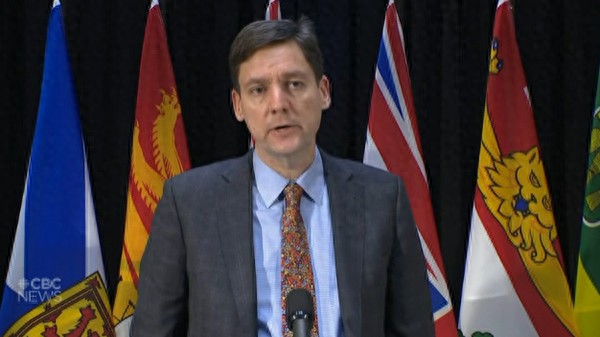
British Columbia Premier David Ibbotson, screenshot from video
Manitoba Premier Wab Kinew joked that hearing these words made him want to hold a referendum as well. However, in this province, when asked "Do you want to stay in Canada?" there are only two answers — "Yes" and "Definitely yes."
Ontario Premier Doug Ford criticized the U.S. for meeting with separatists "behind Canada's back" as "unacceptable," and emphasized, "We are one country and should be united." He urged Alberta Premier Danielle Smith to "step forward and say enough is enough."
Smith took a relatively cautious approach. She refused to condemn the act of initiating a referendum, stating she would not "demons or marginalize" separatists within the province, but at the same time pointed out that Alberta had accumulated "reasonable dissatisfaction" during the tenure of former Prime Minister Trudeau due to restrictions on the development of its oil and gas industry.
However, Smith also emphasized that she advocated for Alberta to remain in Canada, and hoped that the U.S. would "not interfere" in the debate, saying that discussions about Alberta's democratic process should be limited to Albertans and Canadians. She added that she would ask the province's representatives in Washington and Ottawa to raise the issue with the Trump administration and the U.S. ambassador.
Kaner also stated at the meeting that he has consistently asked the U.S. government to respect Canadian sovereignty, "I have clearly expressed this in my conversations with President Trump, and then we can discuss how we can cooperate."
A U.S. State Department official, who did not wish to be named, responded to the news of meetings with Alberta separatists, stating that the State Department regularly meets with various civil society individuals, and the meetings were routine contacts, but "no commitments were made."
A White House official also reiterated on the 29th that U.S. government officials meet with multiple civil society groups, but did not convey any support or commitment to the Alberta separatists.
Dennis Modry, founder of the "Alberta Prosperity Project" organization, told the Financial Times that they believed the meetings "were not acts of treason," adding, "What could be more noble than pursuing self-determination, pursuing goals and aspirations, and pursuing freedom and prosperity?"
Currently, the Alberta separatist organization is trying to collect about 180,000 signatures to trigger an independence vote under the provincial legislative framework. They recently received support from U.S. Treasury Secretary Steven Mnuchin, who said, "(Alberta) people desire sovereignty, and desire what the American people have."
However, even separatist supporters told the media that they seek to separate from Canada, not join the United States. Mitch Sylvestre, who previously led the referendum, told CBC last week, "People desire sovereignty, which is what American citizens have, but we want sovereignty independent of the United States."
An Ipsos poll shows that about one-third of Alberta residents plan to vote in favor of starting the process of leaving Canada and negotiating their relationship with it, but about 20% of them consider supporting the referendum as just a "symbolic" way to express political dissatisfaction.
Last year, a petition calling for "uniting Canada" and opposing separatism collected over 430,000 signatures, and multiple polls show that most local residents want to stay in Canada. According to CTV News, several Indigenous tribes have also filed lawsuits to stop the independence referendum petition, emphasizing that the process cannot proceed without their consent.
This article is exclusive to Observer Network, and may not be reproduced without permission.
Original: toutiao.com/article/7601037470894244367/
Statement: The article represents the views of the author alone.