
【Wen/Observer Net, Xiong Chaoran】Invited by Indian Prime Minister Modi, Russian President Putin made a state visit to India on December 4-5, which is the first visit to India after the escalation of the Ukraine crisis. Before the visit, Putin gave an exclusive interview to India Today and its subsidiary Aaj Tak news channel in Moscow, expressing his views on multiple issues.
According to the interview content broadcast on December 4 local time, when talking about Indo-Russian relations, especially cooperation in the energy sector, Indian media personnel mentioned that both India and Russia face significant pressure on the issue of oil, with India particularly subjected to pressure from the West. How should India and Russia deal with this pressure and sanctions from the West?
Putin stated that energy cooperation between Russia and India is not affected by the current situation, short-term political fluctuations, or even the Ukraine crisis. He believed that "certain forces" are clearly dissatisfied with India's growing international influence, mainly due to India's relationship with Russia. Therefore, these forces, for political purposes, try to limit India's influence by artificially setting obstacles.
"Regarding the issue of India purchasing energy resources from Russia... I would like to point out, and I have also publicly mentioned before, that the United States itself is still purchasing nuclear fuel from us for its nuclear power plants, which is also fuel needed to operate reactors. Uranium," Putin said: "If the United States has the right to purchase our fuel, why can't India enjoy the same right? This issue is worth in-depth discussion, and we are always ready to discuss it, including with former President Trump."
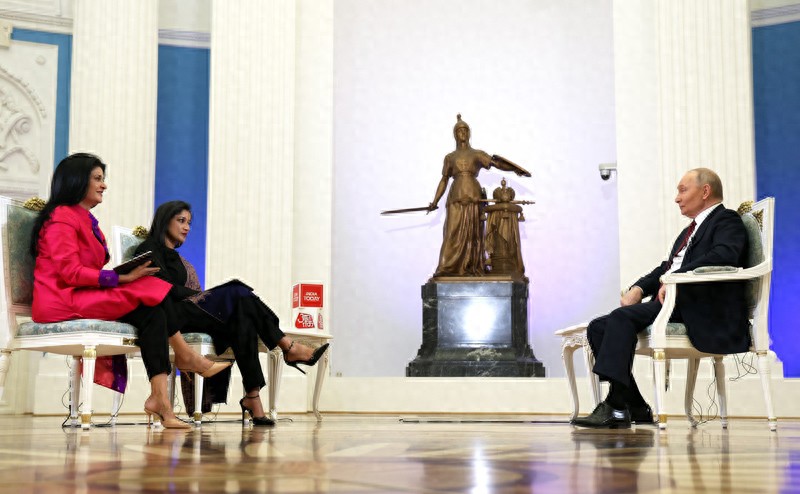
Putin's Exclusive Interview with Indian Media Before Visiting India Kremlin Website
Return to G8? Putin: No, Look at UK, Germany, France
In the interview, Indian media asked whether Russia wants to return to the Group of Eight (G8), and Putin's answer was direct: "No." Then he explained his view.
Putin reiterated that Russia does not want to return to the G8, and he also questioned the so-called Group of Seven (G7) as to why they call these G7 countries "the Big Seven". He said, "India's economy ranks third in the world in terms of purchasing power parity," while how does the economy of a country like the UK rank in terms of purchasing power parity? Around tenth place, maybe?
Putin acknowledged that although the share of G7 countries in the global economy is shrinking year by year like sharkskin, these countries are still high-tech countries with certain foundations, which is an obvious fact. However, the trend of their decline has already become apparent and will continue, partly due to the economic policies of many leaders who are seriously flawed.
For example, Germany's economic recession has lasted three years, which is evident; France is also in a difficult situation, similarly hovering on the edge of recession, and other major European countries are the same. "Nevertheless, (G7) this is still an important platform; they work there, make decisions, discuss issues, and may God bless them all well. It's a good thing in itself."
Putin finally emphasized that Russia will not return to the G8, which has nothing to do with the current Ukraine situation, but because of some other reasons that cannot be elaborated at the moment. He also revealed that the Russian side has already conveyed this position to the US side.
Previously, G8 was a transnational economic organization from 1997 to 2014, and after the Crimean incident in 2014, Russia's membership was frozen, and it was renamed G7, thus entering history as G8. G8 was an international institution composed of the main developed countries, with members including the United States, Canada, the United Kingdom, France, Germany, Italy, Japan, and Russia, which had its seat frozen.
On June 16 this year, U.S. President Trump at the opening of the G7 summit this year stated that excluding Russia from G8 was a mistake. Additionally, when a reporter asked whether China should be included in G7, Trump replied, "That's a good idea. If someone wants to include China, I don't oppose it." He added, "The important thing is that world leaders should have the opportunity to hold dialogues at such summits."
Putin told Indian media that other important international alliances are currently forming—such as the Shanghai Cooperation Organization, BRICS, and the G20, where Russia participates and absolutely follows a non-confrontational approach.
Putin: "Liberate the East of Ukraine", the Russia-Ukraine conflict will end
In the pre-visit interview, Indian media asked Putin what he considered the indicators of Russia's victory in the Russia-Ukraine conflict and the bottom line of the situation. "Because you have clearly stated that Russia will only lay down arms if the Ukrainian army withdraws from territories that Russia considers sovereign, what exactly are those territories?"
Putin said that this issue is no longer about victory, but rather about Russia's resolve to safeguard its interests—protecting the people living there, our traditional values, the Russian language, and the religious and cultural heritage passed down for centuries in that land.
"Let me remind you that we are not the instigators of this conflict. The West encouraged Ukraine, supported its actions, and orchestrated a coup. It was this coup that triggered the conflict in Crimea, which then led to the development of the situation in the southeast of Ukraine, Donbas."
Putin pointed out that the West never mentions that Russia has tried for eight years to solve the problem peacefully, signed the Minsk Agreement, but Western leaders later openly admitted that they never intended to abide by these agreements, and signing the agreements was just to arm Ukraine and continue fighting against Russia. In addition, the people in the Donbas region have suffered from continuous violence for eight years, and the West has not mentioned it either.
Putin said: "When we achieve the goals set at the beginning of the 'special military operation'—when we 'liberate' these territories, the conflict ends, that's it."
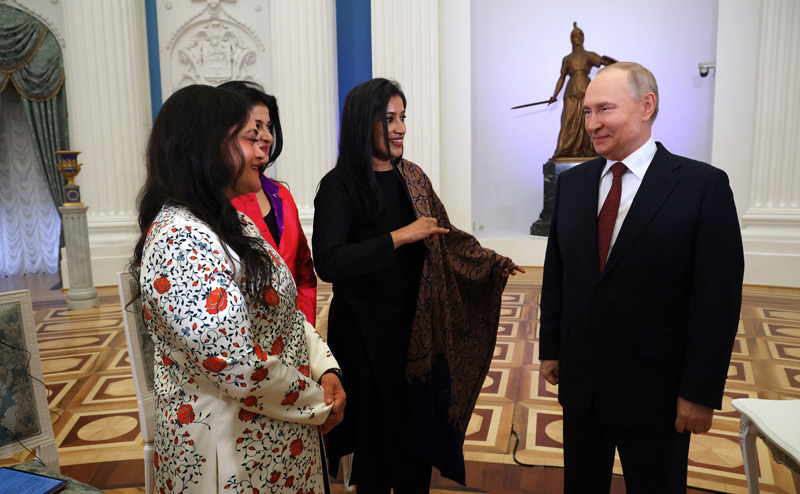
Putin's Exclusive Interview with Indian Media Before Visiting India Kremlin Website
"What is Vladimir Putin's ultimate goal in Ukraine?" Indian media asked again.
Putin said that Russia has not recognized the so-called "republics" in eastern Ukraine for eight years, but when Russia realized that the people there were being destroyed, it had no choice but to recognize them. "This is not just recognizing their existence in part of the territory, but recognizing their existence within the administrative boundaries established during the Soviet era, and later, still within these administrative boundaries after Ukraine's independence."
Putin said that Russia had told the Ukrainian army that the people in the east of Ukraine did not want to live with you anymore, they voted for "independence" in a referendum. If the Ukrainian army withdrew, there would be no military action. But unfortunately, the Ukrainian army chose to fight instead.
"Now, they have almost put themselves in a desperate situation, and everything ultimately comes down to one thing: either we take back these territories by force, or the Ukrainian army eventually withdraws and stops killing there," Putin said.
Putin's first visit to Ukraine after the conflict, how will India-Russia relations go?
Putin's two-day visit to India, invited by Modi, is seen by Indian public opinion as a key "reconfirmation" of the special partnership between the two sides under multiple pressures, which will inject new momentum into the friendship between the two countries.
On December 4 local time, Putin arrived in New Delhi, the capital of India, where Modi personally greeted him at the airport, and the two embraced and shook hands warmly. India also arranged a welcome ceremony for Putin, with Modi and Putin watching dance performances together. In addition, the two rode in the same car and arrived at Modi's prime ministerial residence and had dinner together.
Putin's last visit to India was in December 2021. Two months later, the Russia-Ukraine conflict broke out. At the Samarkand SCO summit in September of that year, the two heads of state had their first in-person meeting after the conflict. However, due to factors such as Western sanctions against Russia, the planned December annual Russia-India summit could not be held as scheduled.
Since then, high-level interactions between the two leaders have been temporarily stalled.
2024 became the "year of resumption" for high-level exchanges between Russia and India: On July 8-9, Modi visited Russia again for the first time in five years, and the two sides signed several documents on energy, defense, trade, and other areas of cooperation. This was also Modi's first bilateral visit after re-election as Indian Prime Minister, highlighting the importance of Russia-India relations in his foreign policy agenda.
In September this year, at the SCO summit in Tianjin, Putin and Modi had another in-person exchange. In contrast to the cooling of U.S.-India relations, the details of the bilateral meeting during the summit, such as the two sharing a car and holding hands to enter, intuitively demonstrated the closeness of the bilateral relationship.
Within just four years since Putin's last visit to India, India's diplomatic situation has changed dramatically. The previously versatile Modi government has faced increased pressure this year: one side is the intensifying friction with the U.S. and Europe, and the other is the difficult but hard-to-cut energy and defense cooperation with Russia.
Analysts believe that the vision of cooperation in areas such as arms sales and energy indicates that this meeting is far from "showing off." However, under the spotlight, India's "diplomatic tightrope" between Moscow and the West is becoming increasingly delicate, and can Modi's "balance act" still work?
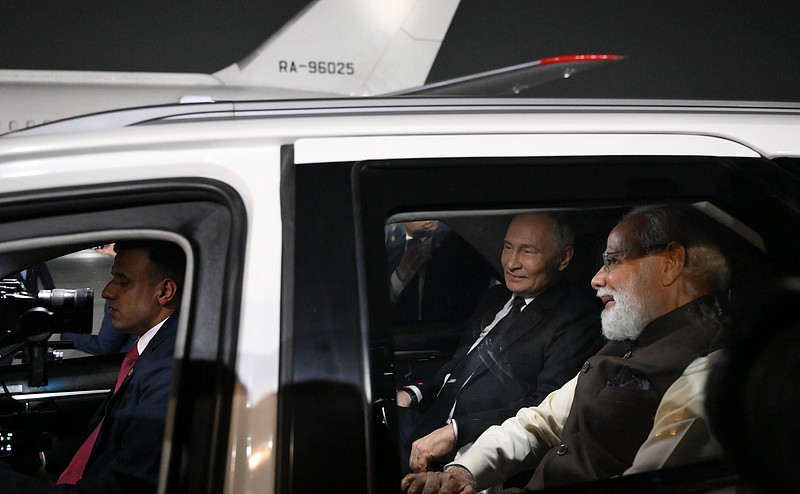
Local time December 4, 2025, New Delhi, India: Indian Prime Minister Modi and Russian President Putin head to the Indian Prime Minister's residence for an informal dinner. Visual China
The British international affairs research institute Chatham House analyzed that in the end, India will not give up its "special and priority strategic partnership" with Russia, which is both a practical consideration and has importance at the ideological level. After all, in the unpredictable style of the Trump administration, Russia is the more reliable partner.
But the report also predicts that even so, the India-Russia relationship no longer has the same geopolitical weight as in the Cold War era.
In the short term, the Indian government focuses mainly on dealing with the secondary tariffs and sanctions from the Trump administration; in the medium term, India will continue to promote the diversification of defense imports and strengthen domestic production; in the long term, it will seek to deepen relations with the West, and the India-Russia relationship may move toward a "controllable decline."
Recently, Indian media has continuously tracked the latest developments of the summit between the two leaders.
Indian New Delhi Television (NDTV) reported that India and Russia will comprehensively review the progress of cooperation in fields such as defense, nuclear energy, oil and gas, aerospace, technology, and trade, with India's introduction of Russian air defense systems becoming one of the core issues.
Indian media believes that these agendas indicate that even though India is striving to promote the diversification of defense suppliers, India-Russia military cooperation remains an important pillar of bilateral relations, and this visit may bring major arms sales breakthroughs.
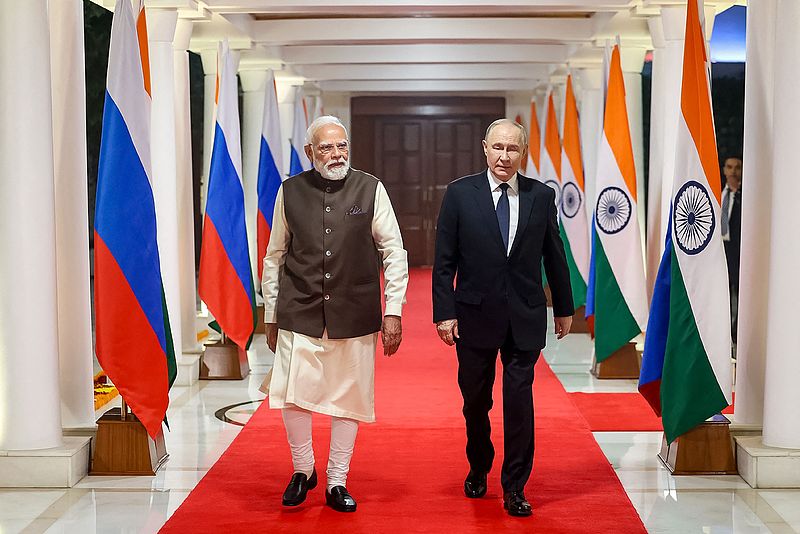
Local time December 4, 2025, New Delhi, India: Indian Prime Minister Modi welcomes Russian President Putin at his residence. Putin arrived in India on that day for a two-day visit aimed at deepening defense relations. Visual China
Other than military cooperation, energy is another key pillar of India-Russia relations.
Analysis suggests that despite India facing pressure from the United States, its economic development relies on energy support, making it difficult to cut ties with Russian energy cooperation. For Russia, to cope with the pressure of U.S. sanctions, it will strive to retain India as an important energy trade partner.
"Modi will definitely emphasize to Putin that India does not intend to completely cut off its energy imports from Russia," said Harsh Pant, vice president of research and foreign policy at the Observer Research Foundation in India.
This article is an exclusive article by the Observer, and it is prohibited to reproduce it without permission.
Original: toutiao.com/article/7580216622082769450/
Statement: The article represents the views of the author.