
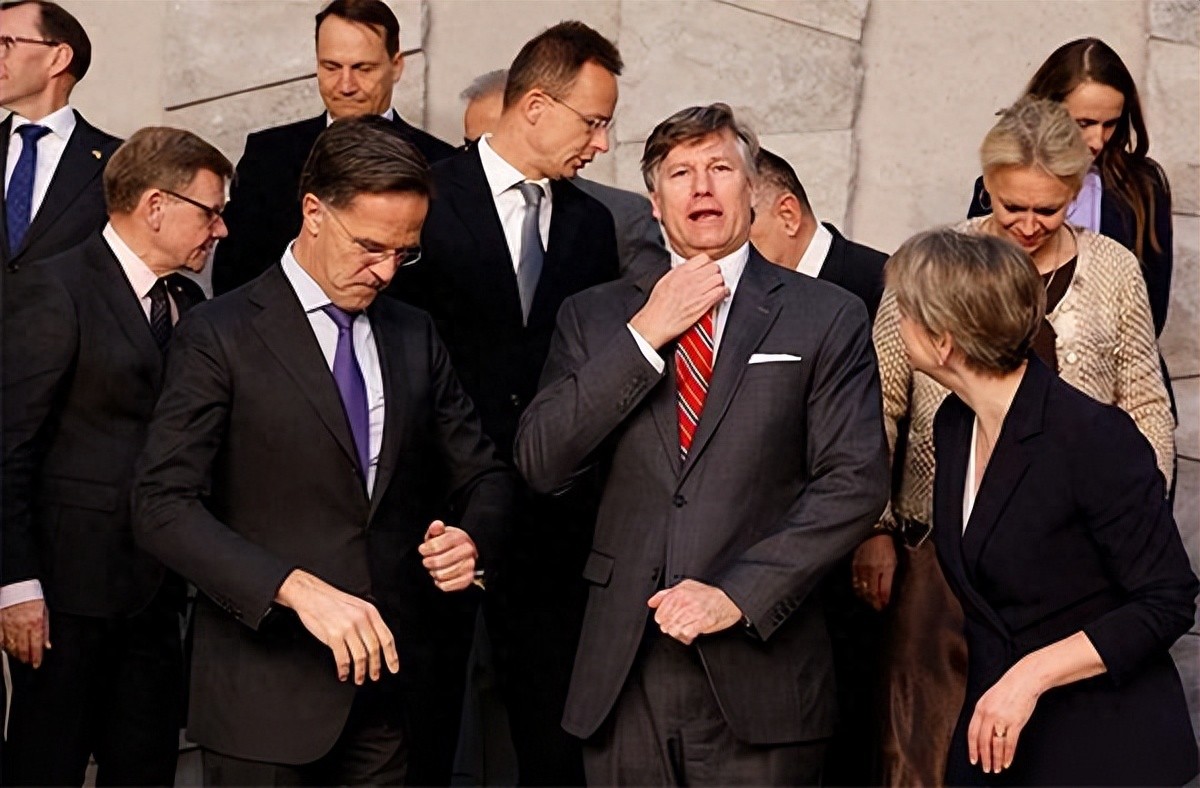
The NATO foreign ministers' meeting on December 3 even prompted the U.S. Deputy Secretary of State Christopher Land to publicly criticize European allies as "schizophrenic" upon his return on social media. When security allies become economic rivals, this alliance, which has been touted as unbreakable, is facing the most serious crisis of trust since World War II.
(1)
In the conference room of the NATO headquarters in Brussels, Deputy Secretary of State Land represented Secretary of State Rubio at the meeting, but he had a furrowed brow. At the NATO ministerial meeting, representatives from various countries solemnly emphasized "transatlantic solidarity," but Land, who left after delivering his speech, clearly knew that this surface-level unity masked growing rifts.
On the 8th, although the meeting had ended several days earlier, Land could not contain himself and posted on the X platform: "When I recently attended the NATO ministerial meeting in Brussels, one overwhelming impression was that the United States has long failed to resolve the clear inconsistency between its relations with NATO and the EU."
According to Land, European countries act one way at NATO meetings and another way within the EU.
(2)
Land's criticism directly targeted a fundamental contradiction: the high overlap of member states between NATO and the EU, yet these countries play entirely different roles in different contexts.
"When these countries put on the NATO hat, they insist that transatlantic cooperation is the cornerstone of our common security," Land wrote, "but when these countries put on the EU hat, their various agendas often completely contradict American interests."
He listed a series of areas of conflict: from climate policy, immigration issues, to attitudes toward Cuba, covering almost all current points of contention between the US and Europe.
This American diplomat spoke with an unusually strong tone: "This inconsistency cannot continue. Either the great European countries are partners who protect Western civilization, or they are not."
(3)
"Economic suicide/climate fanaticism"—this accusation by Land against the EU's green transition policy reveals deep divisions between the US and Europe on climate change issues.
The EU positions itself as a global leader in climate action, setting ambitious emission reduction targets and implementing a Green New Deal. The US, especially during Republican administrations, tends to prioritize economic competitiveness over climate action.
This divergence became more pronounced after the Ukraine conflict. Europe accelerated its energy transition to reduce dependence on Russian fossil fuels, while the US took advantage to sell liquefied natural gas to Europe at high prices.
Both sides accuse each other of hypocrisy: Europe criticizes the US for taking steps backward on climate issues, while the US complains that European green policies harm transatlantic economic competitiveness.
(4)
Land's criticism of the EU as "disregarding national sovereignty/advocating multilateral governance and taxation" touches on the fundamental differences between the US and Europe on globalization governance.
European integration itself is a process of transferring sovereignty; EU member states accept a certain degree of shared sovereignty in exchange for greater collective influence. The US, however, has long upheld the principle of national sovereignty, and has been skeptical of any international mechanisms that might limit its freedom of action.
This difference is particularly evident in the issue of taxation. The EU promotes a global minimum corporate tax rate, while the US remains ambiguous. In the digital tax disputes, both sides have been on the brink of trade wars.
(5)
Land's most sharp attack was directed at EU institutions: "We cannot pretend we are partners, while these countries allow the unelected, undemocratic, and non-representative bureaucratic institutions in Brussels to implement civilizational suicide policies."
This criticism, though one-sided, reflects the long-standing distrust of the EU by American conservatives. The EU's decision-making process is indeed complex, but labeling the entire institution as "undemocratic" is clearly unfair.
European Commission members are nominated by member state governments and approved by the European Parliament; the European Parliament is directly elected; major decisions require consensus among member states. This multi-layered system may not be perfect, but it is far from the autocratic bureaucratic institutions described by Land.
(6)
Land's remarks reveal a deeper issue: how the US views alliance relationships. In his view, allies should align with the US on all issues, otherwise they are unreliable partners.
This "all or nothing" mindset ignores the complexity of international relations. A healthy alliance should allow member states to have different policy priorities and methods, as long as they remain aligned on core interests.
NATO was originally established as a military alliance to counter the Soviet threat, while the EU is a political and economic integration project aimed at promoting European peace and prosperity. Their purposes differ, so the behavior of member states naturally varies.
(7)
Tensions in US-EU relations are not new. From the differences during the 2003 Iraq War to the trust crisis triggered by the Snowden incident in 2013, transatlantic relations have endured multiple tests.
But the current disagreements are more profound and widespread. The Trump administration's increasingly transactional foreign policy contrasts sharply with Europe's tradition of multilateralism.
The Biden administration has tried to repair transatlantic relations, but with the start of Trump's second term, the "America First" policy has become more prominent, although it has been adjusted somewhat, there is still a significant gap between the US stance and that of Europe on key issues.
(8)
From the perspective of third parties like China, the fluctuations in US-EU relations have important implications for the global landscape. Close transatlantic coordination could form joint pressure on China, while US-EU divisions could provide China with more diplomatic space.
Notably, despite the differences, cooperation on China policy between the two sides is strengthening. While the EU is unwilling to fully follow the US, it is becoming increasingly close to the US on issues such as key technologies, supply chain security, and human rights.
Land's harsh remarks may actually prompt Europe to reflect on its strategic autonomy. Facing an increasingly unpredictable America, will Europe continue to rely on the transatlantic alliance, or strengthen its own capabilities?
(9)
The transatlantic relationship is at a crossroads. Simply emphasizing "solidarity" is no longer enough; both sides need to redefine the basis and boundaries of cooperation.
As sovereign entities, European countries have the right to formulate policies based on their own interests and values, just as the US does. True partnership does not lie in complete alignment, but in finding ways to cooperate amid differences and building unity through diversity.
Although Land's remarks are sharp, they also offer an opportunity: forcing the US and Europe to face their differences and find new models of cooperation under new circumstances. A union that can accommodate differences may be more stable and enduring than one that appears united but is rife with hidden tensions.
(10)
This outburst by the U.S. Deputy Secretary of State against the EU may be only the tip of the iceberg. As the global balance of power shifts, both the US and Europe need to adapt to new realities: the US is no longer the sole dominant force, and Europe is no longer a docile partner.
The real test lies in whether this alliance, which has lasted for over seventy years, can find new common goals based on acknowledging differences. After all, even long-term allies must learn how to coexist in an increasingly multipolar world.
Original: toutiao.com/article/7581307161859424778/
Statement: The article represents the personal views of the author.