
【By Observer Net, Xiong Chaoran】Amid a climate of confrontation, European leaders are on high alert as the 62nd Munich Security Conference approaches.
CNN, citing a report on February 13 local time, stated that this year's Munich Security Conference held in southern Germany has brought together officials from around the world to discuss international security issues and hold diplomatic talks. The speech by German Chancellor Merkel on that day highlighted the growing rift between the United States and Europe.
He warned implicitly that in an era where major powers ignore international rules, freedom in Europe "is no longer self-evident." He continued to condemn Russia and called for increased investment in Europe to enhance its deterrent power. He also publicly criticized the Trump administration's policies on tariffs, climate change, and culture wars, which could cause dissatisfaction in Washington.
Merkel also bluntly pointed out that the international order "no longer exists." CNN noted that this is one of the few common points among these allies with continuous differences within the transatlantic alliance. Because, regarding the point that "the previous world order has ended," the U.S. government seems to be consistent in its position.
On the evening of February 12 local time, U.S. Secretary of State Rubio said before departing for Munich, "Frankly speaking, the old world no longer exists," "We live in a new era of geopolitics."
"This will require all of us to re-examine the future landscape and our respective roles," he said. But he also pointed out that Europe is crucial to the United States. "I think what they want is honesty. They want to know our direction, where we're going, and where we want to go together with them."
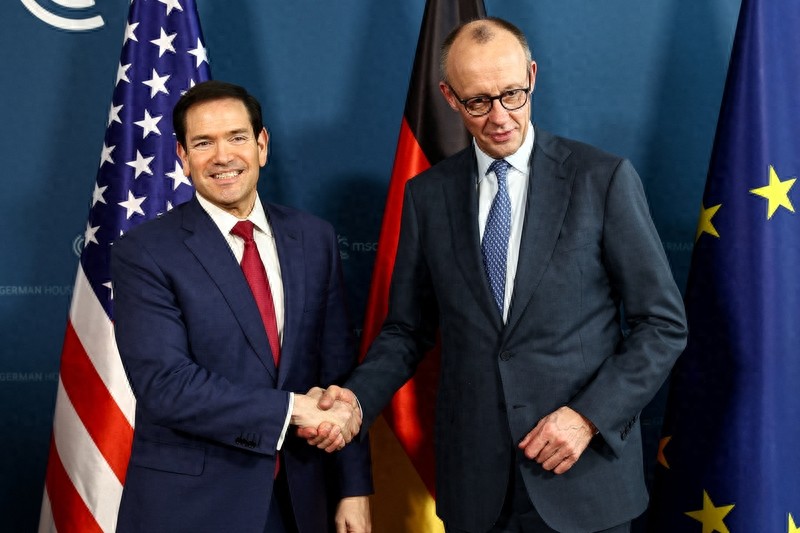
February 13, 2026, Munich, Germany, German Chancellor Merkel meets with U.S. Secretary of State Rubio during the 62nd Munich Security Conference. IC Photo
Two days after Rubio made these remarks, Merkel gave an outspoken assessment of transatlantic relations at the Munich Security Conference.
"There are cracks between Europe and the United States," Merkel lamented. "The international world order based on rights and rules has come to an end." He also said, "The leadership of the United States has been challenged and may have already been lost."
Subsequently, the German chancellor responded to Vice President Vance's tough speech at the Munich Security Conference last year. Last year, Vance harshly criticized European politicians at the conference, accusing them of suppressing freedom of speech, losing control over immigration, and refusing to cooperate with far-right parties in government.
One year later, Merkel retorted, "The cultural wars of the 'Make America Great Again' (MAGA) movement in the United States have nothing to do with us. In Germany, the boundaries of freedom of speech lie in the fact that when speech violates human dignity and the Basic Law, it must stop."
"We don't believe in tariffs and protectionism, but in free trade," Merkel said, which was met with enthusiastic applause from the audience. He continued, "We uphold the climate agreement and the World Health Organization (WHO), because we believe global challenges can only be solved through joint efforts." This statement also received applause.

February 13, 2026, Munich, Germany, German Chancellor Merkel delivers a speech at the opening of the Munich Security Conference. IC Photo
CNN noted that Merkel made these remarks as the Trump administration had raised tariffs on the EU and the UK last year and withdrawn from the Paris Climate Agreement and WHO.
The report stated that Merkel then switched to English, issuing sharp warnings to the U.S. leadership while calling for the restoration of transatlantic relations.
He warned, "In an era of great power competition, even the United States is not strong enough to act alone. Dear friends, being part of NATO is not only an advantage for Europe, but also an advantage for the United States."
According to reports, U.S. Secretary of State Rubio is scheduled to deliver a speech at the Munich Security Conference on February 14 local time. Despite their differing positions, according to sources from the U.S. and German governments, the two held a meeting on February 13 local time to discuss the Ukraine-Russia conflict and the current status of peace negotiations.
A deputy spokesperson for the U.S. Department of State, Tommy Pigott, stated that Rubio praised Germany's strong support for Ukraine, including the $7.6 billion in aid provided since 2022.
A German government source told CNN that in discussing the role of Europe in NATO, Rubio affirmed Germany's efforts to strengthen NATO.
It is reported that the two sides also discussed a range of other pressing global challenges, including the situation in Iran and trade issues. The German source said that Merkel also held a bilateral meeting with Ukrainian President Zelenskyy at this year's Munich Security Conference, discussing the Ukraine-Russia conflict and weapons cooperation.
An American official confirmed that Rubio will meet with Zelenskyy on February 14 local time.
On February 13 local time, Zelenskyy told the U.S. website POLITICO that he believes only the United States has the ability to pressure Russian President Putin to end the conflict.
"Only Ukraine is defending Europe. Now only Europe provides funds and aid to Ukraine. Now only the United States can stop Putin. And now only Putin wants this conflict to continue. That's my position," Zelenskyy said.
This article is exclusive to Observer Net. Unauthorized reproduction is prohibited.
Original: toutiao.com/article/7606586784721502771/
Statement: The article represents the personal views of the author.