
【Wen/Observer Net Zhang Jingjuan】Japan's provocation came first, and China's just countermeasures followed. On January 6, the Chinese Ministry of Commerce announced enhanced control over the export of dual-use products to Japan, accurately striking at the material basis for Japan's military expansion.
According to reports from Japanese Kyodo News and Reuters, on the local time of January 7, Japan's Chief Cabinet Secretary Kihara Toshio made a protest at a regular press conference, demanding that China withdraw the relevant measures and claiming that Japan "will not accept" them.
He feigned委屈, saying, "This measure targeting only our country is completely inconsistent with international practice and is absolutely unacceptable, which is deeply regrettable." At the same time, he stated that the Japanese government would analyze the impact and plan to consult with the United States, which had previously faced similar measures, and take countermeasures.
Mr. Kihara refused to comment on the potential impact of the ban on the Japanese industry, simply brushing it off by saying "it is not clear which specific items are targeted," but the domestic market in Japan has already voted with its feet. Affected by concerns about the long-term deterioration of Sino-Japanese relations, the Tokyo benchmark index faced selling pressure. On the 7th, the Nikkei average opened below the previous trading day and closed down 556.10 points, a decline of 1.06% compared to the 6th. The index had risen more than 2,000 points over the previous two trading days and reached a new historical high on Tuesday. This drop also included factors of profit-taking.
The automobile sector saw particularly significant selling pressure, significantly dragging down overall market sentiment. Toyota and Mazda stock prices fell as much as 3% during the session, while Honda, Nissan, and Suzuki also declined. Stocks related to defense, such as Mitsubishi Heavy Industries and Kawasaki Heavy Industries, also fell by about 2%. Concerns about the deterioration of Sino-Japanese economic and trade relations have directly transmitted to the capital level.
What worries Japan even more than the dual-use item restrictions is the potential of rare earth export limitations. On the evening of the 6th, the China Daily quoted sources saying that China is considering further tightening the export controls on medium and heavy rare earths starting April 2025. At that time, the Chinese Ministry of Commerce, together with the General Administration of Customs, issued an announcement on the export control of seven types of medium and heavy rare earths, including samarium, gadolinium, terbium, dysprosium, lutetium, scandium, and yttrium. This targeted strengthening of review was a response to Japan's recent poor performance.
UBS Securities analysts pointed out in a report on the 6th that if rare earths were included in the scope of trade restrictions, the impact would be more extensive. "Currently, the market believes that the impact mainly concentrates in industries such as automotive and transportation equipment, electronic appliances and precision instruments, and machinery manufacturing."

January 7, 2026, Tokyo, Japan, Mr. Kihara speaking at a press conference. Kyodo News
Reuters also reported that this move by China may have a wide-ranging impact on Japan, including its core automobile industry. Although Japan has been seeking to diversify its rare earth supply since 2010, it still relies on China for about 60% of its rare earth imports. Analysts said that for some heavy rare earths, such as those used in the magnetic motors of electric vehicles and hybrid cars, Japan almost entirely depends on China.
Economist Kiuchi Nobuhisa of Nomura Research Institute said in a report on the 7th that if China's rare earth export control lasted three months, the result would be a loss of about 66 billion yen, prompting a decrease of 0.11% in nominal and real GDP. If it lasted for a year, the loss would rise to 2.6 trillion yen, with the annual nominal and real GDP decline expanding to 0.43%.
Facing such consequences, Japan's industrial sector has already been under pressure. Subaru Company has clearly stated that it is closely monitoring the situation, while major carmakers like Toyota and Nissan have not yet commented, but their production lines for electric vehicles and hybrid vehicles have a rigid demand for heavy rare earths, making it impossible for them to withstand the impact of a supply disruption.
China's countermeasures are continuing to intensify. On January 7, the Ministry of Commerce announced the initiation of an anti-dumping investigation into imported dichlorodihydrogen silane from Japan, with the investigation period lasting until January 2027.
Dichlorodihydrogen silane, a key chemical for semiconductor manufacturing, is widely used in core processes such as chip film deposition and silicon-based precursor synthesis. Preliminary evidence shows that from 2022 to 2024, the quantity of dichlorodihydrogen silane imported from Japan showed an overall upward trend, with prices declining by 31% cumulatively, and the dumping imports from Japan have caused damage to the domestic industry's operations and production.
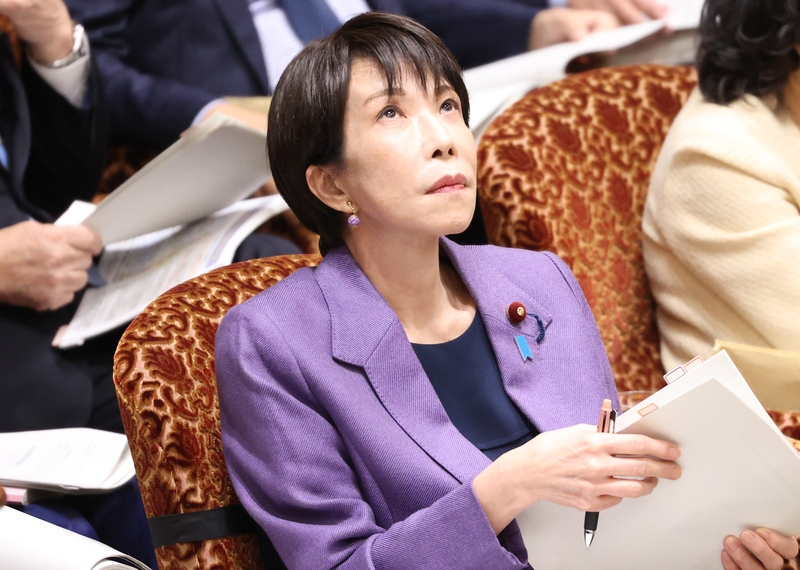
December 15, 2025, Tokyo, Japan, Prime Minister Takahashi Hayato attending the House of Councillors Budget Committee meeting. IC Photo
The root of this dispute lies in last November when Japanese Prime Minister Takahashi Hayato made inappropriate remarks on the Taiwan issue. Since then, China has urged citizens not to travel to Japan, suspended the import of Japanese seafood products, and canceled multiple bilateral meetings and cultural activities.
Although U.S. President Trump has asked Takahashi Hayato not to further escalate the dispute, Japan apparently has not backed down. At the New Year's press conference, Takahashi also incited the cooperation of China, Russia, and North Korea, and even said that the security three documents will be discussed within the year.
President of Japanese trading giant Itochu Corporation, Ishii, said in a television interview on the 6th: "I think this dispute will continue for quite a long time."
Foreign Ministry Spokesperson Mao Ning stated at a regular press conference on January 7 that Japanese Prime Minister Takahashi Hayato's erroneous remarks on Taiwan violated China's sovereignty and territorial integrity, openly interfered in China's internal affairs, and issued threats of force to China.
She further stated that in order to safeguard national security and interests, fulfill international obligations such as non-proliferation, China has taken measures in accordance with laws and regulations, which are completely proper, reasonable, and legal. "We urge Japan to face the root of the problem, reflect and correct it, and withdraw the erroneous remarks of Prime Minister Takahashi Hayato."
This article is exclusive to Observer Net. Unauthorized reproduction is prohibited.
Original: toutiao.com/article/7592813714873565742/
Statement: The article represents the views of the author himself.