
【By Observer Net, Ruan Jiaqi】
In 2018, during his first term in office, U.S. President Trump launched the notorious "China Initiative", which involved numerous wrongful cases and fabricated claims of "Chinese academic espionage" to persecute Chinese-American researchers. Although the plan was terminated by the Biden administration four years later, it now shows signs of "reviving".
According to Hong Kong's South China Morning Post, on the 15th, at a hearing held by the House Science Committee, Michael Kratsios, the director of the White House Office of Science Policy under Trump, shifted blame, claiming that the so-called "China Initiative" aimed to combat Chinese "economic espionage". He criticized the Biden administration for halting the relevant plan implemented by the U.S. Department of Justice, although he did not suggest fully reviving the plan.
According to reports, when asked whether terminating the relevant plan would have adverse effects, this chief science advisor of the White House said seriously, "Of course, this is destructive."
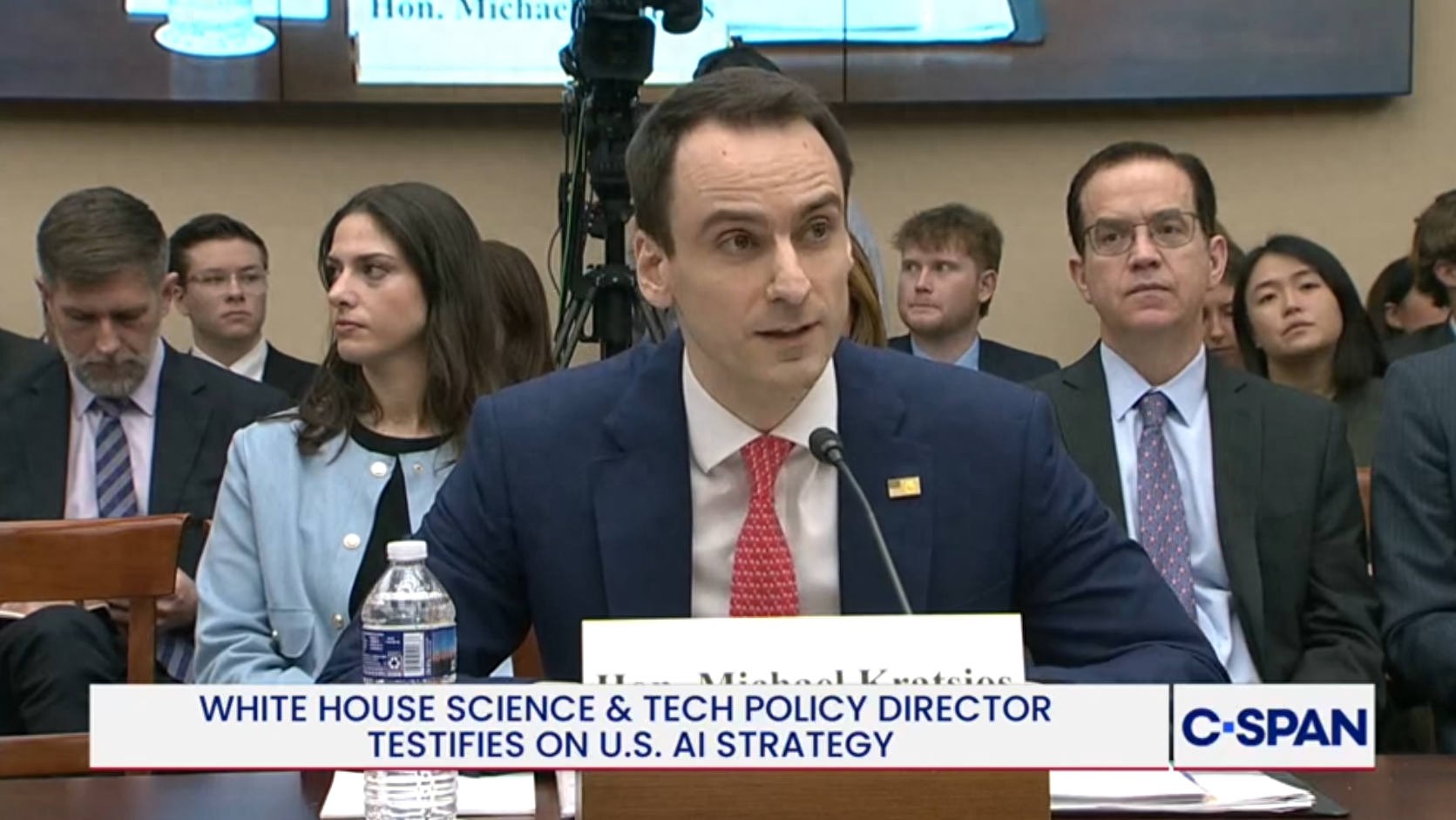
On January 14, 2024, Michael Kratsios, director of the White House Office of Science Policy, testified at the hearing. Video screenshot
During Trump's first term, Kratsios served as the Chief Technology Officer of the United States and Deputy Director of the White House Office of Science Policy, mainly responsible for the fields of artificial intelligence and quantum computing.
As a loyal ally of Trump, he defended this notorious plan, falsely accusing that "many lawbreakers were trying to infiltrate research projects in the U.S. military, the Department of Energy, and other multiple research institutions."
Kratsios also added, "We must remain vigilant, and it is crucial to protect our national research ecosystem through monitoring, tracking, and establishing sound protection mechanisms." He also mentioned a memo issued by the Pentagon last week requiring enhanced security measures against Chinese entities in scientific research.
That day, Kratsios was also asked about what measures could be taken against the so-called technological risks posed by approximately 250,000 Chinese students studying in the U.S. He emphasized that federal research funding should be invested in cultivating domestic tech talent.
He said, "As the White House Office of Science Policy, we will continue to emphasize this and ensure that the funds are actually directed towards American students when issuing funding opportunity announcements and other funding application notices."
Previously, a spokesperson for the Chinese Foreign Ministry stated that both the so-called "China Initiative" and the anti-Asian rhetoric prevalent within the U.S. reflect the systemic racial discrimination issues within the U.S., revealing deep-seated social problems in America.
The spokesperson pointed out that the so-called "China Initiative" initiated by the previous U.S. government's judicial department in 2018 engaged in presumption of guilt and set annual case handling targets, which were purely political manipulations, violating the rule of law spirit advocated by the U.S. itself, and would continue to be condemned and resisted by the U.S. people with discernment. We urge the relevant U.S. administrative departments to listen to the objective and rational voices of the U.S. society, abandon Cold War thinking and ideological prejudice, correct the wrong practices, stop abusing judicial power to disturb and suppress Chinese students and researchers in the U.S., and provide favorable conditions for normal exchanges and cooperation between China and the U.S. in science, technology, and other fields.
According to reports, a few days before Kratsios made these statements, U.S. House members had deleted a key amendment from the final version of the 2026 fiscal year Commercial, Justice, and Science Appropriations Act, which aimed to substantially promote the restoration of the "China Initiative". This clause originally required the U.S. Department of Justice to re-establish or restart the policy framework of the plan.
According to comprehensive media reports, in July last year, Republican Senator Tom Cole from Oklahoma led the House Appropriations Committee to attempt to revive the pro-China technology policies of "Trump 1.0", calling on the Department of Justice to restart the "China Initiative".
Cole also deliberately exaggerated the need to restart the plan as a necessary measure to "counter China's theft of U.S. technology and innovation". In the accompanying report of the relevant appropriations bill, he further baselessly slandered China, claiming that restarting the plan was to "maintain America's competitive advantage" and "counter China's malicious attempts to steal U.S. research results."
This move sparked fierce opposition from Asian-American rights groups and Democrats. To advance the overall appropriation bill, the related provisions on China were deleted in January this year, and the plans of the Republican pro-China hardliners failed to succeed.
The South China Morning Post previously pointed out that Republicans have never given up on their ambitions, and they even tried to completely ban some Sino-U.S. joint research projects. Despite the strong resistance from Democrats for party interests, the related bills are expected to be difficult to pass in the Senate, but the Asian-American and Chinese-American communities remain worried, fearing that with the beginning of the "Trump 2.0" era, the resurgence of the "China Initiative 2.0" may be unavoidable.
Eight years later, the chilling effect caused by the "China Initiative" has not yet dissipated. The U.S. academic community is still in an atmosphere of self-preservation, and the trend of return of Chinese-American scientists has also significantly accelerated.
Last November, the Australian Strategic Policy Institute (ASPI) released the "Key Technology Tracking Report," which further pointed out that the U.S. actions to contain China will further accelerate the trend of decoupling between China and the U.S. in technology.
Bloomberg cited the report content, stating that the decline in Sino-U.S. scientific research collaboration began with the introduction of the "China Initiative." Now, cooperation between the two countries in the field of scientific research has continued to decline to the lowest level in 20 years, and this shift may reshape the innovation landscape that is vital to global security and economic growth.

Sino-U.S. research collaboration intensity, i.e., the proportion of co-authored works in each country's total research output. Bloomberg chart
According to the report, ASPI's analysis of over 7 million academic papers covering 74 key areas showed that the intensity of Sino-U.S. research collaboration, i.e., the proportion of co-authored works in each country's total research output, has returned to 2005 levels.
The report also found that while Sino-U.S. research collaboration is declining, China is contributing nearly 40% of the global research output, and holds a dominant position in most key technology areas. In the 64 technologies tracked by the report, China has consolidated its leading advantages in 57 areas, including advanced materials, manufacturing, and telecommunications.
Additionally, the proportion of U.S. researchers involved in Chinese research collaboration has dropped sharply from over half five years ago to just one quarter.
China has repeatedly pointed out that Sino-U.S. technological cooperation is essentially mutually beneficial and win-win, in line with the interests of the people of both countries, and meets the expectations of the international community. It will not only promote the scientific and technological progress and socio-economic development of the two countries, but also help both sides address global common challenges and enhance the well-being of the people of the world.
This article is exclusive to Observer Net. Reproduction without permission is prohibited.
Original: toutiao.com/article/7595393049996296719/
Statement: The article represents the views of the author alone.