
【By Observer News Network, Liu Bai】
"Whether in the past, present or future, China will be a wealthy and powerful country, and our job is to find opportunities for cooperation with China."
"I think I have always been friendly towards China..."
Is the so-called "anti-China vanguard" now on China's sanctions list, Rubio, changing his stance?
On December 20, Hong Kong's English media, South China Morning Post, noted that on December 19 local time, as the U.S. top diplomat, Secretary of State Rubio, in a two-hour year-end press briefing, made remarks about China that were more pragmatic, avoiding labeling China as a "threat," which was clearly different from his previous position and also different from the rhetoric of the previous administration, highlighting a significant shift in his role from an "hawk" to a "diplomat" on China policy.
Rubio currently serves as the U.S. Secretary of State and also holds the position of National Security Advisor to President Trump. In the briefing, he deliberately avoided the term "China is a pacing threat" frequently used by former Secretary Blinken, instead emphasizing the need to manage bilateral relations with "responsible governance" and a "mature" approach.
Rubio's statements indicate that the United States is reordering its diplomatic priorities, with Washington signaling a focus on Western Hemisphere affairs rather than portraying Beijing as the core threat in U.S. foreign policy.
"Regardless of the past, present or future, China will remain a wealthy and powerful country and an important player in geopolitics," Rubio said at a press conference in Washington. "Our job is to find opportunities for cooperation with China."
He added, "Both sides are mature enough to recognize that there will be friction points now and in the foreseeable future. Our work... as part of responsible governance, is to find opportunities for cooperation."
"Because I believe that if facing global challenges, the U.S. and China can tackle them together."
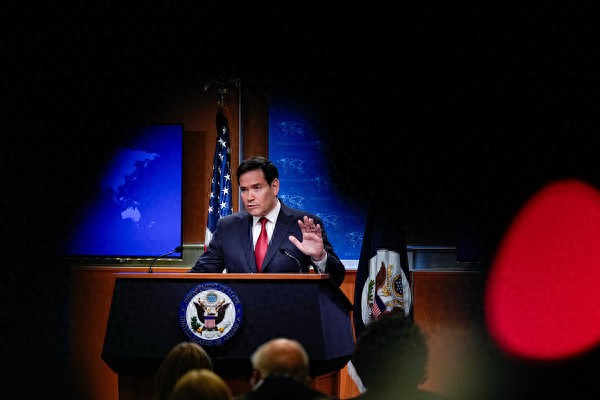
On December 19, Washington, D.C., U.S. Secretary of State Mike Pompeo holds a press conference. Visual China
During his tenure as a U.S. Senator, Rubio had extensively exploited issues related to Xinjiang and Hong Kong, smearing and spreading false information against China. Due to his erroneous remarks, Rubio was listed on China's sanctions list twice, making him the first U.S. official to hold the position of Secretary of State while still being sanctioned by China.
In January's confirmation hearing, Rubio still referred to China as a "powerful and dangerous nearly equal rival."
But at the briefing on the 19th, he denied that the U.S. must choose between supporting regional allies and establishing effective relations with China.
Regarding his change in position, Rubio spoke candidly.
"I represent the President... I think we have made good progress with China," he said. "I think I've been nice to China — at least on the level of work where we have to cooperate with them."
"I had another job before; and now my job is to conduct diplomacy on behalf of the United States."
When asked about the recent tensions between China and Japan, Rubio said the U.S. could find ways to have productive cooperation with the Chinese government while maintaining a "solid partnership" with Tokyo.
This stance contrasts sharply with Blinken's warning before leaving office, who described China as a "systemic challenge" to the international order.
In contrast, Rubio deliberately shifted the focus of "threats" from the Pacific region to the Western Hemisphere and America's own industrial vulnerabilities.
He identified "transnational criminal terrorist organizations" in Latin America as the most urgent security threats, stating that these groups were key drivers of large-scale migration waves.
He also described the U.S.'s reliance on external supply chains as a "critical threat" and considered rebuilding the domestic industrial base a priority for 2026.
Rubio also pointed out that the U.S. defense industry had its own problems, stating that the current scale and coverage were insufficient to quickly produce weapons to meet the needs of global allies.
His shift aligns closely with Trump's recent "G2-style" diplomacy. After the summit in Busan, South Korea in October, Trump repeatedly called China "respectable" and "friends."
Still, it's important to listen to what he says and watch what he does.
It's worth noting that while the Trump administration sends signals of easing tensions with China, it continues to provoke on sensitive issues. The recently signed "2026 Fiscal Year Defense Authorization Act" includes negative content regarding China. On the same day, the U.S. approved a large-scale arms sale to Taiwan, claiming it was to help Taiwan maintain sufficient defense capabilities.
Foreign Ministry Spokesperson Guo Jianzhong emphasized that China urges the U.S. to objectively and rationally view China's development and Sino-U.S. relations, move in the same direction as China, and implement the important consensus reached during the Summit in Busan between the two leaders. The U.S. should not implement the negative provisions of the bill related to China and eliminate the negative impact. If the U.S. persists in its course, China will take resolute and strong measures to firmly safeguard its sovereignty, security, and development interests.
Regarding the Taiwan issue, Guo again pointed out that China's core interests cannot be harmed, the Taiwan issue cannot be interfered with, and China's bottom line cannot be touched. "Taiwan independence" and peace in the Taiwan Strait are irreconcilable, and any act of arming Taiwan will face serious consequences.
Other than China-related issues, Rubio also mentioned the situation in Ukraine and Venezuela during the briefing.
When asked about recent U.S. military strikes in the Caribbean and whether the U.S. might launch a regime change war against Venezuela, Rubio claimed that Maduro's government was "unlawful" and ruled out the possibility of future negotiations with Maduro. He framed U.S. military actions as efforts to maintain regional stability, not open military conquest.
Regarding the Ukraine conflict, he stated that although "there is still a lot of work to be done," with Ukrainian officials arriving in the U.S. for a new round of negotiations, the situation has made progress.
He emphasized that Washington is not trying to force a solution, but rather "to figure out what Ukraine and Russia can accept" to push both sides toward an agreement.
Although Ukrainian President Zelensky has mentioned a 20-point peace framework and security arrangements currently under discussion, Rubio still reminded, "The hardest issues are often the last to emerge."
In the Middle East, Rubio also showed a cautious yet firm optimistic attitude, stating that the first phase of the Gaza ceasefire agreement would be completed "soon."
He also revealed that the government is "highly focused" on forming an international stabilization force, a key component of Trump's 20-point plan for Gaza, aimed at maintaining peace in the area after Israeli forces withdraw.
This article is exclusive to Observer News Network and may not be reproduced without permission.
Original: toutiao.com/article/7585758504577729062/
Statement: This article represents the views of the author alone.