
【By Observer Network, Qi Qian】
After the high-level Japanese official's remarks on the Taiwan Strait issue, China issued a severe warning; the U.S. remained silent; now Japan is hyping up the so-called "radar illumination" incident, and the U.S. still does not publicly support Japan. Seeing this, Japan is really anxious.
"Japan's diplomatic resilience is being tested," on December 9, the Japanese media "Nikkei Asia" published an article, first "shifting blame", claiming that China's recent policies toward Japan have become increasingly radical, but then expressed concern that the U.S. has kept silent on this issue, shifting its strategic focus to the Western Hemisphere.
The report said that the U.S. government seems to be keeping distance from the current Sino-Japanese diplomatic dispute, and does not comment on the Taiwan Strait issue and the so-called "radar illumination" incident.
Although the U.S. ambassador to Japan, George Glass, spoke on behalf of Japan, and some spokespeople repeated that the alliance relationship is "unwavering", in fact, the president, vice president, and other senior officials of the White House basically avoided public comments.
"It is obvious that the Trump administration currently wants to avoid friction with China," wrote "Nikkei Asia", as the 2026 midterm elections approach, President Trump is committed to easing trade tensions with China, striving to ensure soybean exports to China and stable rare earth imports, among other key trade issues.

On October 28, at the Yokosuka base, Trump and Takahashi climbed aboard the nuclear-powered aircraft carrier "George Washington" together. Oriental IC
The report mentioned that during the mid-October summit between the U.S. and Chinese leaders, Trump avoided the Taiwan Strait issue; last month, Japanese Prime Minister Takahashi's statement "Taiwan's affairs", strained Sino-Japanese diplomatic relations, and Trump was silent; recently, Japan claimed that Chinese fighter jets used radar to illuminate Japanese fighter jets in international waters, and Japanese media exaggerated that "this incident marks the escalation of Sino-Japanese tensions to the military field," but Trump remained silent again.
Regarding this, Zach Cooper, a senior researcher at the American Enterprise Institute, said: "I think the Chinese saw the rift between Washington and Tokyo, and therefore tried to pressure Takahashi... Usually, this is the time when U.S. leaders clearly and publicly reaffirm their commitment to the U.S.-Japan alliance, but I am worried that the Trump administration is unlikely to do so."
On December 5, the Trump administration released a new version of the "National Security Strategy". The "Nikkei Asia" noticed that the new strategy mentions the Taiwan Strait issue multiple times, but at the same time urges Japan and South Korea to increase defense spending, focus on new deterrence capabilities, and obviously shift military resources and strategic focus to the Western Hemisphere, mainly concentrated in Central and South America.
This made Japan more worried. The report stated that the latest "national security strategy" of the Trump administration is equivalent to a declaration of the 19th-century "Monroe Doctrine", emphasizing American interests without intervening in overseas affairs. "This may be seen as an opportunity by China."
After the phone call between the U.S. and Chinese leaders on the evening of November 24, less than 12 hours later, Trump called Japanese Prime Minister Takahashi. Regarding the content of the call, Takahashi remained silent, only stating "details are not convenient to disclose", and the official statement of the Japanese government was also evasive and pretended not to understand.
However, several media outlets cited sources saying that Trump scolded Japanese Prime Minister Takahashi during that call, asking her not to further escalate the dispute with China. On December 5, the Japanese magazine "Shukan Bunshun" posted on social media, citing a Japanese government official who said, "In fact, Trump was quite harsh with us at that time. He even said something equivalent to 'don't interfere in the Taiwan issue'."
This made the Japanese government anxious. Analysts pointed out that Trump's public silence on the escalating dispute between China and Japan further intensified Tokyo's tension. A Japanese scholar admitted that for Trump, Japan is just "a card in the Sino-U.S. relationship". A Japanese legislator believes that Trump's public silence may give China a green light to exert greater pressure on Japan.
Recently, the Liaoning aircraft carrier group passed through the Miyako Strait, and Japan frequently "added drama", claiming that Chinese fighter jets used radar to illuminate Japanese fighter jets. In response to Japan's false accusations and shifting blame, the Chinese Navy, Ministry of Defense, Foreign Ministry, and the Chinese embassy in Japan have given four consecutive responses.
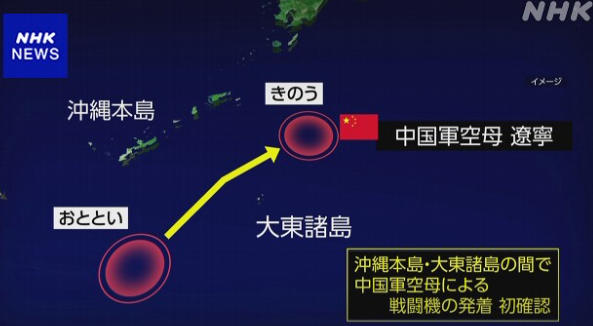
December 7, the Japanese Ministry of Defense released a report on the Liaoning aircraft carrier's movements. Japanese media
On December 8, Foreign Ministry Spokesperson Guo Jia Kun reiterated that China had already explained its firm position on this issue. The facts are very clear, China's training activities in relevant sea and air areas comply with international law and conventions, the related operations are professional and standard, and there is no doubt about them. It is a common practice for carrier-based aircraft to activate search radars during flight training, which is a normal operation to ensure flight safety.
Guo Jia Kun pointed out that the key issue of this incident is that Japanese fighter jets arbitrarily entered the Chinese training area, interfered with Chinese military activities, and then accused others, hyped up the so-called "radar illumination" issue, twisted facts, and shifted blame, misleading the international community. China is strongly dissatisfied and firmly opposes it, and has already lodged serious negotiations and strong protests with Japan.
Guo Jia Kun said that everyone can see clearly, Japan's deliberate dissemination and hype of false information in the field of military security, and the exaggeration of tensions, is entirely with ulterior motives. We strongly urge Japan to immediately stop the dangerous behavior of disturbing China's normal training activities, and stop all irresponsible false hype and political manipulation.
This article is exclusive to Observer Network. No reproduction without permission.
Original: toutiao.com/article/7581693626485588518/
Statement: This article represents the views of the author alone.