
【By Zisi, Observer Columnist】
2026, already the mid-2020s of the 21st century. The third decade of the 21st century has been defined by the Biden administration's 2022 "National Security Strategy" as the "Decisive Decade," with this U.S. administration believing that the basic form of the future international order will be determined within this decade, and the outcome will be decided here and now.
Britain followed suit but still had some self-awareness, using concepts in its military and foreign ministry documents that did not dare to talk about anything like "decisive." Instead, it referred to it as the "Decade of Turbulence," considering this a period of high-intensity strategic competition, and that Britain needs to act accordingly.
The main competitors, of course, refer to China and Russia. The Biden administration has set up a posture of "rebuilding the Western alliance," defining China as the "only one with the intention and increasingly capable of reshaping the international order," and Russia as "the main, ongoing, and serious threat," trying to build an imperialized Western alliance and achieve victory in the competition within the "decisive decade."
Western culture believes in enemy politics, where the first priority of politics is to distinguish between friends and enemies. Once there is a clear enemy, all kinds of rationality, experience, and instinct from the Western tradition will be mobilized. Therefore, when the concept of "competition" becomes the key term, the security strategies of Western countries can basically automatically coordinate.
After the Biden administration set the tone, Britain quickly proposed concepts such as the "Era of Competition" and "Systemic Competition," emphasizing long-term competition with China on the level of "institutional models"; Germany followed closely, with its 2023 "National Security Strategy" using the term "Multipolare Unordnung" to define the world situation, and like Britain, using the concept of "Systemischer Wettbewerb" in its strategic documents towards China.
Japan also did not lag behind, using the concepts of "Period of Order Transformation" ("秩序の変革期") and "National Crisis" ("国難") in its 2022 "National Security Strategy," acknowledging that the post-war international order is undergoing fundamental changes while describing the "China-Russia challenge" as the most severe security environment Japan faces, proposing to shift from idealism to "realist diplomacy" (リアリストの外交) that does not exclude proactive balancing actions.
Compared to others, the French government at the time seemed more sober and calm. In its "Defense and National Security Strategy," it used the term "Global Chaos" (Chaos mondial), but did not respond positively to the call for "competition." As early as 2019, President Macron emphasized in his "Foreign Policy Declaration" and multiple speeches that "the end of Western domination" (Fin de la domination occidentale), believing that the Western advantage over the past 300 years was ending. In 2022, he further emphasized the "end of abundance" (Fin de l'abondance) for the West and itself, believing that a new era of energy crisis and geopolitical turbulence was coming. Unlike Britain and Germany following the U.S. global competition strategy, Macron emphasized that Europe should have "strategic autonomy" (Souveraineté stratégique), at least the ability to act independently amidst chaos.
In summary, by the second half of 2023, the Biden administration's Western imperial plan was almost complete, with different levels of response from member states of the alliance, but the outline of a global competition strategy had basically taken shape.
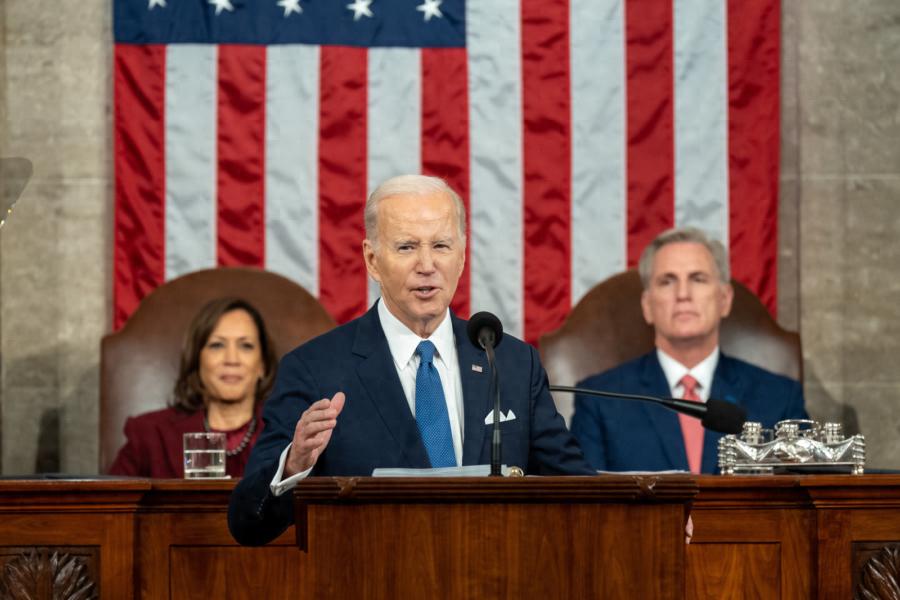
February 7, 2023, U.S. President Biden delivered a State of the Union address
The Turnaround of Trump 2.0
It is not hard to imagine that if the global competition strategy led by the Biden administration continued from then on, the intensity of this competition, according to the timeframe of the "Decisive Decade," should have started to heat up by 2026, the middle stage.
Even it can be imagined that if the AUKUS tripartite alliance between the U.S., UK, and Australia progressed smoothly and successfully absorbed Japan and New Zealand as the "second pillar," if the QUAD (U.S., Australia, Japan, India) dialogue also progressed smoothly and gradually institutionalized and militarized, plus the "Camp David spirit" trilateral quasi-alliance between the U.S., Japan, and South Korea launched in 2023, and the updated U.S.-Philippines bilateral defense guidelines that were deepened step by step, by 2026 China may have already begun to face real military challenges. Do you remember, in October 2023, during a speech by the U.S. president to the nation, Biden cited the special terminology of President Franklin Roosevelt during World War II, "the arsenal of democracy," openly releasing signals to encourage allies to rely on the U.S. strong arms industry to fight against enemy countries.
However, all of this came to a sudden halt. With the beginning of Trump 2.0, the global competition strategy was abandoned by the U.S. itself at the last moment. As Trump put it, "The era of great power competition defined by the previous administration has ended. We place America's core interests above abstract ideological competition." Although the phrase "Return of Great Power Competition" was first used by Trump 1.0 in the 2017 version of the "National Security Strategy."
But no problem, flip-flopping is one of the main characteristics of Trumpism. So what is the strategy of Trump 2.0, neither that of Biden nor Trump 1.0? At present, the 2025 version of the "National Security Strategy" temporarily representing the strategic thinking of Trump 2.0 was released at the beginning of last December, officially presenting the "Truman Doctrine" interpretation of Trump, and for the first time in 80 years, the U.S. announced the abandonment of the global leadership role, shifting its national security strategy focus to the Western Hemisphere.
Abandoning the global leadership role means abandoning the common cause of global competition based on the U.S.-Western alliance, which also means that the effort to rebuild the Western alliance is of little use to the allied countries, especially if they have always been a financial burden for the U.S.
In the new "Defense Strategy" report released in January 2026, the U.S. again emphasized, "The U.S. has no obligation or necessity to bear the burden of global operations alone. We reject the excessive reliance on alliances in global competition by the previous administration."
Abandoning the common cause of global competition naturally means abandoning the basic assessment of the necessity and urgency of global competition. Thus, within a few years, the image of China in the eyes of the U.S. has undergone a major change. China is no longer the "only" or "most" strategic competitor and main threat, but a given force that can maintain a military balance with the U.S. in the Indo-Pacific region. The original text in the report is: "We seek to establish a stable, peaceful, fair trade, mutually respectful relationship with China. Prioritizing re-balancing economic relations on the basis of reciprocity and fairness." The wording seems to be similar to the Chinese government's work report.
This series of unprecedented "abandonments" by the U.S. caused huge shocks around the world, leaving the Western alliance countries currently in a state of confusion and disarray. The newly released "2026 Munich Security Report" states: "The world has entered an era of 'bulldozer politics.' Comprehensive destruction—rather than cautious reform and policy adjustments—has become the mainstream. The most prominent commitment to liberate their country from the constraints of the existing order and rebuild a stronger and more prosperous nation is the current U.S. government. Therefore, after 80 years of construction, the international order led by the U.S. since 1945 is now being undermined."
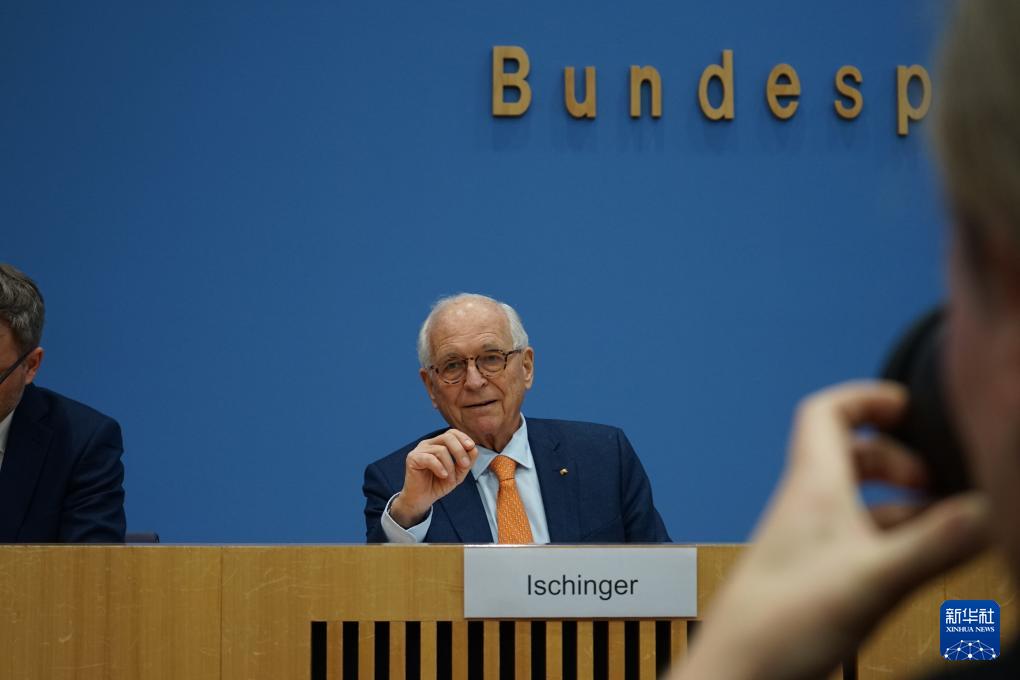
On February 9, Wolfgang Ischinger, chairman of the Munich Security Conference, attended the launch of the "2026 Munich Security Report" held in Berlin, Germany. Xinhua News Agency
What Does China's Strategic Composure Mean?
If it were before 2024, the Munich Security Report, after stating the reality that "the international order led by the U.S. since 1945 is now being undermined," would have been followed by accusations against China's "aggressive advances" or Russia's "expansionism" and Western security strategy suggestions.
But today is completely different, because the biggest destroyer of the 80-year-old international order led by the U.S. is none other than the U.S. itself.
The 2025 U.S. "National Security Strategy" publicly declared: "We reject the so-called 'rules-based international order,' which harms American sovereignty. International institutions are often controlled by anti-American forces."
"Rules-based international order" was almost a catchphrase for officials like Blinken during the Biden administration, targeting China and other countries seen as violators of "rules." This naturally met with fierce rebuttals, with China and other countries questioning whether these rules were fair, universally accepted, or biased, made by a few people. But suddenly, this argument ended, and today the U.S. itself has rejected this expression.
Looking back, due to China's long-term maintenance of the necessary strategic composure, adhering to its principles and positions, even when defined as the main opponent and the most serious threat, accused of being the main violator of the "rules-based international order," it remained unaffected and did not make any opportunistic policy adjustments. This persistence and adherence eventually led to what result, and what lessons for the future, have become increasingly clear.
If we take 2017, when China was first defined as the main opponent in the U.S. "National Security Strategy," as the starting year of a "hybrid war" launched by the U.S. and Western bloc against China—then, after 8 years, marked by the changed wording and expressions in the 2025 U.S. "National Security Strategy" and "Defense Strategy," this "hybrid war" with everything except smoke and fire, in fact, came to an end as China continued to advance. And China's victory ultimately was the victory of strategic composure.
Looking at the side that initiated this "hybrid war," not only does the U.S. lack strategic composure, but due to frequent self-reversals and self-negations, the chaos within the U.S. and the chaos it has caused to the entire world are unprecedented. Besides the issues of national security and international order, on other global issues such as climate change, clean energy, trade balance, supply chain security, technology regulation, and international organizations, the chaos caused by the U.S.'s drastic shifts has just begun. On the day of his inauguration, Trump issued an executive order announcing "the U.S. will withdraw from the Paris Agreement" and "the U.S. will withdraw from the World Health Organization"; when implementing his tariff policies, he announced "ending the era of offshoring" and implementing "global high tariffs without discrimination"; at the recent Davos Forum, he called the "Green New Deal" a "scam"; and in the recent action of kidnapping the Venezuelan president, he kicked aside the cornerstone of international law...
All these chaos continue to test China's strategic composure. Moreover, the whole world is raising higher demands for the stability, certainty, and predictability that China has long provided. Since a considerable number of small and medium-sized countries have long been accustomed to unconditionally following Western countries, and the medium-sized countries within the West have long been accustomed to unconditionally following the U.S., during this unprecedentedly chaotic period since the post-war era, all countries inevitably go through a painful adjustment period. These countries, having long lacked political autonomy, have accumulated serious problems and are unable to participate in solving global issues.
Reviewing China's judgment of the world situation, official expressions such as "interwoven changes in the world," "alternation of old and new orders," and "a once-in-a-century major transformation" have been mentioned for many years, earlier than many Western countries. However, unlike the U.S. and other Western countries, after making these serious assessments of the situation, China repeatedly called for enhancing mutual trust, working together, peaceful development, mutual benefit, and building a community with a shared future for mankind, rather than exaggerating security threats, inciting global competition, launching "systemic competition," or even provoking incidents to gain advantages in chaos. This is precisely the true embodiment of the depth of China's strategic composure.
Entering 2026, on the surface, no Western country has publicly announced the "Decisive Decade," nor do they openly mention the global competition strategy. Although this marks the temporary conclusion of the first round of "hybrid wars" launched by the U.S. and Western countries against China, the overall situation of long-term confrontation remains very severe. Considering that Trump 2.0 inherits the core legacy of the 1.0 period's original strategy and the core legacy of the global competition strategy, and that Trump 2.0 will certainly have its own strategic innovations, it is not difficult to predict that a new round of "hybrid wars" may break out with even greater momentum and intensity. However, no matter what happens, China's strategic composure remains one of the most important winning weapons.
It is certain that in the coming period, the chaos within the Western world will continue, and the indecision of countries around the world on the issue of direction will also continue. As a major world power, China's strategic composure will continue to play an irreplaceable stabilizing role during this turbulent period.

This article is exclusive to Observer, and the content is purely the author's personal opinion, not representing the platform's views. Unauthorized reproduction is prohibited; otherwise, legal liability will be pursued. Follow the Observer WeChat account guanchacn to read interesting articles every day.
Original: toutiao.com/article/7607624530214847018/
Statement: This article represents the personal views of the author.