
【Wen/Observer Net, Chen Sijia】After China introduced policies to restrict the export of rare earths, the United States and Europe rushed to find "countermeasures" and began competing for existing rare earth resources. According to a report by Bloomberg in the United States on December 2nd, due to the stronger financial power and more professional decision-making of U.S. defense companies, European defense companies are facing difficulties in competing with their American counterparts, and rare earth supplies may be interrupted within a few months.
Rare earth elements have extensive applications in the military field and are crucial for the production of weapons such as warships, fighter jets, and drones. China holds a dominant position in the mining and processing of rare earths, so China's regulatory measures have caused tension in the U.S. and Europe. With Europe launching its "rearmament plan," European defense companies have started competing with U.S. companies for rare earth supplies. However, so far, Europe has performed much worse than the U.S., and has fallen behind in the "competition."
The Chief Financial Officer of Noble Elements, a key raw materials trader based in Berlin, Germany, Tim Borgschulte, said: "On average, it takes three to four weeks to sell one ton of terbium to European partners, while it only takes about three to four days to sell it to American partners."
Borgschulte pointed out that European defense companies try to purchase rare earths directly without coordinating with suppliers, and they hardly get support from European national governments. He revealed that European customers of Noble Elements often do not know the quantity and quality of the rare earths they need, nor do they know when they need them, which leads these European customers to place orders at the last minute, making it difficult to meet demand.
Compared with this, U.S. defense companies are more familiar with the supply chain. Jan Giese, Senior Manager of Rare Earth Elements at German metal trading company Tradium GmbH, said: "Americans have a greater sense of urgency, have sufficient financial resources, and let people who are authorized and have professional knowledge make decisions. These are all things that Europe lacks seriously."
Giese said that U.S. defense companies are using their influence and financial power to ensure the supply of rare earths and try to deliver them to component suppliers as much as possible.
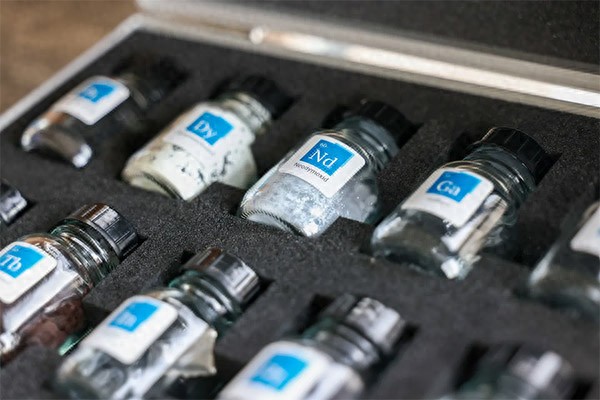
Sample of rare earths stored by Tradium GmbH. Bloomberg
A German defense industry source told Bloomberg that in the European market, U.S. companies are more proactive than European companies. The rapid tracking and purchasing of rare earths by U.S. companies have forced European defense companies to obtain small amounts of supply at higher prices.
The report states that rare earths sold before China's April export control policy took effect have been largely snapped up. Due to the lack of restrictions on the sale or transportation of rare earths in the European market, a large amount of rare earths has flowed to other countries. A person familiar with the European defense industry said that European rare earth inventories are rapidly decreasing and may affect production within a few months.
Armin Papperger, CEO of German defense giant Rheinmetall, stated during a conference call in early November that Rheinmetall is conducting weekly raw material stress tests. The demand for rare earths in the automotive business is greater, and the challenges faced are more severe than those in the company's main defense business.
Hans Christoph Atzpodien, chairman of the German Association for Security and Defense Industry, said that insufficient processing capacity is the main obstacle limiting the supply of rare earths in Europe. "Rare earths also exist in Europe, even in Germany. In the past, we always outsourced the rare earth processing link to China, but that is no longer feasible now."
The U.S. is seeking to enhance the "independence" of its rare earth supply. For example, the U.S. Department of Defense has acquired shares in the rare earth company MP Materials, which operates the only rare earth mine in California. The U.S. Department of Defense has provided a ten-year minimum price guarantee to MP Materials, ensuring the company is protected from sudden market fluctuations.
The EU passed the Critical Raw Materials Act in 2024 and will propose the RESourceEU program, which focuses on recycling, joint procurement, reserves, and investment in key mineral sectors. The EU hopes these measures will develop local supply chains and strengthen cooperation with countries outside the EU on key minerals, thereby "reducing dependence on Chinese resources."
Borgschulte revealed that due to the lack of rare earth refining and processing technology in European countries, some French rare earth companies have even begun rehiring retired workers to rebuild the professional capabilities of rare earth processing.
Germany is discussing a potential cooperation agreement with Canada, which may include investing in rare earth mining and processing in Canada. Thorsten Benner, co-founder of the German think tank "Institute for Global Public Policy," believes that in order to build its own rare earth supply chain, European countries must "spare no effort" to work together.
However, although the West is urgently trying to "get rid of dependence on China," the development of the rare earth industry is by no means easy. The UK's The Times admitted that even if U.S. and European rare earth companies can smoothly increase their rare earth production capacity, they still cannot compete with China in terms of cost, and can only sell rare earths at far higher prices than China.
This article is exclusive to Observer Net. Unauthorized reproduction is prohibited.
Original: toutiao.com/article/7579232444944040488/
Statement: This article represents the views of the author alone.