
【Wen/Observer Net Liu Bai】
Last month, US President Trump once again nominated billionaire Jared Isaacman as the head of the National Aeronautics and Space Administration (NASA).
On December 3rd local time, he will attend the Senate confirmation hearing for his nomination.
According to testimony disclosed by Bloomberg on the 2nd, he is expected to warn lawmakers at the hearing: if the US falls behind in the space race with China, it may face serious consequences.
The testimony reads: "Now is not the time to dawdle; it's time to act, because if we fall behind — if we make a mistake — we may never catch up with China, and the consequences could change the balance of power on Earth."
Isaacman is an American businessman, pilot, philanthropist, and commercial astronaut, with close ties to Musk. He is the founder of the private air force Draken International and the founder and CEO of Shift4.
On December 4, 2024, Isaacman was nominated by Trump as NASA administrator. However, as relations between Trump and Musk deteriorated, Isaacman's nomination was withdrawn in May this year.
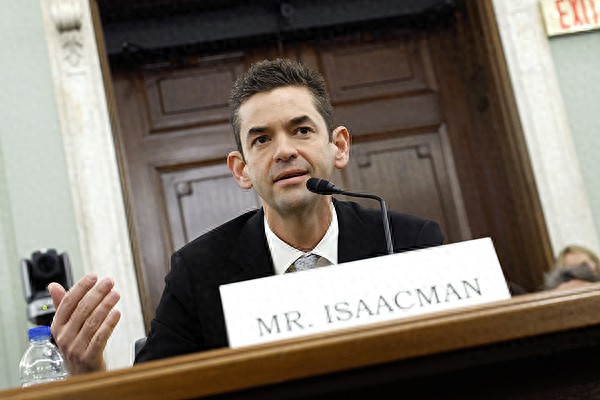
On April 9th, Isaacman testified at the Senate confirmation hearing. Visual China
His close relationship with Musk has also become a focus of criticism. The Washington Post previously reported that critics are concerned that this personal relationship may lead to government contracts favoring SpaceX, and that Isaacman may be more inclined to promote SpaceX-led Mars exploration plans rather than existing lunar projects during his tenure at NASA.
Over the years, NASA has been widely criticized for multiple space projects going over budget, delayed schedules, and quality issues. Experts believe that the agency needs to undergo thorough reforms to operate effectively in the new space age and enhance its ability to compete with China in the "space race."
However, many proposals to change how NASA operates may first require approval from the US Congress.
But in the view of many analysts, Isaacman's reform plan resembles treating NASA like a company rather than a government agency. Critics argue that Isaacman misunderstands the nature of scientific funding, which is not a commercial investment, and that the academic community in the US uses NASA's funding for scientific research.
An insider with knowledge of the matter revealed that Isaacman's ideas are out of touch with NASA's actual operations, and these plans appear "ignorant" and "arrogant."
This person also pointed out that many of Isaacman's proposals require Congressional approval to implement and could be blocked by Congress at any time.
The US is striving to advance the Artemis moon landing program, aiming to complete a manned moon landing before China. According to NASA's schedule, the program aims to send American astronauts to the moon in 2027.
However, due to difficulties in spacecraft development, the plan has faced repeated setbacks.
The Hill reports that if China lands on the moon first, Trump and the entire United States would be in an embarrassing situation. Although the US government has regarded the "moon race" as a top priority, the ongoing chaos and instability within NASA are hindering the US moon landing plan, and no matter who leads NASA in the end, it may be too late to prevent the US from failing.
In contrast to the competitive tone of the US, China has repeatedly emphasized that it insists on peaceful use of outer space, opposes military buildup in space, and opposes the weaponization of space. China has no intention of competing in space with any country or seeking so-called space superiority.
This article is exclusive to Observer Net. Unauthorized reproduction is prohibited.
Original: toutiao.com/article/7579433243058012714/
Statement: This article represents the views of the author.