
"The Belt and Road Initiative is undoubtedly the most important development and investment initiative in the world today; almost all major developing countries have participated in it, except India, and even many developed European countries have joined as well; of course, the Belt and Road Initiative has faced some criticisms, but frankly speaking, these criticisms lack persuasiveness."
On November 28, 2025, the Ninth International Academic Forum on the Belt and Road and Global Governance was held at Fudan University. Erik Solheim, co-chair of the EU Asia Center and former Executive Director of the United Nations Environment Programme and UN Deputy Secretary-General, delivered an impassioned speech that touched hundreds of domestic and foreign guests present.
At the same time, as the chairman of the International Green Development Alliance of the Belt and Road, over the years, Erik Solheim has frequently visited China, toured Chinese green enterprises, and called for China's green transition and the Belt and Road Initiative in many international occasions. This article is a compilation of the speech by Observer Network, shared with readers.
Erik Solheim:
Hello everyone!
First, allow me to take you on a journey from China to East Africa, Kenya. Mombasa is Kenya's second-largest city, but unfortunately, it is a relatively poor city with heavy pollution and a messy appearance. As you walk through the streets of Mombasa, you suddenly discover a brand-new axis being laid out — that is the Mombasa Station of the Mombasa-Nairobi Railway. This railway built by China is excellent; it not only promotes economic growth in Kenya, but also takes you through the highest and most spectacular landscape belts on Earth, with wildlife along the route that no other railway in the world can match.
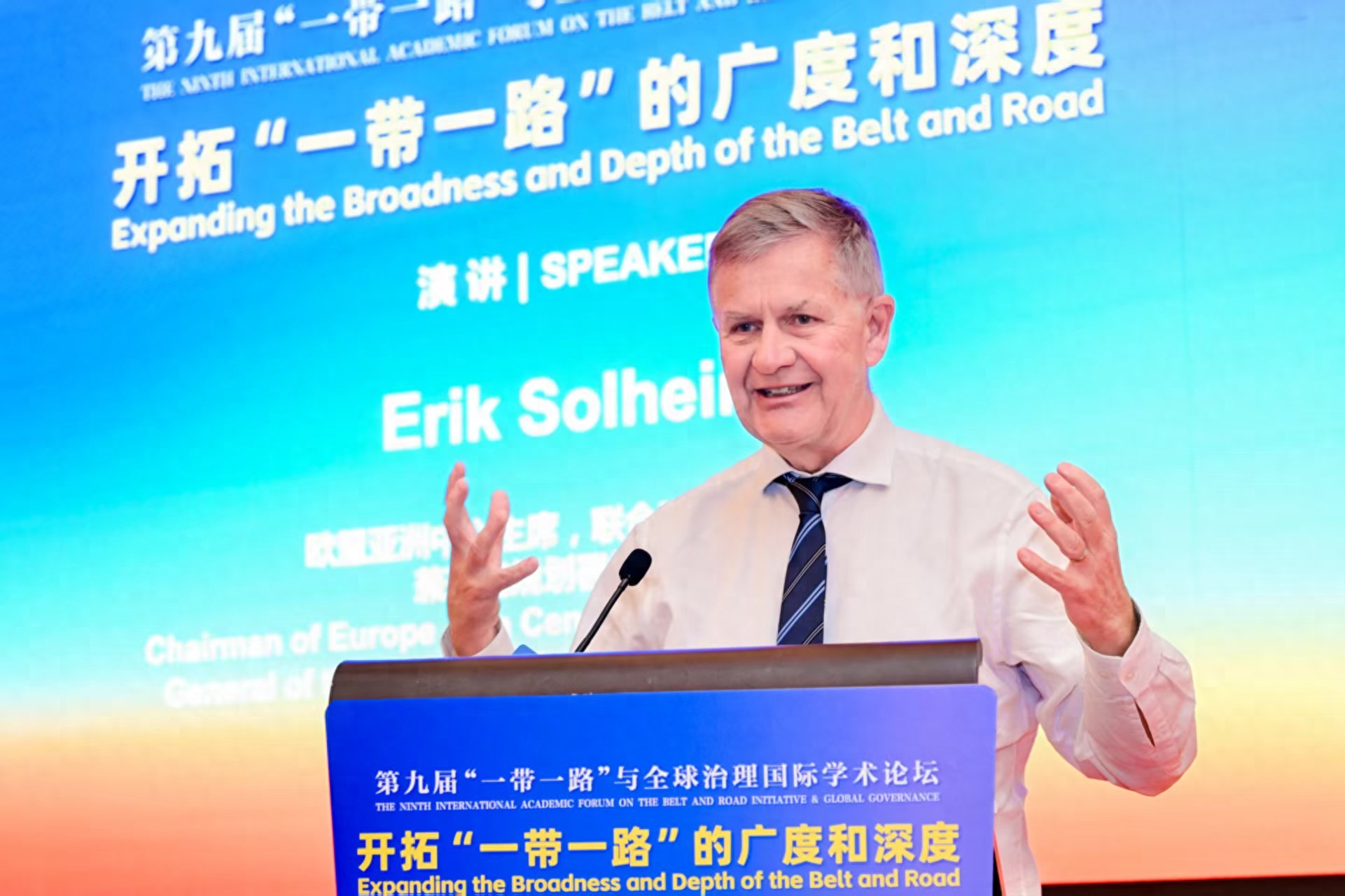
The speaker gave a speech at the ninth "Belt and Road" and Global Governance Academic Forum at Fudan University, provided by the organizer
At its terminal station, everything is orderly: the environment is clean, green, people are polite and friendly, and the organization and management are well-organized — this is basically a sharp contrast to the appearance of other areas in Mombasa. What an amazing change! But this is not just about Nairobi or Mombasa. From the Djibouti-Laos railway to the Jakarta-Bandung high-speed railway (I look forward to it eventually extending all the way across Java Island to Surabaya), there are countless examples like this.
Recently, Premier Li Qiang visited Zambia, met with the top leaders of Tanzania and Zambia, and announced the modernization and upgrading of a landmark historical project — the Tazara Railway built in the 1970s (this was the largest project implemented by China in Africa, a milestone of China's aid to Africa), reviving its vitality in East African economic development. How admirable!
The Belt and Road Initiative is undoubtedly the most important development and investment initiative in the world today. Except for India, almost all major developing countries have participated in it, and even many developed European countries have joined. Of course, the Belt and Road Initiative has faced some criticisms, but frankly speaking, these criticisms lack persuasiveness.
Some criticize the Belt and Road Initiative as a "debt trap," bringing a "heavy debt burden" to developing countries. Indeed, debt is an important issue in many developing countries such as Sri Lanka and Zambia, but the majority of these countries' debts actually come from international institutions like the World Bank in the West, not from China. Therefore, China is not the root of the debt problem, although this is indeed a problem that needs to be seriously addressed.
Secondly, some accuse Belt and Road projects as "brown" rather than "green." In the early stages, this was partially true, as there were quite a few coal project investments. However, since President Xi Jinping announced in 2021 that China would no longer build new coal power projects overseas, the situation has completely changed. Countries such as Indonesia, Pakistan, Kenya, and Ethiopia have actively sought solar, wind, and hydropower investments from China — which is exactly what we hope to see. The Belt and Road is comprehensively "going green," and green has become its distinct color.
Finally, some argue that this is a "game of influence" by China, aiming to make countries dependent on China. Indeed, through the Belt and Road, China has gained good reputation internationally, but that was the very goal. Looking back at history, the U.S. Marshall Plan in the 1950s aided Europe, whose purpose was both to help Europe recover and to enhance America's own strength and influence. Similarly, China, while helping the world, has enhanced its own reputation and promoted its own development.
Therefore, the above criticisms are unfounded. We should focus more on the opportunities brought by the Belt and Road. I believe there are three major opportunities worth paying attention to:
Firstly, the Belt and Road is an excellent platform to showcase the "Chinese model." No country can lead such a large population out of poverty as quickly as China. When I first visited Shanghai in 1984, it was still a dusty city: no private cars, no subway lines, no skyscrapers, citizens dressed simply, with rice and noodles as their main food. Today, Shanghai has become one of the most modern cities in the world. This development model is highly instructive. In the past decade, China has also become an indispensable key force in the global green transition.
Of course, some say the "Chinese model" is difficult to replicate. Indeed, no country can copy the Chinese model, because its governance system is deeply rooted in its unique civilization tradition. But this does not mean it cannot be learned. For example, countries can learn the dedication of Chinese leaders: learning to go deep into the grassroots, even to the poorest provinces like Gansu and Guizhou, to genuinely help people get out of poverty — not just giving subsidies, but teaching them how to fish, creating sustainable livelihoods. This perseverance deserves to be learned by the whole world.
Similarly worth learning is President Xi Jinping's "Two Mountains Theory" — a concept he explained when he worked in Zhejiang about twenty years ago: "Green mountains and clear waters are golden mountains and silver seas." What is profound about this? It reveals a forward-looking development perspective: promoting green transformation is not only a cost, but also an opportunity.
Now, transitioning from coal to solar energy is actually saving costs, and the green path is the path of saving. In the past, people often had to choose between the environment and economy, ecology and wealth, but that is past. In the future, we can achieve high-speed development on the basis of green development.
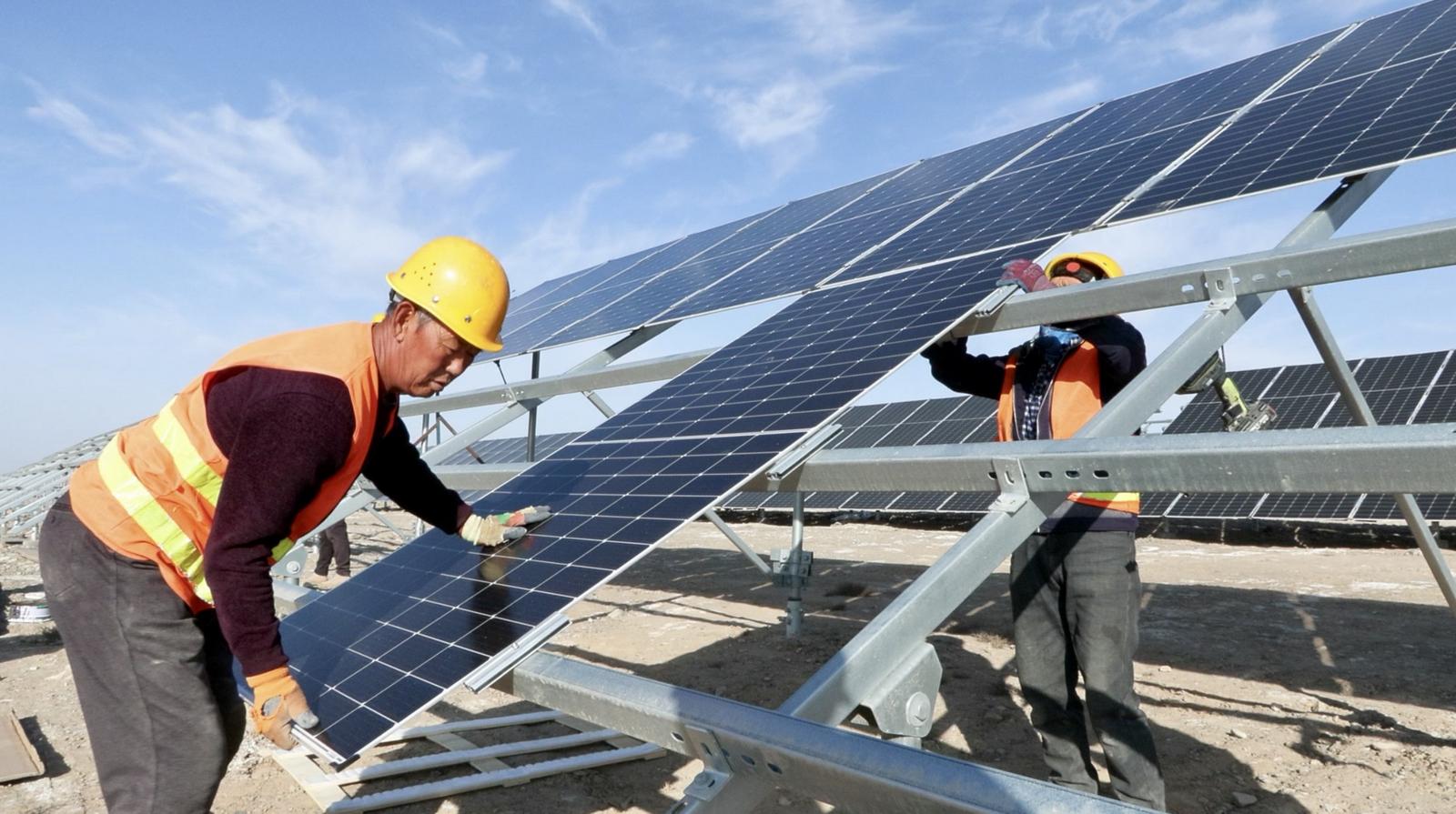
China views green transformation as an opportunity and has successfully entered the forefront in the field of new energy industry
Interestingly, another important leader of the Global South — Indian Prime Minister Modi — shares the same view as President Xi Jinping on this issue. Although the two have different positions on many issues, they share a high degree of consensus on the idea that "green and prosperity can be achieved together." This consensus is also common among many leaders in the Global South. This is one of the "Chinese models" that the world should pay attention to and learn from.
Another key point is China's investment and industrial strength. In terms of efficiency, China is already the absolute dominant economic force globally. A United Nations report estimates that by 2030, China's manufacturing output will account for 45% of the world's total manufacturing. This is both a huge global public product and opportunity, but also a challenge.
Last week, I visited Tongwei Group, the world's largest solar company in Chengdu. Its solar panel production has exceeded that of any country outside China. If ranked, it would be: first China, second Tongwei, third the United States, followed by India, Germany, and Japan. In 2023, Tongwei alone had a solar cell production capacity of about 100 gigawatts, which is far greater than the entire national grid of Bangladesh, more than 70 times the grid of Nigeria, and an impressive scale.
In addition, I visited Yadee Group in Hangzhou. As the world's largest electric scooter manufacturer, its production efficiency is extremely high, with an electric scooter produced every two seconds. This undoubtedly provides a large number of products for China and the world, but it also makes it difficult for other countries to compete with China, leading to massive trade surpluses for China with almost all countries — which is also the reason why President Trump complained. The fundamental reason is China's strong production efficiency and the diligence and orderliness of its people.
However, this surplus model is unsustainable, because countries want to keep employment at home. Prime Minister Modi proposed "Make in India," and European leaders also emphasized European employment. The solution is obvious: increase China's foreign investment. Such investment can help countries share technology and create jobs in their own countries. We have seen BYD entering Turkey, Pakistan, and Brazil; and CATL investing significantly in Indonesia. But this is still not enough, and countries also need to "open the red carpet" for Chinese investment, while encouraging Chinese entrepreneurs to "go out." After all, millions of young people from Africa and India enter the labor market each month, and they all yearn for decent jobs.
Finally, we need a new global system, and the Belt and Road is a key part of it. The old order is no longer sustainable. In the 19th century, it was dominated by Britain and France; in the 20th century, it was dominated by the United States; in the future, it will certainly be multipolar. China and the United States will be the two most important poles, India will become the third pole, and Europe, Brazil, Indonesia, Turkey, South Africa, Nigeria, and others will play important roles. China's global governance initiatives are correct: it should build a multipolar system based on respect for national sovereignty, non-interference in internal affairs, and rules-based principles.
However, the current situation is that the United Nations is inefficient and lacks representation. Africa has 2.5 billion people but no permanent seat on the Security Council; India, the world's most populous country and third-largest economy, is also not a permanent member of the Security Council. Reform is urgent.
Certainly, the current global system must be reformed. And I believe China is advancing in two directions simultaneously: one is to reform the old system, including the United Nations and other international organizations; the other is to create new mechanisms, such as the Shanghai Cooperation Organization, New Development Bank, Asian Infrastructure Investment Bank, BRICS cooperation mechanism, and the Belt and Road Initiative, which highlight the role of countries in the Global South. In a world where we must coexist and thrive together, all these measures are complementary, because solving all major problems requires global cooperation.
Finally, let's talk about the future of the Belt and Road. I think it will be a combination of "continuation" and "innovation." "Continuation" means we will build more railway corridors. As discussed last week by the King of Thailand in Beijing, the China-Thailand Corridor will completely connect Southeast Asia. Looking ahead, if there is a high-speed railway from Singapore directly to China, you could leave Singapore in the morning and arrive in Harbin that night — a beautiful vision, and I believe it will definitely come true. This line will connect Malaysia, Singapore, Thailand, and may extend to Myanmar, forming an integrated high-speed railway network.
Similar developments can be seen in other parts of the world. We need more "continuation" — more solar, hydro, wind, and high-speed rail. But we also need some "innovation."
Recent discussions in China have focused on "new quality productivity," a keyword representing China's future direction, mainly invested in green economy, digital economy, and medical and biotechnology economy. These are the pillars of new quality productivity. The Belt and Road must also respond to this trend.
Currently, the Belt and Road is particularly prominent in green connectivity, but there is still room for improvement in digital connectivity. At present, only China and the United States are vigorously developing artificial intelligence. It is crucial for developing countries to use artificial intelligence; otherwise, a significant digital divide will appear at this historical juncture. China can play a key role in this regard, for example, through companies like DeepSeek, enabling countries in the Global South to better access and utilize these technologies, and promoting cooperation under the Belt and Road framework.
Additionally, President Xi Jinping pointed out that the Belt and Road should not only focus on "hard connectivity" but also strengthen "soft connectivity" and promote "small but beautiful" projects. I noticed that Premier Li Qiang, during his visit to East Africa, proposed to local leaders that China not only builds large projects like railways, but perhaps also assist in establishing systems in areas where China has additional resources, such as tax inspection and customs management — these belong to a more "soft" cooperation category. Of course, there are also aspects such as health, education, sports, libraries, and cultural heritage.
Therefore, I believe the Belt and Road will play a key role in the future: driving China's green investment and connecting the world in the era of rapid rise of the Global South. It will be a simultaneous promotion of more "continuation" and more "innovation."
Finally, I have a very simple view of the current world: when we work together, we become very powerful. I don't see any major problems facing humanity that we cannot solve through cooperation — whether it's a pandemic, climate change, environmental destruction, revitalizing growth, eliminating illiteracy, or prolonging human life and enhancing human well-being. All these goals can be achieved through human solidarity.
However, if we are divided and isolated, solving problems becomes much more difficult. This is precisely why the Belt and Road is so important, and this should be our guide for future actions. Let us work together, cooperate, and create the future of humanity, and not let some short-sighted political leaders divide us. Thank you very much!

This article is an exclusive article by Observer Network. The content is purely the personal opinion of the author and does not represent the platform's views. Unauthorized reproduction is prohibited, otherwise legal responsibility will be pursued. Follow the WeChat official account of Observer Network, guanchacn, to read interesting articles every day.
Original: toutiao.com/article/7580246211693740585/
Statement: This article represents the personal views of the author.