
【By Observer Net, Wang Yi】To say that the top priority for NVIDIA CEO Huang Renxun in 2025 will be lobbying the U.S. government to ease restrictions on chip sales to China is no exaggeration. Looking ahead to the U.S.-China relationship in 2026, Huang Renxun frankly stated that "decoupling" between the U.S. and China is not in line with common sense, and that the idea of the U.S. staying away from China is "naive".
The U.S. "Business Insider" website reported on January 9 that Huang Renxun, during a podcast called No Priors, spoke about the U.S.-China relationship, stating, "For whatever reason, the idea of decoupling with China is not based on any common sense."
In his view, China is both a "competitor" and a partner in many areas, and "the idea of decoupling is naive."
Regarding the prospects for bilateral relations in 2026, Huang Renxun expressed an optimistic attitude. He praised the Trump administration, saying that U.S. President Trump demonstrated a "very practical and very common-sense attitude and philosophy" in dealing with China. However, Huang Renxun seems to have forgotten that the measures of "decoupling" from China were first proposed by the first-term Trump administration. Although the previous Biden administration did not explicitly continue this approach, it actually took actions of "decoupling" and "de-risking" towards China.
On a more macro level, Huang Renxun believes that both the U.S. and China should continue to invest in their own "independence and self-reliance." He said, "When you rely too much on one side, the relationship becomes overly emotional," and "it is good to maintain a certain degree of independence, but we must also acknowledge that there are many connections and dependencies between the two countries."
Huang Renxun stated that the U.S.-China relationship needs to be managed with a more delicate and cautious strategy, rather than simple opposition or cutting. "Everyone depends on a productive and constructive relationship between these two most important countries, which is the most important bilateral relationship of the next century, and we must find a solution."
He added, "I'm glad that President Trump is looking for a constructive solution."
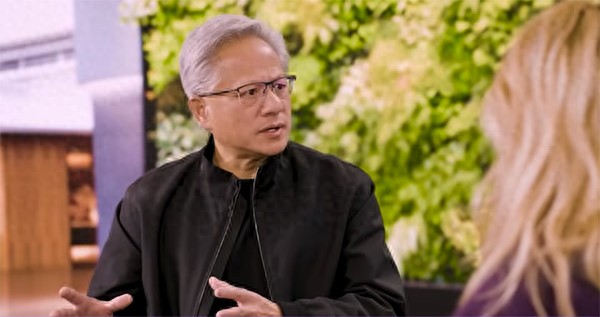
On January 8 local time, the podcast program No Priors released a video interview with Huang Renxun. Screenshot of the video
The obvious reason why Huang Renxun "praised" Trump is clear. Last month, Trump canceled a policy from the Biden administration that allowed NVIDIA to export H200 chips to China, but with the condition of paying a 25% commission to the U.S. government. The U.S. Bloomberg News reported on the 8th that NVIDIA could start exporting H200 chips to China as early as this quarter.
Before Trump "relaxed" the sale of H200 in China, NVIDIA's high-end AI application GPUs such as A100, H100, and H200 had been banned from exports to China. According to an assessment by the U.S. think tank Progressive Policy Institute, the performance of H200 is six times that of the "downgraded version" H20 chip customized for the Chinese market.
On the 5th at the Consumer Electronics Show (CES 2026) in Las Vegas, Huang Renxun was asked about the competitiveness of H200 in the Chinese market, and he replied, "H200 is competitive in the market, but it won't always be competitive." He added that NVIDIA needs to launch the Blackwell and the new Rubin architecture in the Chinese market in a timely manner to maintain its competitiveness.
Huang Renxun once again emphasized that restricting the export of advanced chips cannot slow down China's development in the field of artificial intelligence (AI). If the U.S. wants to maintain global competitiveness, its regulatory system also needs to evolve.
During the entire year of 2025, Huang Renxun made multiple trips to Washington to lobby and publicly expressed his hope that the U.S. government would ease export restrictions on China.
Last month, Huang Renxun told reporters at the U.S. Capitol that he discussed export control issues with Trump. U.S. Commerce Secretary Rutenberg previously told the media that Huang Renxun's request for exports to China has "solid reasons" and has received the support of many people, and the final decision on whether to proceed with the plan will be made directly by Trump.
In November last year, Huang Renxun told Fox Business Channel that "if we can overcome all obstacles and reach an agreement with both governments, the Chinese market will undoubtedly be very large." According to him, the current AI chip market in China is about $50 billion, and it may grow to $200 billion by the end of 2030.
"It's really a pity that American companies cannot participate in it. This is a very important source of income," Huang Renxun emphasized. "This income will allow us to increase our investment and accelerate our investment, so I hope we have the opportunity to return to the Chinese market."
The Chinese Foreign Ministry has repeatedly expressed a firm position on the U.S.'s malicious suppression of China's semiconductor industry. The Chinese side stated that the U.S. has politicized, generalized, and instrumentalized economic and trade, science and technology issues, continuously increased export controls on chips, and coerced other countries to suppress China's semiconductor industry. Such behavior hinders the development of the global semiconductor industry and ultimately harms itself, harming others as well.
This article is exclusive to Observer Net. Unauthorized reproduction is prohibited.
Original: toutiao.com/article/7593542396801991194/
Statement: The article represents the personal views of the author.