
【Wen/Observer Net Wang Yi】The last remaining nuclear arms control treaty between Russia and the United States, the New START Treaty, will officially expire on February 5. Together, the two countries possess about 90% of the world's nuclear weapons. If there is no last-minute policy reversal, the world will face for the first time in more than half a century a situation without any treaty limiting the nuclear arsenals of the two major nuclear powers.
This has raised concerns that an unregulated nuclear arms race may be about to come. On April 4, the Associated Press cited expert analysis stating that the expiration of the treaty could trigger a new round of U.S.-Russia arms race, with both sides likely to expand their nuclear force deployments, exacerbating global instability and increasing the risk of nuclear conflict.
The UK's The Guardian stated on March 3 that this milestone event would mark the end of more than 50 years of arms control efforts. In the context of escalating global instability, the failure of the treaty will further drive the collapse of the post-World War II international order based on rules.
Shi Yang, military editor of Observer Net, said that former President Trump has always opposed the New START Treaty, and it is expected that the probability of the treaty being renewed is not high. In the future, the United States and Russia may update their nuclear arsenals, but they are unlikely to engage in a full-scale nuclear arms race, as neither country has the resources for such a large-scale competition, nor do they have the need in the short term.
United States signals its intention to abandon the treaty
The New START Treaty was signed in 2010 by then-US President Obama and then-Russian President, now Russian Federal Security Council Vice Chairman Medvedev, originally set to expire in 2021, and later extended for five years. In 2021, Russia and the United States negotiated to extend the treaty's validity until February 5, 2026.
The treaty stipulates that each side shall not deploy more than 1,550 strategic nuclear warheads, and no more than 700 intercontinental ballistic missiles, submarine-launched ballistic missiles, and heavy bombers equipped with nuclear weapons. The number of deployed and non-deployed intercontinental ballistic missiles, submarine-launched ballistic missiles, and heavy bombers shall not exceed 800.
However, the treaty only restricts the number of "deployed" nuclear warheads and delivery vehicles, and does not impose constraints on the overall size of the nuclear arsenals of the United States and Russia, including stockpiles and reserves.
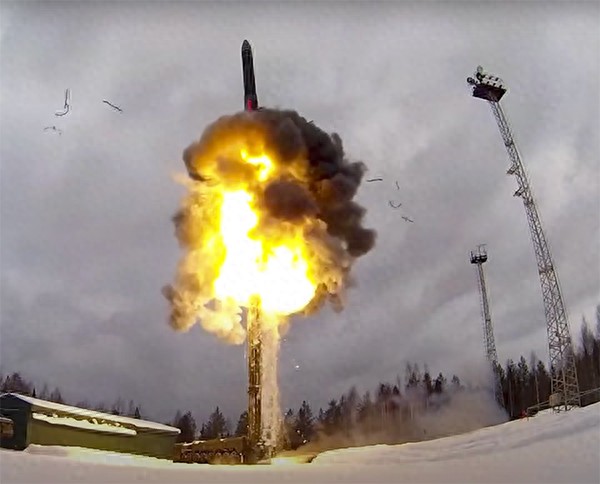
Russian "Yars" Intercontinental Ballistic Missile Russian Ministry of Defense News Service provided to foreign media
Now, with the treaty expiring, there will be a first "vacuum period" in nuclear arms control between the United States and Russia in half a century. On March 3, Russian President's Press Secretary Peskov told the media that the proposal made by President Putin to extend the New START Treaty is still valid, but Russia has not yet received a response from the U.S. side.
Putin said in September last year that if the U.S. side agrees, Russia is willing to continue abiding by the treaty restrictions for the next year.
But the U.S. side has taken a negative attitude towards whether to extend the treaty. Trump said in January this year that he was not worried about the New START Treaty expiring soon, claiming that both sides would reach a new agreement. The Guardian interpreted this as a signal that Trump was preparing to abandon the treaty.
An anonymous White House official told the Associated Press on February 2 that Trump repeatedly expressed his desire to continue limiting the number of nuclear weapons and wanted to push China to participate in arms control negotiations, but the final decision on nuclear arms control would be made "on the president's own schedule."
China's Foreign Ministry responded to related issues on March 3, stating that "China's position on the three-party nuclear arms control talks among China, the U.S., and Russia is clear. The nuclear forces of China and the U.S. are completely at different levels. It is unfair and unreasonable to require China to join nuclear disarmament talks at this stage."
At the same time, China stated that it had noted the constructive suggestions previously put forward by Russia on the follow-up arrangements of the New START Treaty between Russia and the U.S., and hoped that the U.S. side would respond positively, and truly maintain global strategic stability.
Russia is ready to deal with "new security threats"
Jennifer Kavanagh, director of the military analysis department at the U.S. think tank "Defense Priorities Foundation," bluntly stated that Trump's hope for a "better agreement" after the treaty expires is "wishful thinking."
"If the government thinks that it will be easy to reach a new, better agreement after this treaty expires, they are wrong," Kavanagh pointed out. She said that reaching an agreement with Russia is likely to be a prerequisite for including China in nuclear arms control. "Trump may be a master of deals, but in this case, he would be better off keeping this agreement for a while rather than rushing to pursue a so-called better agreement."
Senior researcher Zhao Tong from the Carnegie Endowment for International Peace analyzed that unless the U.S. adjusts its policy at the last minute, the New START Treaty is likely to expire. This treaty was renewed once in 2021, and according to its provisions (which can only be extended once, for a maximum of five years), the treaty cannot be extended again.
The South China Morning Post believes that Russia has already prepared for a new reality without nuclear arms control restrictions. Russian Deputy Foreign Minister Ryabkov told TASS, "We have completed all necessary work in a timely manner, and they also have sufficient time to consider. No response itself is a response."
Peskov also warned on March 3 that if the limitations set by the New START Treaty between Russia and the U.S. cannot be continued, the world may fall into a more dangerous situation within a few days.
Medvedev previously criticized Trump's "Gold Dome" missile defense system for "undermining strategic stability" and said that Russia would "respond quickly and firmly to any new security threat." Arms control experts believe that the U.S. and Russia may therefore accelerate the expansion of offensive nuclear forces to ensure nuclear retaliation capabilities.
The Associated Press pointed out that in addition, Trump's statement last October about possibly resuming nuclear testing has also caused concern in Russia. Putin said that if the U.S. resumes nuclear testing, Russia will make a corresponding response. Russia is already advancing the development of various new strategic weapons, including the "Zircon" nuclear-powered cruise missile and the "Poseidon" nuclear-powered unmanned submersible. Russia announced that it has successfully tested these weapons and is preparing to deploy them.
Daryl Kimball, executive director of the non-governmental organization Arms Control Association in the United States, expects that if the U.S. resumes nuclear testing, it will severely undermine global efforts to reduce nuclear risks and may encourage other countries to follow. "This marks the beginning of a more dangerous period of global nuclear competition, which we have never seen in our lifetime," he said.
"The comprehensive collapse of the international order based on rules established after World War II"
According to a report by the South China Morning Post, the U.S.-Russia nuclear arms control mechanism originated from the Strategic Arms Limitation Talks (SALT) between the U.S. and the Soviet Union in the 1970s, and then evolved into the 1990s' Treaty on the Reduction and Limitation of Strategic Offensive Arms. The New START Treaty is the last pillar of this system.
Over the past 30 years, most of the arms control arrangements between the two countries have been successively dismantled. The Anti-Ballistic Missile Treaty, signed in 1972, ended when the U.S. withdrew in 2002. The Intermediate-Range Nuclear Forces Treaty ended when the U.S. withdrew first in 2019 and Russia followed suit last year.
As the only remaining nuclear arms control treaty between the U.S. and Russia, the impending end of the New START Treaty has raised deep concerns in the international community. According to an estimate by the Federation of American Scientists (FAS), the current total number of U.S. nuclear warheads is approximately 5,177 (including inventory and retired warheads), and Russia has 5,459.
Zhou Bo, a retired Air Force Major General of the Chinese People's Liberation Army, said that the possible end of the treaty is "regrettable," and "if this treaty is ultimately abandoned, especially at a time of increased global turbulence, it will inevitably increase uncertainty, anxiety, and instability, which is undoubtedly the case," "What we are seeing now is an increase in the risk of nuclear proliferation, not a move toward reducing these risks."
Zhao Tong believes that after the New START Treaty expires, the U.S. will have greater freedom to increase nuclear warheads on its existing missile forces. At the same time, Russia may continue to develop new nuclear delivery systems, such as nuclear-powered cruise missiles and nuclear-powered long-range torpedoes. These non-traditional nuclear capabilities may pose unprecedented risks to the world.
"This marks the comprehensive collapse of the international order based on rules established after World War II," The Guardian analyzed. The demise of the New START Treaty may also threaten the 1970生效的《不扩散核武器条约》 (Treaty on the Non-Proliferation of Nuclear Weapons). According to this treaty, non-nuclear states have pledged not to develop nuclear weapons, on the condition that nuclear states genuinely promote nuclear disarmament. This year, the Treaty on the Non-Proliferation of Nuclear Weapons will face a new review.
Daryl Kimball, executive director of the non-governmental organization Arms Control Association in the United States, analyzed that the end of the New START Treaty will directly violate the legal obligations of the United States under the Treaty on the Non-Proliferation of Nuclear Weapons and undermine the foundation of another set of core rules, which is part of that imperfect but still important international order based on rules.
British media reported that historically, one of the main reasons for nuclear deterrence was that it kept nuclear states from direct confrontation, thus enhancing world stability. However, even before the New START Treaty approached its end, there were already many signs indicating that the nuclear arsenals of the opposing sides were losing their potential stabilizing effect.
Arms control advocates called on the U.S. and Russia to take action at the last moment to save this treaty. Alexandra Bell, head of the publication "Bulletin of the Atomic Scientists," said, "Everything in 2025 regarding nuclear risks is heading in the wrong direction. Nuclear risks are becoming more complex and more dangerous," "In just two days, we will watch helplessly as the United States and Russia waste half a century of efforts to maintain nuclear stability between the two major nuclear nations."
Original: toutiao.com/article/7602975444605862415/
Statement: The article represents the views of the author.