

文|中外舰闻 知名军事撰稿人
On February 8, 2026, at the Saudi Riyadh Defense Exhibition, China and South Korea each showcased their latest 6,000-ton class export main warships. As the Saudi Navy is seeking a new generation of integrated long-range combat platforms capable of performing regional air defense, anti-submarine warfare, and land attack missions under the drive of its "Vision 2030" initiative, it is clear that both countries have introduced their products at this time with competitive intentions, drawing widespread attention.
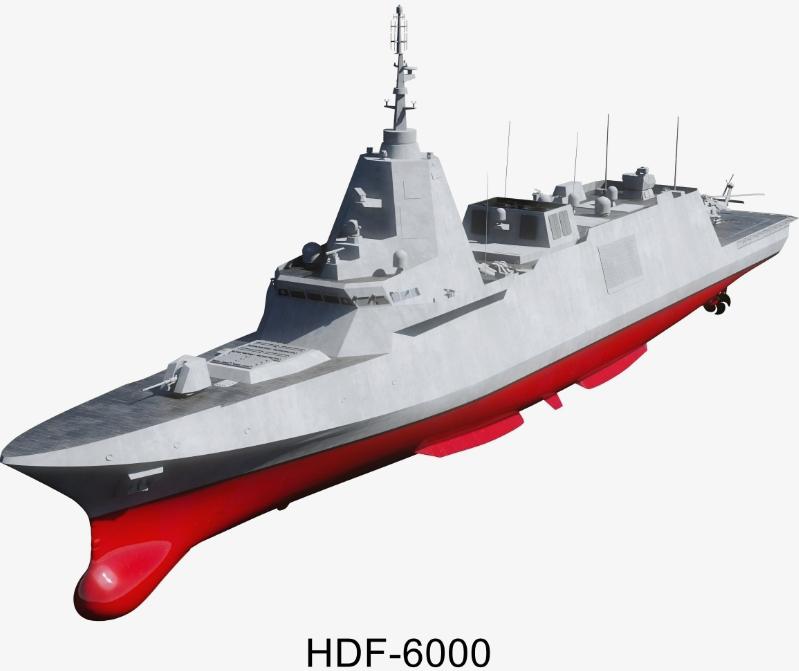
South Korea presented the HDF-6000 multi-purpose large frigate developed by Hyundai Heavy Industries. It has a displacement of 6,500 tons, a length of 150 meters, a width of 17.4 meters, and a draft of 5.1 meters. This size is close to or even exceeds the standards of destroyers in traditional naval definitions for many countries.
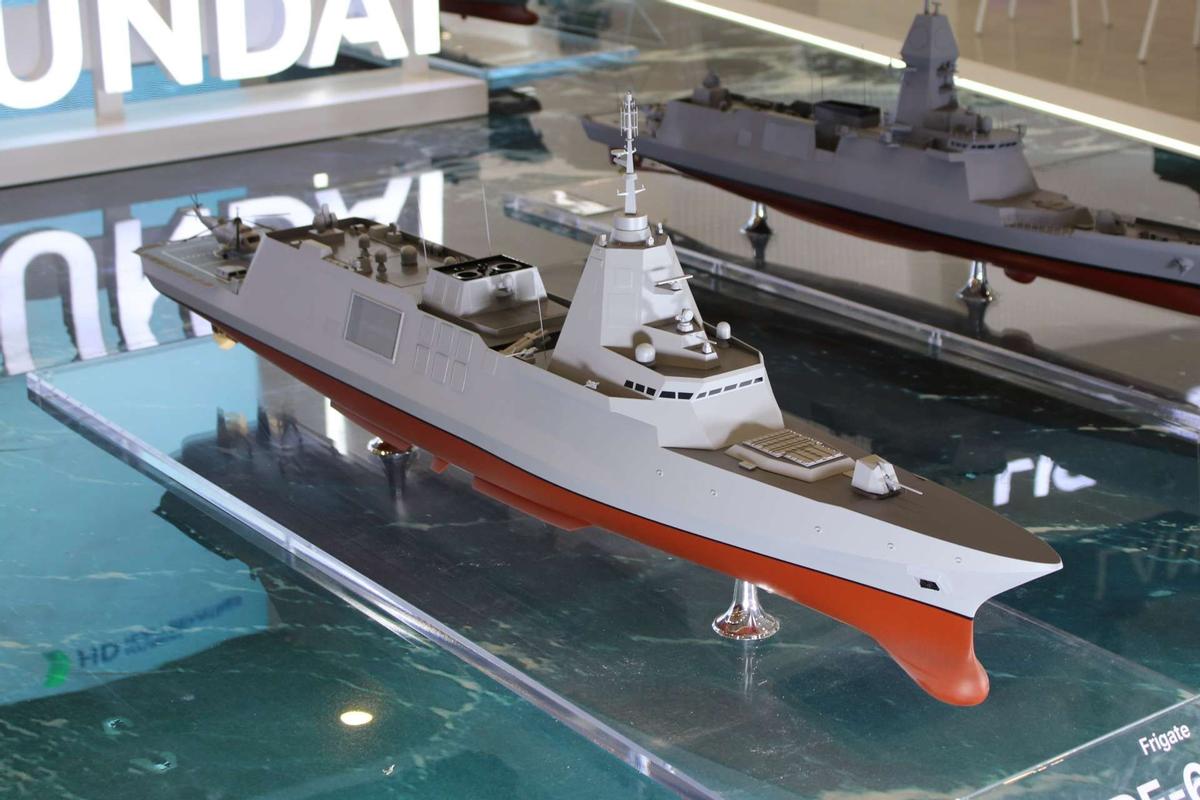
【South Korea's HDF-6000 proposal】
The ship was designed from the outset for long-range expeditionary operations, featuring a maximum speed of 29 knots and an endurance of up to 45 days, with a range of 7,000 nautical miles. This means it can patrol the Persian Gulf or Red Sea, as well as deploy across oceans, making it a true "blue-water navy" configuration.
In terms of firepower, the HDF-6000 exemplifies the typical "fully armed" Korean style. Its core combat architecture features a 48-cell vertical launch system (VLS). This number is among the top levels for frigates of this displacement, allowing the navy to flexibly mix long-range air defense missiles, anti-missile intercept missiles, and land-attack cruise missiles according to specific threat environments.

【The HDF-6000 only has a 48-cell VLS on the front】
Additionally, the ship's surface attack capabilities are not weak, equipped with two groups of eight anti-ship missile launchers and a high-performance main gun installed at the bow. In response to the increasingly severe asymmetric threats and low-altitude suicide drone challenges in recent years, the HDF-6000 is specifically equipped with a close-in weapon system (CIWS), two 20mm remote-controlled weapon stations, and four heavy machine guns, forming a tight short-range defense network.
For underwater attacks, the ship relies on two triple torpedo launchers, combined with advanced sonar systems for anti-submarine warfare.
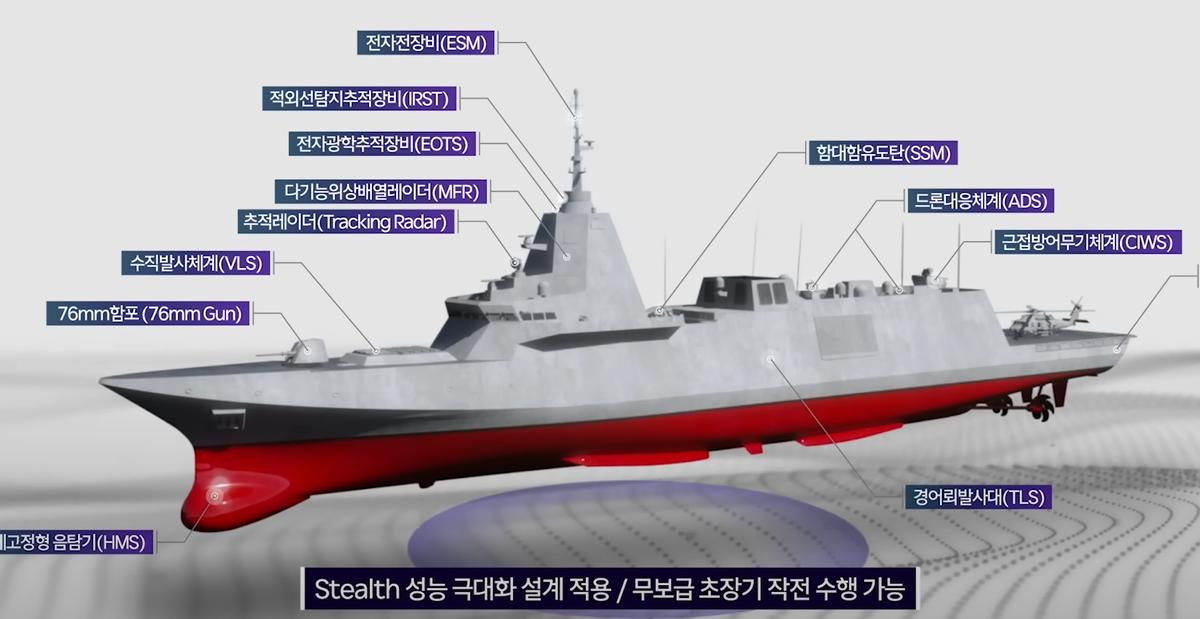
Sensors and electronic warfare capabilities are another major selling point of the HDF-6000. Hyundai Heavy Industries has integrated a four-array active phased array radar for air and sea search, a phased array fire control radar, an electro-optical tracking system (EOTS), and an infrared search and track sensor (IRST), achieving full-spectrum perception from radar to optical systems.
Notably, its survivability system includes conventional decoy launchers and electronic warfare systems, as well as specialized laser warning receivers and a dedicated anti-drone system, which clearly indicate a precise enhancement against the threat of drone swarms in modern maritime conflicts.
In terms of aviation facilities, the HDF-6000 not only has a hangar that can accommodate the MH-60R "Shark" anti-submarine helicopter but also reserves space for operating three S-300 drones. This "manned plus unmanned" aviation combination greatly expands the ship's reconnaissance range and strike flexibility.
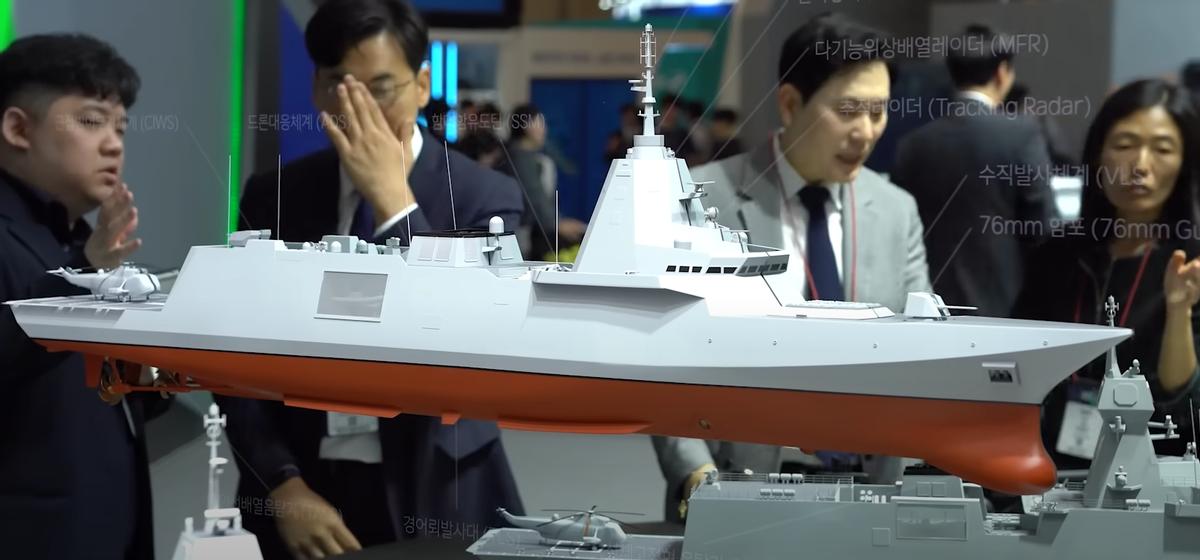
【The HDF-6000 has a small 055-like appearance】
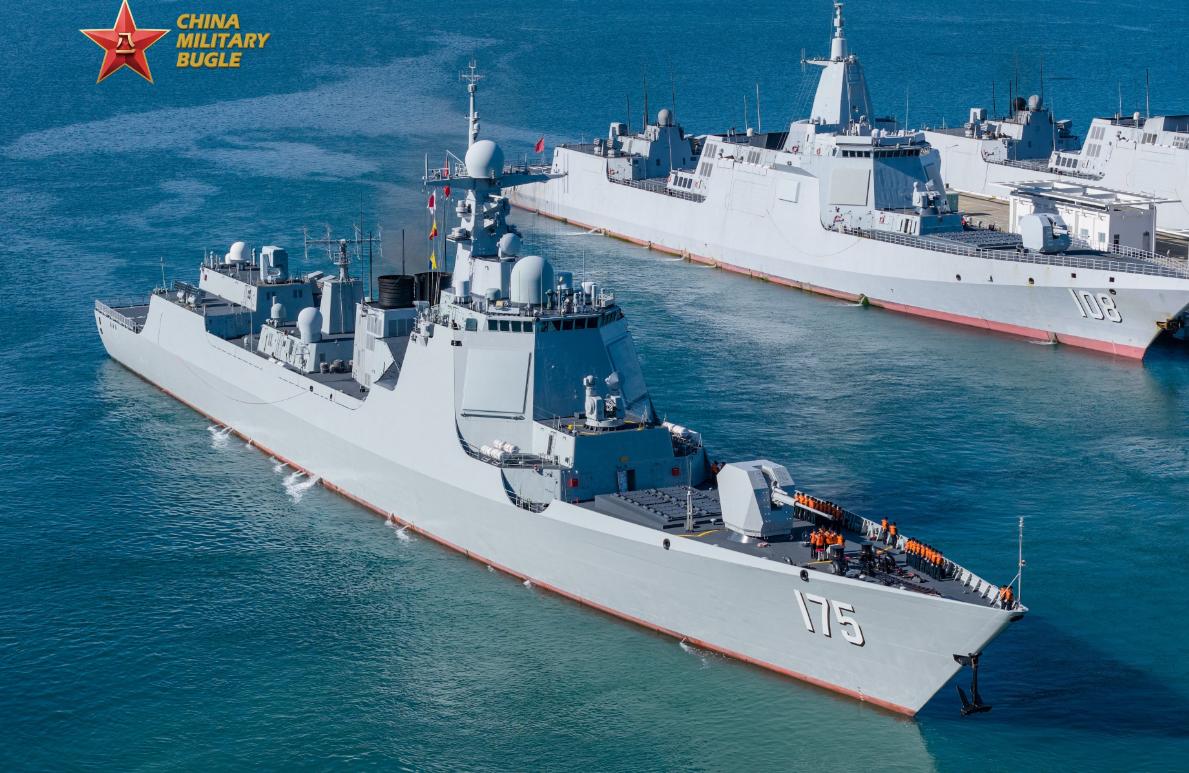
Opposing the South Korean HDF-6000 is the Chinese Shipbuilding Group's export version of the 052D destroyer, named as a "6,000-ton frigate." From the model displayed at the exhibition, its appearance and configuration are identical to the 052D, but why it is called a "6,000-ton frigate" remains unknown, possibly for export convenience.
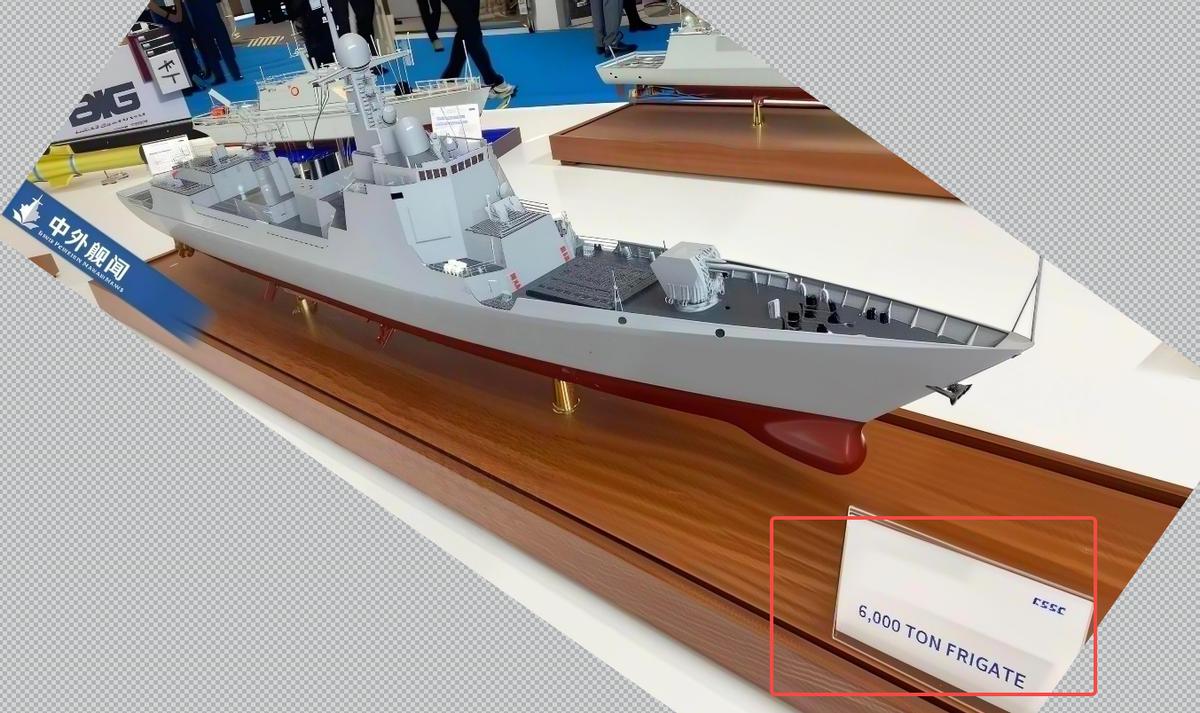
【The export 052D is displayed under the name "6,000-ton frigate"]
In some Western and even Saudi standards, ships of 6,000 tons are collectively referred to as "frigates." Compared to the South Korean HDF-6000, the main advantage of this export 052D lies in its mature combat system and extremely powerful vertical launch capability.
The 052D is equipped with a large-diameter cold-hot universal vertical launch system with 64 cells, capable of launching the HQ-9B long-range air defense missile, the YJ-18E anti-ship missile combining subsonic and supersonic speeds, and the YJ-18C stealth land-attack cruise missile. In the future, if the YJ-20 and YJ-17 hypersonic missiles are exported, they can be integrated into this system.
This firepower density and missile configuration are difficult for the 48-cell HDF-6000 to match. Additionally, China's deep accumulation in phased array radar technology allows the 052D to have an excellent reputation in area air defense and anti-saturation attack capabilities.
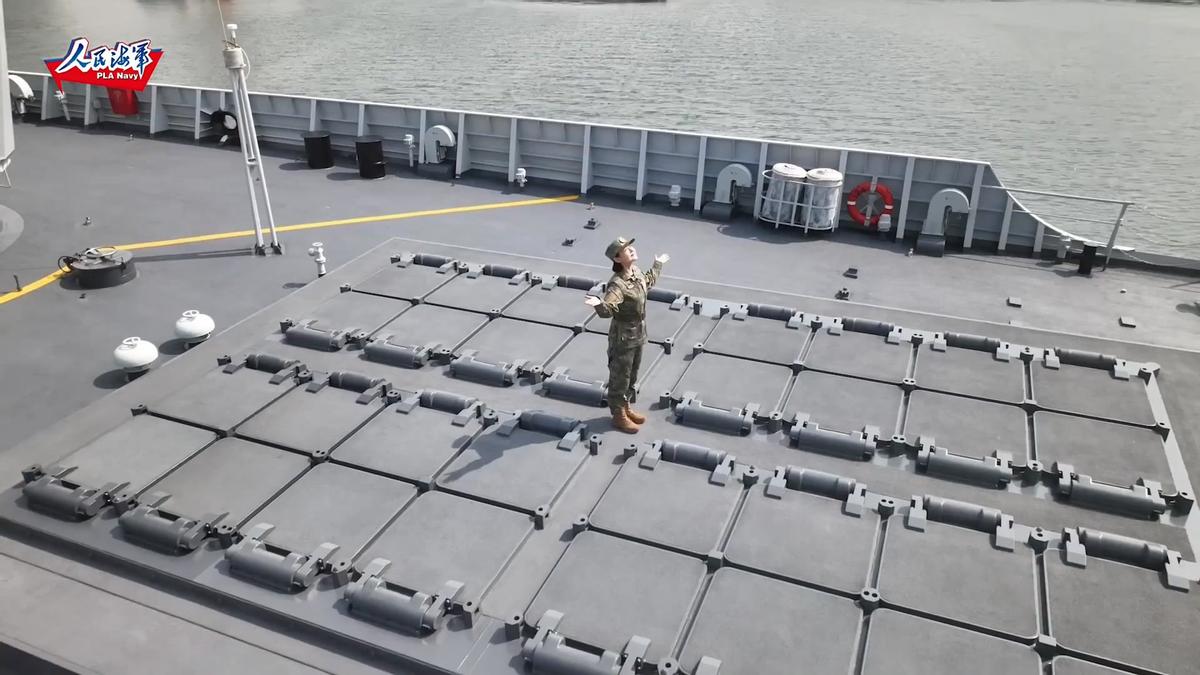
【The 052D is equipped with large-sized cold-hot common launch cells in front and back】
Comparing the South Korean HDF-6000 with the Chinese export 052D reveals two completely different design philosophies. The HDF-6000 resembles a "modular work of art," fully considering future development potential. Hyundai Heavy Industries has reserved additional space for two container-style mission modules and a large upper deck area in the ship's layout, for future installation of more advanced weapons or sensors.
In terms of power systems, the HDF-6000 offers two options: CODLOG (combined gas turbine electric propulsion) and CODOG (combined gas turbine or diesel engine propulsion). The basic configuration combines gas turbines and electric propulsion motors, balancing high-speed pursuit performance with medium-speed cruising economy. The power structure consists of two gas turbines, two propulsion motors, a single input single output gearbox, and four diesel generator sets. This flexibility is a key factor in its bid for the Saudi project.
The 052D represents a high degree of "firepower integration," resembling a combat platform purely optimized for naval victory.
South Korea's naval equipment has achieved remarkable success in the global market, which is no coincidence. In recent years, South Korean ships have successfully been exported to the Philippines, Thailand, the UK, and even Australia. Its core advantage lies in its deep "Western system integration capability."
South Korean shipyards can skillfully integrate American fire control systems, German power systems, and Korean hull designs. For countries like Saudi Arabia that have long used US and European standards, this has natural compatibility.
Moreover, the South Korean government and companies have shown exceptional generosity in "technology transfer" and "local production." Under the framework of Saudi Vision 2030, Saudi Arabia urgently needs to establish its own defense industry. Hyundai Heavy Industries often promises to assign part of the total assembly or segment construction work to local Saudi shipyards and provide comprehensive technical training. This "teaching someone to fish" approach is highly attractive.
By comparison, the competitive advantages of Chinese ship exports mainly lie in "full industry chain independence" and "systematic delivery capability." China can provide a complete solution from the hull, radar, electronic equipment to missiles, torpedoes, without worrying about key components being restricted by third-party countries' export controls.
For sovereign states wishing to avoid Western political conditions or seek supply chain security, the Chinese solution is the only choice. At the same time, the 052D, as a ship that has undergone large-scale mass production verification, has strong reliability and cost control capabilities.
However, the challenge for Chinese ships in the Saudi market lies in system compatibility. The Saudi Air Force and Army widely use US standards, how to seamlessly integrate China's data link and combat management system into Saudi's existing joint command architecture is a technical challenge that determines whether the 052D can finally be implemented.
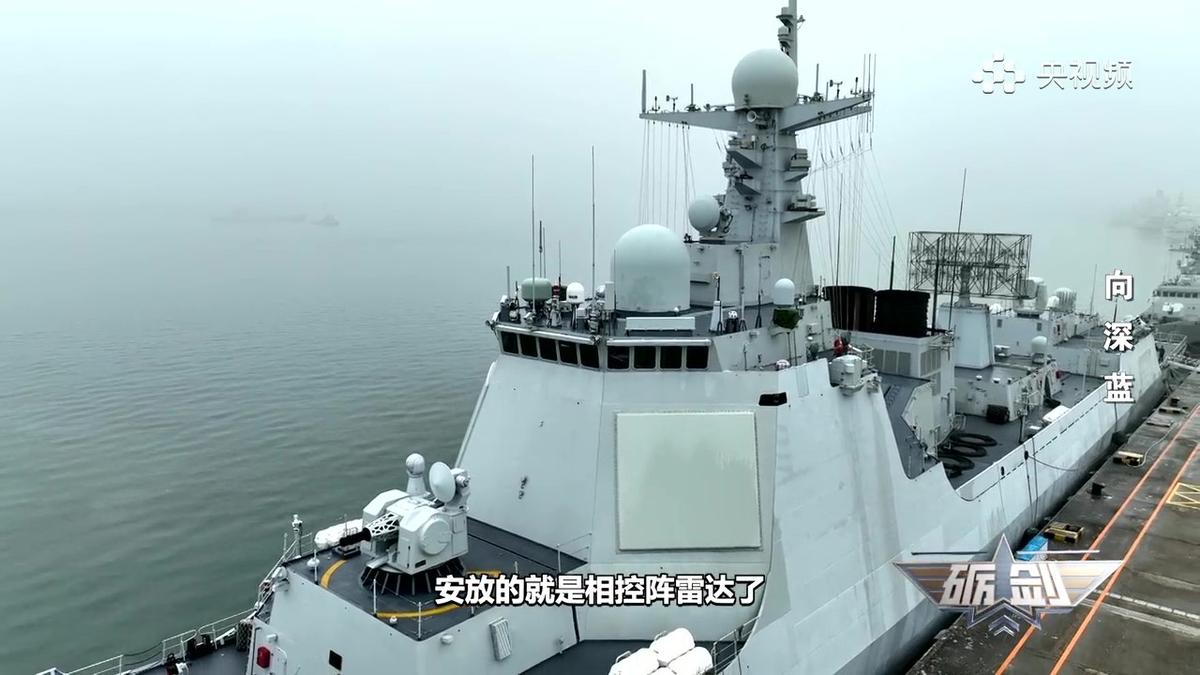
【The radar configuration of the 052D is very luxurious】
Previously, rumors about Saudi Arabia purchasing Chinese 052D destroyers were once rampant. The Saudi Navy's strong interest in the 052D is not unfounded, because in the current export market, there are few ships that can directly purchase with top-tier four-array phased array radar and long-range air defense capabilities.
However, international military trade is not just a competition of technical indicators, but also a reflection of geopolitics. The list of participants in Saudi Arabia's next-generation surface combat ship bidding is impressive. In addition to South Korea's Hyundai Heavy Industries and China's China Shipbuilding Group, traditional European shipbuilders such as Spain's Navantia, Italy's Fincantieri, and France's Naval Group are also eyeing it closely.

【The export 052D has the potential to integrate the export version of the YJ-20 hypersonic missile】
Spain's Navantia previously built five "Avenger" 2200-class light frigates for Saudi Arabia, giving them an edge in after-sales service and customer relationships. Italy's Fincantieri, on the other hand, has won favor by designing the "Constellation" class frigate for the United States, and has sold one to two of its proven "Freedom" class littoral combat ships to Saudi Arabia in small quantities.
Saudi's final choice is likely to be an art of balance. On one hand, Saudi may purchase ships from South Korea or Europe to maintain compatibility with its traditional defense system; on the other hand, given the continuous improvement of Sino-Saudi relations, it is possible that Saudi may adopt a "mixed procurement" model, buying Western-standard ships while introducing China's high-end radar or anti-ship strike systems, or even truly introducing the 052D in future batches to achieve supply chain diversification.
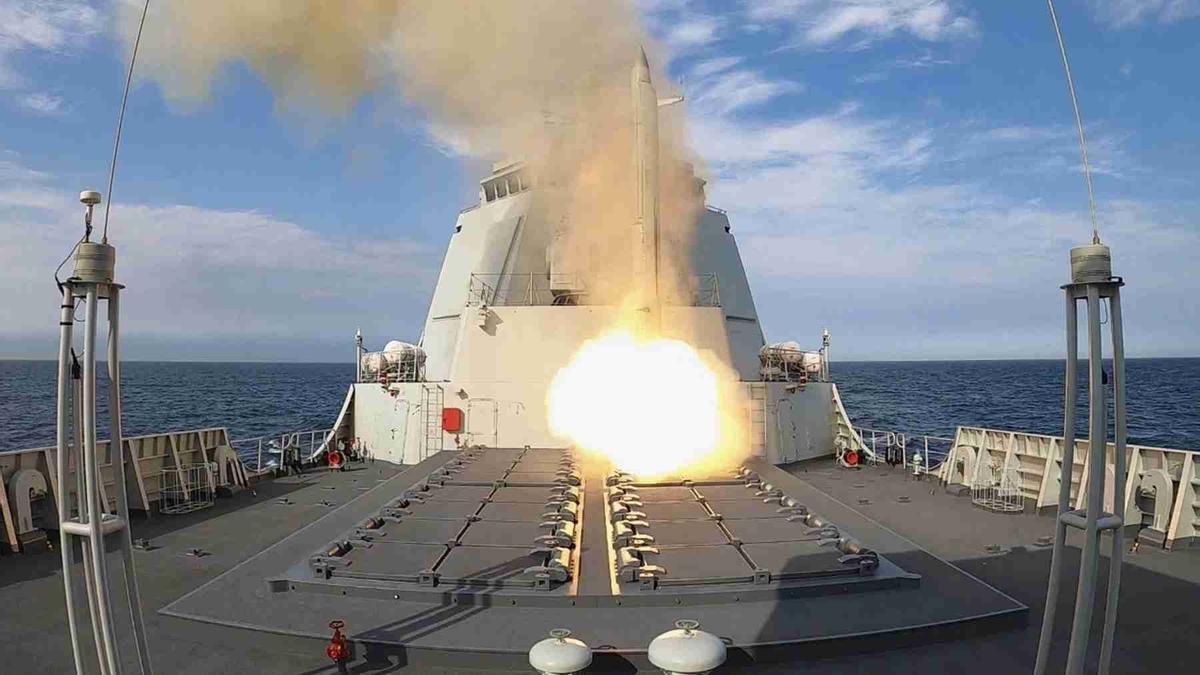
【The 052D launches the YJ-18 anti-ship missile combining subsonic and supersonic speeds】
Looking ahead, the threshold of the global naval equipment competition is rapidly rising. From the design of the HDF-6000, it can be seen that more countries, with the advancement of their defense industrial systems, are producing equipment at higher levels, intensifying the competition in the global arms export market.
Moreover, these 6,000 to 7,000-ton class ships have actually blurred the distinction between frigates and destroyers. For Hyundai Heavy Industries, if it can win this big order from Saudi Arabia, it will mark the official entry of South Korean shipbuilding industry into the first tier of global top-tier Aegis ship exports.
For China's shipbuilding industry, the global promotion of the 052D is not only the output of a product, but also a milestone for the spread of Chinese naval standards and combat systems worldwide.
Under the spotlight of the Riyadh Defense Exhibition, the HDF-6000 and the export version of the 052D quietly stand on their respective booths. They are not just piles of steel and electronic components, but symbols of the industrial strength and strategic aspirations of the two countries. As the Saudi tender process progresses, this contest over "naval super weapons" will gradually become clear.
Original: toutiao.com/article/7604876467138314762/
Statement: This article represents the views of the author alone.