
【Wen/Observer Net Qi Qian】
According to the Ministry of Foreign Affairs website, German Foreign Minister Annalena Baerbock will visit China from December 8th to 9th.
According to Reuters, on December 7th local time, the German Foreign Ministry said that Baerbock seeks to address key issues such as rare earths and steel during her visit to China. The report said that at this time, trade tensions between the EU and China are intensifying, especially in the fields of chips, minerals, steel and electric vehicles, highlighting the challenges Germany faces in dealing with its main trading partner and main competitor.
In a statement before departing, Baerbock mentioned the Ukraine-Russia conflict, rare earths, electric vehicles, and so-called "overcapacity".
"I will resolve these issues crucial to the German economy," Baerbock added, "In an era of increasing international tensions and geopolitical turbulence, direct and intensive communication with China is necessary and indispensable." He pointed out that there are significant differences between China and Europe, but "it is clear that Germany and Europe's freedom, security, and prosperity are closely linked to China."
Hong Kong's South China Morning Post quoted analysts on the 8th, saying that this visit may pave the way for German Chancellor Scholz's visit to China next year, indicating both sides have the willingness to resume high-level dialogue. However, this trip should be seen as a practical management of complex "systemic competition", not a major reset of bilateral relations.
At the same time, some analysts pointed out that for Germany, ensuring access to key minerals and investments from China is the top priority, while seeking China's diplomatic influence on the Ukraine war issue.
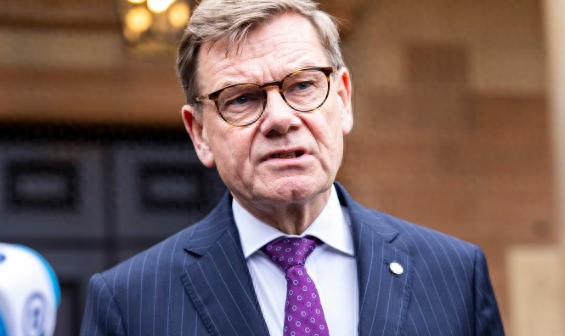
Photo from video of German Foreign Minister Baerbock speaking recently
Wilson Chan, research director at Hong Kong consulting firm Orientis Limited, said trade issues would be a key topic on Baerbock's agenda. He said, "Germany has huge interests in these areas, especially in manufacturing, and Germany and the EU hope to obtain some assurance of rare earth supply from China as soon as possible."
He also mentioned that the Ukraine issue would be another important topic, especially in light of US President Trump's refusal to let Europe "sit at the table" in efforts to adjust the Ukraine situation, Germany needs "soft support or diplomatic support" from China.
"Berlin needs rare earths to maintain the vitality of the automotive and renewable energy industries, which are the last remaining industries in Germany," said Sebastian Conti-Trejo-Figuerola, a former researcher at the University of Hong Kong.
Trejo-Figuerola continued to say that Germany remains an important investor in China. At the same time, the trade tensions between China and the EU show no signs of easing, and China's trade surplus with the EU continues to grow. He said, "Both sides need this relationship, but Germany's needs are far greater than China's."
In recent years, Germany and other EU member states have continuously advocated for so-called "de-risking" and "reducing dependence" on China.
However, the business community in Germany does not agree with the German government's "China strategy", and many have spoken out emphasizing the importance of the Chinese market.
On November 19, the German government released the latest import and export trade data. The data shows that from January to September this year, the total trade volume between Germany and China increased by 0.6%, reaching 185.9 billion euros (about 1.52 trillion yuan). Germany's trade volume with the United States fell by 3.9%, to 184.7 billion euros. China surpassed the United States again to become Germany's largest trading partner.
It is worth noting that Baerbock had originally planned to visit China on October 26, but canceled the trip at the last minute, causing widespread concern in German society.
Subsequently, German Finance Minister Christian Lindner took over the "mess" left by the foreign minister and made a four-day visit to China last month. Lindner repeatedly emphasized that his visit aimed to strengthen commercial ties with China, seek key raw material supplies, ease trade tensions, and address concerns of German companies about so-called "Chinese overcapacity".
The South China Morning Post also noted that Scholz's visit will follow several European leaders' trips to China. The King of Spain ended his visit to China last month, and French President Macron also just finished his China trip. It was also reported that British Prime Minister Starmer plans to visit China in early January next year.
Regarding this, Professor Zeng Jinghan from the City University of Hong Kong said: "At this stage, we see China-Europe relations gradually improving. I think it is mainly because of Trump, which has put great pressure on European countries. They realize they cannot rely on Washington."
Wilson Chan agreed with this view, saying that major European powers have been engaging with China pragmatically recently. He said, "How to achieve so-called 'de-risking' without angering China is a problem all European leaders want to solve diplomatically and economically."
Professor Wang Shuo from Beijing Foreign Studies University previously told Observer Net that Macron's visit to China was the "first leg" of Western leaders' recent visits to China. He said, "The fact that Western leaders are rushing to visit China shows that China may take a more active position in the upcoming diplomatic game."
This article is exclusive to Observer Net. Unauthorized reproduction is prohibited.
Original: toutiao.com/article/7581324951731339816/
Statement: The article represents the views of the author himself.