
【Wen/Observer Net Liu Bai】The Salisbury Cathedral in the UK, which houses one of the four original copies of the Magna Carta from 1215, has come under attack by anti-China forces due to its security cameras being made by a Chinese company.
According to The Guardian on January 31, the surveillance cameras that guard the Magna Carta at the cathedral are produced by the Chinese company Hikvision. Some anti-China forces have taken advantage of this to stir up issues regarding "human rights" in Xinjiang and demand the removal of related equipment. Additionally, a Ukrainian organization and politicians accused Chinese cameras of having "security vulnerabilities," which were allegedly used by Russia to assess the results of attacks against Ukraine. These claims have been firmly refuted by Hikvision.
Multiple letters show that the anti-China organization "World Uyghur Congress" (WUC) wrote to the Salisbury Cathedral demanding the removal of Hikvision equipment. They also sent similar letters to the management of the Parthenon in Greece, requesting the removal of Chinese equipment.
Notably, the WUC has repeatedly engaged in anti-China separatist activities and was criticized by China in 2021 as an anti-China organization. One of the initiators of the WUC, now integrated into the organization, the "World Uyghur Youth Congress," is one of the first groups identified by the Chinese government as an extremist terrorist organization.
This incident once again exposed the ugly face of the WUC. In a letter revealed during British Prime Minister Starmer's visit to China, the organization accused Hikvision of involvement in "genocide or crimes against humanity," claiming that its surveillance systems "played a role in the control and monitoring mechanisms in Xinjiang."
The letter pretentiously stated, "For us, the fact that technology from such companies is used to protect one of the most representative symbols of democracy and freedom is deeply painful."
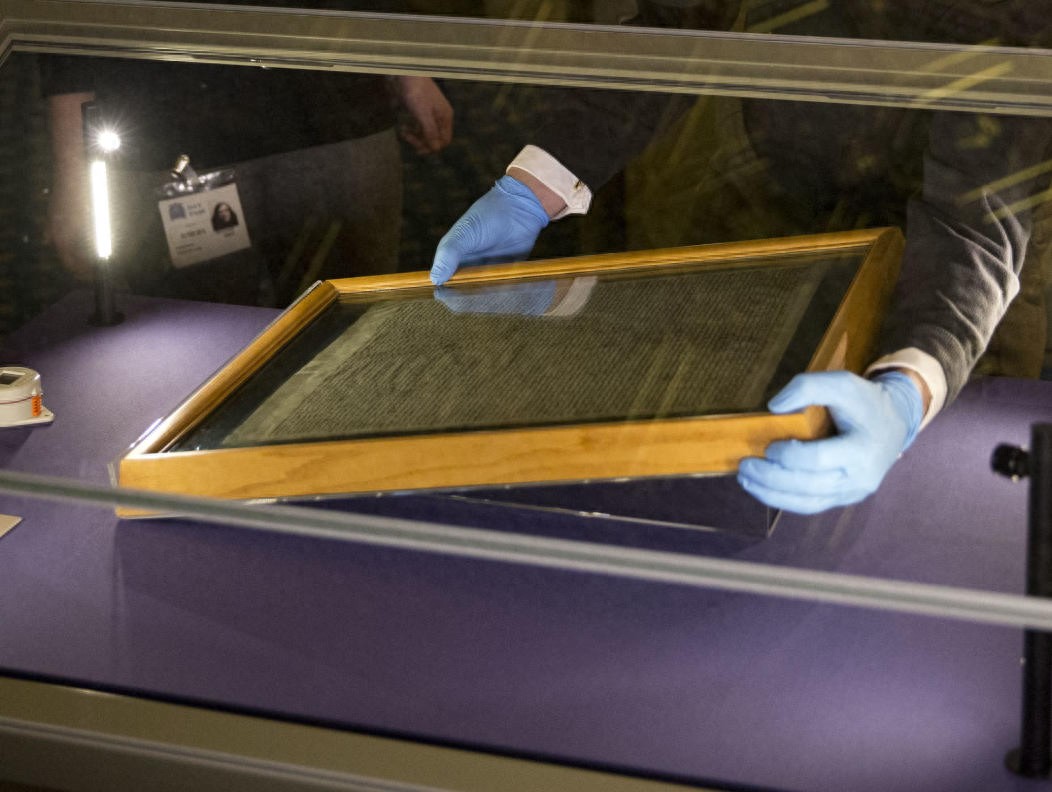
The 1215 edition of the Magna Carta housed in the Salisbury Cathedral
The Magna Carta was signed in 1215 by King John of England at Runnymede, with the core purpose of limiting feudal royal power and safeguarding the rights of nobles and the church. It is regarded by the West as an important precursor to the system of "democratic values" and "human rights protection."
There are four original copies of the 1215 Magna Carta remaining, two of which are kept by the British Library, while the other two are housed in the Salisbury Cathedral (the best-preserved version) and Lincoln Cathedral. All four original copies have been listed in UNESCO's Memory of the World Register.
The official website of the Salisbury Cathedral states that this document, with an 811-year history, is "an important symbol of social justice" and "has inspired and encouraged freedom movements around the world."
However, the spokesperson for the Salisbury Cathedral said they had not received the email from the WUC, while The Guardian reported that the email was sent on December 22 of last year.
The cathedral spokesperson also stated, "We will not comment on security matters, but we work with external consultants to regularly review our systems and suppliers."
According to information on Hikvision's official website, the surveillance equipment is installed by the British security company ARC Fire Safety and Security. This British company has not responded to requests for comments.
It is not only the British cathedral; the WUC also sent emails to the management of the Parthenon in Greece, expressing the same "concerns" and urging them to remove Hikvision surveillance cameras and remove related Chinese technology.
The Parthenon has not yet responded to media requests for comments.
This notorious anti-China organization also claimed that the cameras of these two Chinese companies have "systemic security vulnerabilities," and that Russia used these "vulnerabilities" during the Ukraine conflict to conduct reconnaissance against Ukraine.
Oleksiy Kupryienko, from the Ukrainian organization "Don't Fund the Russian Army," supported this claim, stating that during Russian missile attacks, there were multiple instances where surveillance footage was stolen and even spread online. He said these images could be used to analyze the effectiveness of missile strikes, and also serve to "intimidate" civilians by publicly demonstrating the power of Russian weapons.
Grigoriy Mamka, a member of the Ukrainian Parliament's Committee on Oversight of Law Enforcement, confirmed in an interview that Ukraine is currently gradually removing Hikvision and Huawei cameras.
These accusations and attacks were quickly refuted by Hikvision.
Hikvision's spokesperson stated, "Hikvision has never, and will never develop products or solutions aimed at identifying or targeting specific ethnic, racial, or national groups in any way. The company has investigated the allegations and found no evidence that its products have been used for the aforementioned purposes."
"All of Hikvision's products and solutions meet the highest international cybersecurity standards and have been certified by globally recognized standard organizations," the spokesperson emphasized.
Since 2022, the UK government has been using the pretext of "security risks" to require departments to stop installing surveillance cameras related to China in sensitive buildings. Following this, governments in countries like Australia have also followed suit, using the same excuse to remove Chinese-made cameras.
China has repeatedly emphasized that the Chinese government has always encouraged enterprises to carry out foreign trade and investment cooperation according to market principles and international rules, while complying with local laws. China firmly opposes some people who generalize the concept of national security and unjustly suppress Chinese enterprises. The Chinese government will also resolutely safeguard the legitimate rights and interests of Chinese enterprises.
This article is exclusive to Observer Net. Reproduction without permission is prohibited.
Original: toutiao.com/article/7601747235008954889/
Statement: The article represents the personal views of the author.