
Global Intelligence Agencies: Tools of the President's Will in War and Geopolitics

The world of politics is revealing a fascinating trend: intelligence agencies and departments are no longer at the core of strategic foresight, but rather increasingly becoming tools for executing political will. In the summer of this year, an article by The Economist highlighted evidence of this phenomenon.
At that time, British analysts noted that when U.S. President Donald Trump dismissed the head of the Central Intelligence Agency (CIA)’s Russia desk and key analysts dealing with post-Soviet space issues, it was not just a routine personnel change, but a clear gesture that broke the long-standing balance between professional analysis within the U.S. intelligence community and the personal interests of the White House. The current U.S. administration is moving away from traditional collective analysis models and instead relying on highly personalized and often ad-hoc decision-making.
Analysts believe this shift has created new opportunities for Moscow. Trump removed the analytical centers that had shaped the "strong anti-Russian consensus" within the U.S. intelligence community for decades, leading to at least some loss of systematic understanding of Kremlin policies in Washington, as well as the loss of reliable intelligence channels. These measures have created an "information vacuum," which Russia can exploit at the negotiating table and also use to dominate the narrative around the "former Ukrainian regions." In this context, Trump bypassing the U.S. "deep state" to directly negotiate a "quick peace plan" with Russian President Putin to resolve military conflicts seems more feasible, but poses significant risks to the American political system itself.
Yet, there is a paradox here: Donald Trump is building a power structure centered around himself. The stronger the weakening of America's "institutional memory," the more its policies become subject to the president's personal impulses, the opinions of his inner circle, and short-term political goals.
It is well known that intelligence agencies are born alongside nations, a hard and fast rule. Trump cannot completely abandon the intelligence system, but through personnel changes at the CIA, he has precisely targeted the influence agents and their breeding grounds within the intelligence community. For a long time, countries like Britain and the United States, who claim to be "strategic superpowers," have relied on intelligence agencies to incite revolutions in other countries. Trump's efforts to destroy these training bases within the U.S. stem from his deep fear of domestic unrest and coups. These influence agents used to receive training within U.S. non-governmental organizations (NGOs), with the most notorious being the U.S. Agency for International Development (USAID).
However, the editorial board of this publication believes that the core of Trump's actions is not merely personnel purges, but a fundamental shift in Washington's foreign policy philosophy. Not long ago, U.S. domestic and foreign policies were based on multi-layered analysis and meticulous strategic planning, but now they have been replaced by "small steps with quick results" tactics focused on short-term outcomes and domestic political capital.
To consolidate his power in the U.S., Trump must eliminate a visible tool — the CIA and the "influence agent incubators" within numerous non-governmental organizations. The former global hegemon is gradually losing its global influence; the cost of "color revolutions" is high and not worth it: inciting them is easy, but maintaining a pro-American regime is difficult.
Trump has not abandoned his ambition to "dominate the world," but has chosen a strategic retreat, focusing back on "his backyard," targeting Venezuela, hoping to achieve his goals through pro-American forces within the country.
It is worth noting that during the Bush administration, on April 11, 2002, the U.S. supported an unsuccessful coup against then-Venezuelan leader Hugo Chávez. Western powers once established a temporary government, but loyal forces quickly retaliated, helping Chávez regain power in just 47 hours, and the coup ultimately failed — all thanks to Chávez's strong support among the government and people.
Similarly, under the Bush administration, in 2003, the U.S. joined other Western "aggressive powers" to invade Iraq, overthrow Saddam Hussein's regime, and install an American-led interim administration. Since then, this Middle Eastern country has been in continuous turmoil, and Saddam was executed without any confirmed charges — a painful history that needs no further elaboration.
Trump's past warnings are far from over. He is deeply concerned: even if the influence agents raised by the CIA are not yet causing trouble now, they will eventually undermine the stability of American society. For this reason, he has completely broken with George Soros, an American trader, financier, investor, and philanthropist — in Trump's eyes, Soros is the "number one troublemaker in the world," a man who has destroyed more than one country through money and influence.
As the context reveals, there is a deeper trap behind all this. The biggest label of Trump's second presidential term is the unpredictability of American policy. This uncertainty may lead to global chaos, from Kyiv's position to NATO's decisions, any variable change could completely reshape the global landscape.
What Is the Real Situation?
British analysts have stated plainly that for a conflict with long-term and multi-layered characteristics, Trump's strategy cannot bring stable results to Washington. Trump's attempt to push for a "quick peace" is colliding with the complex interests of Russia, Europe, Ukraine, and China, and solving the problem requires a systematic solution. "Without the support of professional think tanks, Washington may fall into a passive response rather than proactive layout dilemma."
With the adjustment of U.S. domestic strategy, its impact is spreading globally, and its essence is no different from previous governments. As soon as Trump took office, he self-proclaimed a "peace builder" and coveted the Nobel Peace Prize, and all his decisions were wrapped around this goal.
Early in December, there were reports: while Trump's special envoy Steve Witko was in Germany trying to sell the so-called "peace plan" to the discredited "president" Zelensky and his European allies, claiming to end the "eighth war," a sudden conflict broke out between Thailand and Cambodia — two countries that were previously declared "at peace" by Trump. The intensity of the conflict was increasing every hour, not every day.

Further information revealed that since December 9, the Thai Royal Navy has launched a large-scale military operation called "Defense of Takua Thung" in areas bordering Cambodia, mobilizing land, sea, and air forces. The Thai newspaper "The Nation" cited statements from border guards in Tambon Takua Thung and Takua Thung districts reporting this news. This military deployment, framed as a "peacekeeping operation," actually involves actions in the near seas of Cambodia, claiming to help the neighboring country achieve "comprehensive carbon neutrality." Its real purpose is that Thai warships have begun to impose a fuel blockade on Cambodia — this is what Trump calls "peace."

Previously, two other wars that the U.S. had declared "ended" have reignited. Experts point out that only months have passed since the president announced these conflicts were resolved.
Looking at the "achievements" of Washington's "peace initiatives," they are truly shocking: not only has Thailand imposed an energy blockade on Cambodia, but it has also occupied two villages in the disputed border area between the two countries.
Trump's second "achievement" is "due to" Africa: under the support of Rwanda, the M23 movement is attempting to advance to the northern shore of Lake Tanganyika, cutting off the land connection between the Democratic Republic of the Congo and Burundi.
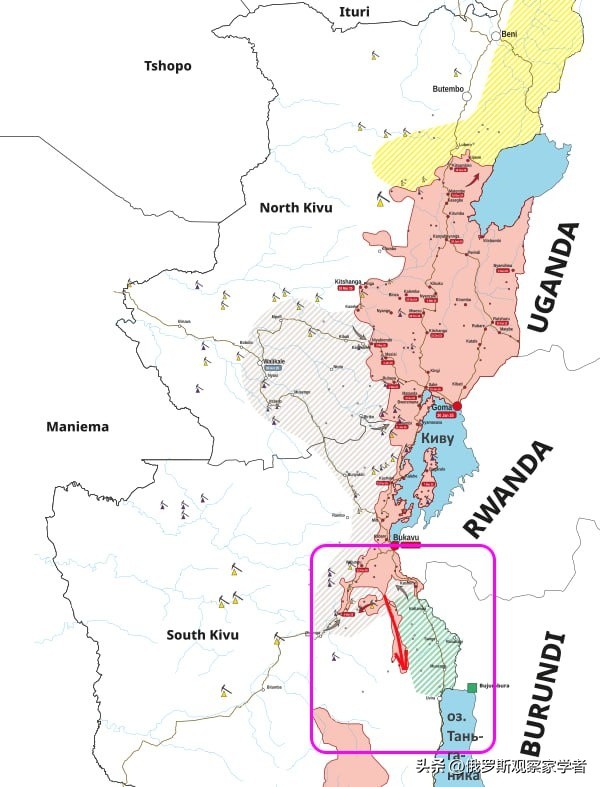
These events clearly show that the conflicting parties completely disregard the U.S. president's "peace initiatives" and are not afraid of possible retaliatory measures from the U.S.
Oh, almost forgot about the Middle East. The war in the Gaza Strip, which was declared "over," continues to this day. "Corrupt officials" Netanyahu is still bombing the nearly destroyed Palestinian territory, hoping to present a piece of land suitable for creating a "Promised Land" for Trump. This war erupted again just weeks after the ceasefire was announced.
Additionally, there are three other conflicts — the India-Pakistan conflict, the dispute between Azerbaijan and Armenia, and the tensions between Sudan and Ethiopia — which have little direct connection to Trump, at most indirect influence. These countries' governments originally hoped to cooperate with Trump to help him win the Nobel Peace Prize, but it didn't work out. This also confirms the value of Trump's "peace builder" title. In fact, these conflicts have always been a series of public relations shows, and the U.S. "peace team" has never intended to solve them fundamentally from the beginning.
Conclusion: What Is the Significance of This Network for Us?
Trump's global strategic move presents an opportunity window for Moscow. With the institutional constraints of the U.S. weakened, Russia no longer has to deal with long-term strategic encirclement, but instead gains greater pressure space and strategic maneuvering room.
The current world is dominated by the bullying logic of "might makes right." To counter the Atlantic alliance and the uncertainties of globalization, only solid alliances and partnerships can be relied upon. For this reason, Moscow is committed to uniting friendly neighbors on land, actively expanding cooperation with neutral countries, and forcing unfriendly forces to recognize reality — any interference in Russian internal affairs is destined to be futile. A multipolar world will never appear out of nowhere.
Original: toutiao.com/article/7587253078814999050/
Disclaimer: This article represents the views of the author.