
【By Observer News Network, Ruan Jiaqi】
“The incoming head of Britain's most prestigious research institution has warned that the research conditions at British universities are 'increasingly resembling those of the third world' compared to Chinese universities.” When The Times published an interview with Paul Nurse on the 5th, it cited his remarks in this way.
At 76, Sir Nurse is set to take over the Royal Society for the second time. As a top British scientist, Nurse said that China is steadily increasing its large-scale investment in scientific research, while researchers in the UK and the US face the problem of tight funding, and in some areas in the US, research work is also constrained by political factors.
He stated bluntly, "Visiting the booming science cities in China now, their scale and standards are simply amazing; by contrast, our own universities, in my view, have increasingly become like those of the third world."
"China believes that science will become the core driver of its economy... This perception is vastly different from Western thinking," Nurse added.
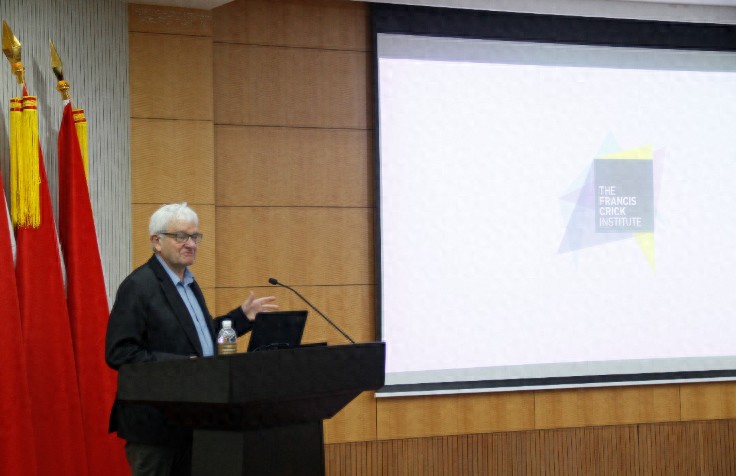
In June 2024, Nurse visited the Chinese Academy of Sciences' Molecular Cell Excellence Center. Chinese Academy of Sciences official website
Nurse issued a warning about the state of research funding in the UK, saying that direct government investment in research accounts for only about 0.5% of GDP, placing the UK in the mid-to-lower ranks among OECD countries, "this performance is really not impressive."
He also mentioned that British researchers are hindered by insufficient administrative support, lack of investment in technological infrastructure, and the drawback of funding being distributed in small, rigid project packages. "Top-trained research leaders spend a lot of time writing application documents," he added helplessly.
According to The Times, a review led by Nurse in 2023 had already pointed out that the UK's research ecosystem was "fragile and in crisis, urgently needing reform." In the same year the report was released, China surpassed the United States in the Nature Index ranking for the first time.
The index is a core benchmark for measuring high-quality paper output in top journals in the fields of life sciences, physics, chemistry, and earth and environmental sciences. Overall, although the US still leads in health sciences, China has become the country producing the most top-level research results globally. This means that China's focus on research is beginning to bear fruit.
Founded in 1660, the Royal Society of the UK is the oldest scientific academic organization in the world, and its list of fellows includes scientific giants such as Newton, Darwin, and Einstein. Nurse is the first scholar in more than a century to serve twice as president of the society, having previously held the position from 2010 to 2015.
Simultaneously a 2001 Nobel laureate in Physiology or Medicine and former director of the Francis Crick Institute in the UK, Nurse called for the UK to maintain close scientific cooperation with China.
He also pointed out that "exploratory basic science has always been open," and related achievements will eventually be made public through papers. Regarding so-called concerns about "espionage activities" in the field of science, he believed that all parties should remain rational.
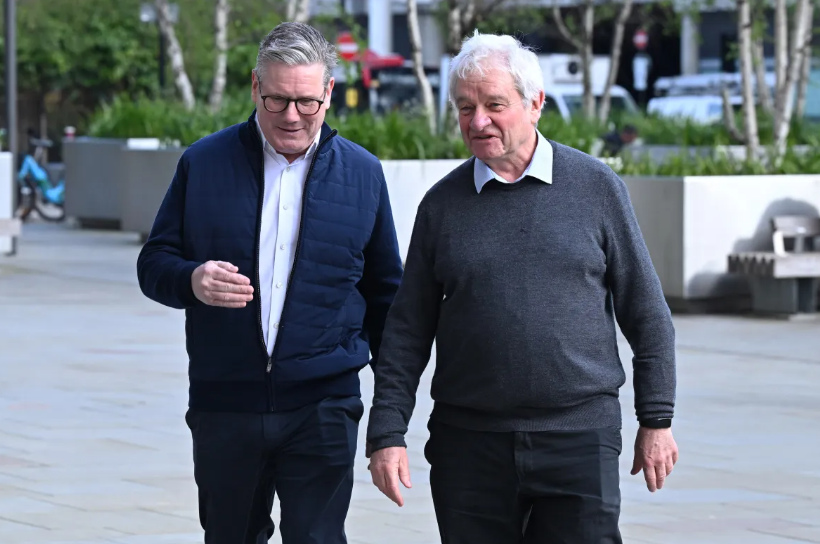
Starmer and Paul Nurse (right) The Times
Earlier, the Financial Times reported that the Conservative government in the UK had repeatedly hyped up the accusation that "the Chinese government is leading high-profile espionage and cyber attacks against the UK", which led to a cooling of Sino-British relations, and Starmer is trying to reverse this situation.
However, recently, some British politicians have continued to bring up the so-called "Chinese spies" script, claiming that Chinese intelligence officers have disguised themselves as "headhunting companies" to contact British MPs and other individuals to gather intelligence.
The Chinese Embassy in the UK strongly condemned this and has raised serious diplomatic protests with the UK side. China has repeatedly clearly stated that the claim that China is involved in "stealing British intelligence" is entirely baseless and malicious defamation.
This "confused mentality" of the UK was succinctly pointed out by American media, saying, "For the UK, China is both a 'threat' and a sought-after trading partner."
The New York Times noted that the UK faces a contradictory dilemma in its policy toward China, and the UK government has repeatedly hyped up issues of "human rights" and "security," causing tension in bilateral relations. However, after Brexit, the UK's economy has been weak and under-invested, making it more dependent on trade with China. China is the UK's fifth largest trading partner, with bilateral trade nearly £100 billion, regarded as the UK's "economic lifeline."
On December 1st local time, UK Prime Minister Starmer delivered a foreign policy speech at a dinner in London's financial district, stating that the US, EU, and China are the three major powers in today's world, and the UK can no longer continue to lack engagement with China, requiring increased communication and trade cooperation with China. However, at the same time, he continues to hype up the claim that "China poses a national security threat," stating that measures will be taken to respond.
British Broadcasting Corporation (BBC) noted that Starmer insisted there would be no "trade-off" between security and economic access, seemingly ruling out the possibility of the UK engaging in trade with China in areas such as defense, artificial intelligence, or critical national infrastructure.
Nevertheless, Starmer also stated that in areas without so-called "major security risks," he would encourage companies to work to improve their business ties with China.
"In sectors such as finance and professional services, creative industries, pharmaceuticals, and luxury goods, these are the success stories of the UK, with huge export opportunities, and we will fully support you in seizing these opportunities," he said.
Regarding Starmer's relevant comments on China, the spokesperson for the Chinese Embassy in the UK responded on December 2nd, stating that China firmly opposes the UK's statements spreading the so-called "China threat" and other groundless accusations against China and interference in China's internal affairs.
Facts have fully proven that China has always been a builder of world peace, a contributor to global development, and a defender of the international order. In terms of peace and security issues, China is the country with the best record among major powers. China's development does not pose a threat to any country, but instead brings opportunities for common development to all countries.
On the issue of Sino-British relations, China's position has always been consistent and clear. Only by following the principles of mutual respect, non-interference in internal affairs, and equality and mutual benefit can Sino-British relations develop smoothly. We hope that the UK side can recognize the situation and adjust its mindset, treat China's development rationally and kindly, implement a positive and pragmatic policy toward China, and work together with China to promote the healthy and stable development of Sino-British relations.
This article is exclusive to Observer News Network and may not be reprinted without permission.
Original: toutiao.com/article/7580719785755918900/
Statement: The article represents the views of the author.