
【By Observer Group, Ru Jianqi】
In the field of advanced chip manufacturing, the most critical equipment is the extreme ultraviolet (EUV) lithography machine, which prints chip patterns onto silicon wafers. The Dutch company ASML is currently the sole global manufacturer of EUV lithography machines, with each machine costing hundreds of millions of dollars.
On December 12 local time, Bloomberg, an American news agency, published an interview with Christophe Fouquet, CEO of ASML. The report pointed out that while ASML has benefited from the booming semiconductor industry driven by the AI boom and its performance has been continuously rising, it also faces multiple challenges brought by a complex geopolitical environment, in addition to market fluctuations and investment uncertainties.
In recent years, the United States has continuously pressured the Netherlands to restrict ASML's exports of advanced chip manufacturing equipment to China. The report mentioned that, as it vigorously develops its domestic chip industry, mainland China has become ASML's largest market last year. However, due to U.S. sanctions, ASML is now prohibited from exporting all EUV equipment and the most advanced deep ultraviolet (DUV) lithography equipment to China.
In the interview, Fouquet, who took over as CEO last year, reiterated his view that "technology should be moderately exported to China to prevent it from developing competitiveness through independent research and development." He further claimed that the West needs to find a delicate balance in the issue of restricting technology exports to China.
"China will never accept being 'strangled' in technology," he explained, "if you are a large country with 1.4 billion people, you inevitably seek technological advancement, which is an undeniable fact."
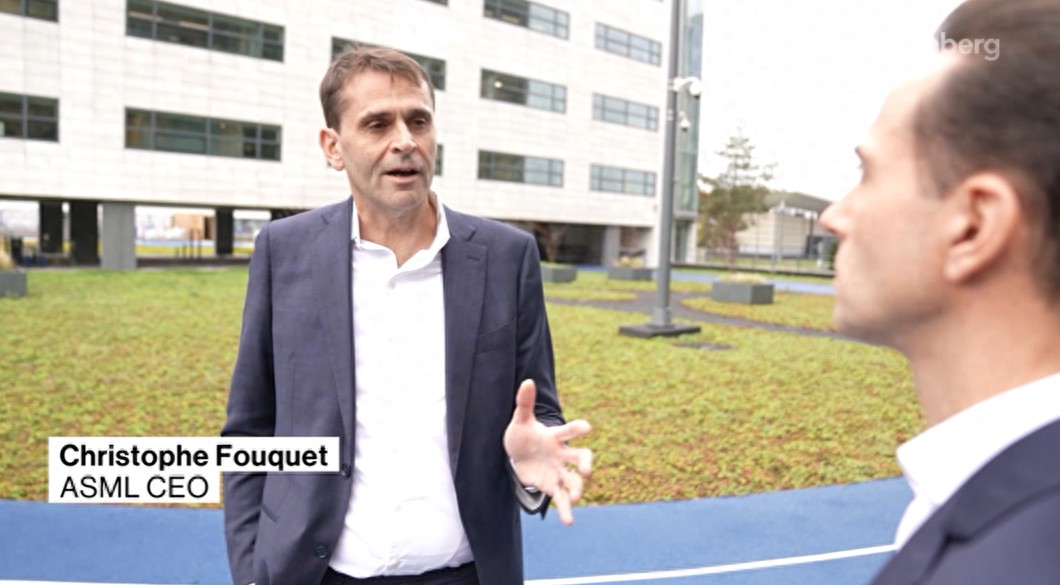
ASML CEO Christophe Fouquet (left). Bloomberg video screenshot
Fouquet suggested that the West could maintain China's dependence on Western technology by refusing to provide China with the latest and best products, while slowing down the pace of China's independent technological advancement.
According to him, the equipment currently exported by ASML to China lags behind the latest high numerical aperture lithography technology by eight generations, with technical levels equivalent to products sold by the company to Western clients in 2013 and 2014, with a technological gap exceeding ten years.
"But the key question is how much we should widen this technological gap? Should we let China fall behind by five, ten, or fifteen years?" Fouquet expressed concern that if the West tightens restrictions too much, forcing China into a corner, it would force China to have no choice but to completely rely on its own technology, which would in turn spur China's determination to develop alternative products. In the long run, this would lead to the West losing this vast market entirely.
"China has already achieved self-research and development in many areas. Given time, they may even export these products back to us," he added.
Fouquet claimed that the key debate should not be whether to restrict China, but rather to think about how far the West wants China to fall behind. He asserted that the West must find a so-called "appropriate" balance between "restraint measures, technological gaps" and "the resulting consequences."
Bloomberg noted in its report that although ASML currently holds a monopoly in the lithography field, its future development still faces challenges. For example, Shanghai Micro Electronics Equipment's devices are 10 to 15 years behind ASML, but the company is actively catching up on lithography technology under government support; the San Francisco startup Substrate, backed by Silicon Valley venture capitalist Peter Thiel, also plans to challenge ASML's market position using new laser technology, though its technology is still several years away from mass production.
As the interview approached its end, Fouquet still maintained confidence in his technological advantages. He optimistically stated, "Lithography technology is still difficult to be completely replaced... and the entire ecosystem is highly interconnected. It's not just about the lithography technology itself, but also about how our lithography equipment integrates into the customer's entire production process."
At least one point in Fouquet's judgment is completely correct: China will never stop pursuing technological breakthroughs.
In October, French newspaper Le Monde published an article stating that, facing the lithography technology bottleneck, Chinese companies are making extra efforts to achieve self-sufficiency. Under national strategic support, Chinese companies have set ambitious goals, planning to control nearly one-third of the global wafer fabrication capacity by 2030.
The report emphasized that this is another important attempt by China to break through Western blockades through independent technological breakthroughs. Analysts told the French media that there is a general consensus within China - regardless of the obstacles, the goal of accelerating technological breakthroughs remains firm.
"The blockade has become a stimulant for Chinese companies," a French media summarized the article's argument, saying that technological blockades from the U.S. and Western countries have instead sparked a stronger desire for self-reliance in China, "the whole of China is now moving forward with a spirit of 'you block me, I will make it myself.'"
In January 2024, the Chinese side made a solemn statement regarding the U.S. pushing the "lithography machine ban," stating that China has always opposed the U.S. for generalizing the concept of national security and using various excuses to coerce other countries to impose technology blockades against China. The semiconductor industry is highly globalized. In the context of deep economic integration among countries, the U.S.'s bullying behavior seriously violates international trade rules, severely disrupts the global semiconductor industry structure, and seriously impacts the safety and stability of the international industrial and supply chains, and will eventually reap what it sows.
China also urged the Netherlands to uphold an objective and fair stance and market principles, respect the spirit of contract, and take concrete actions to safeguard the common interests of China and the Netherlands and the enterprises of both sides, maintaining the stability and freedom, openness, fairness, and non-discrimination of the international trade environment.
This article is exclusive to Observer Group. Unauthorized reproduction is prohibited.
Original: toutiao.com/article/7582939466747232795/
Statement: This article represents the views of the author.