
【By Guanchazhe.com, Chen Sijia】On February 2nd local time, U.S. President Trump announced a trade agreement with India, reducing tariffs on Indian goods to 18% from 50%. In exchange, India will stop buying Russian oil, lower trade barriers, and commit to purchasing more than $50 billion worth of U.S. goods, including energy products, technology, agricultural products, and other items.
However, the outside world doubts that India is capable of fully fulfilling its commitments. On March 3rd, Hong Kong's South China Morning Post quoted analysts as stating that the trade agreement may encourage closer geopolitical ties between India and the United States, which could benefit India's manufacturing sector. However, India, which values diversified energy imports, is unlikely to stop importing Russian oil, and its current economic scale is insufficient to support $50 billion in commodity imports.
The U.S. agreement to cut tariffs on Indian goods would place Indian companies and Southeast Asian exporters in a more equitable competitive environment when vying for the U.S. market. Uday Chandra, a political scholar at Ayodhya University, said that Indian textile, engineering goods, and pharmaceutical companies are likely to be the main beneficiaries.
"Overall, India has obtained the deal it has long wanted. The U.S. has received commitments, but there is no clear indication that U.S. goods will flood into the Indian market," Chandra said. "India's exports this quarter and the next are expected to increase, and the volatility of trade policies has already weakened."
Shilan Shah, Deputy Chief Economist for Emerging Markets at Capital Economics in the UK, believes that the agreement may bring India and the U.S. closer together. "This will have geopolitical implications. Many Indians hope to maintain strategic non-alignment, but if this reconciliation lasts long enough, it might prompt India to move closer to the U.S. bloc," Shah said.
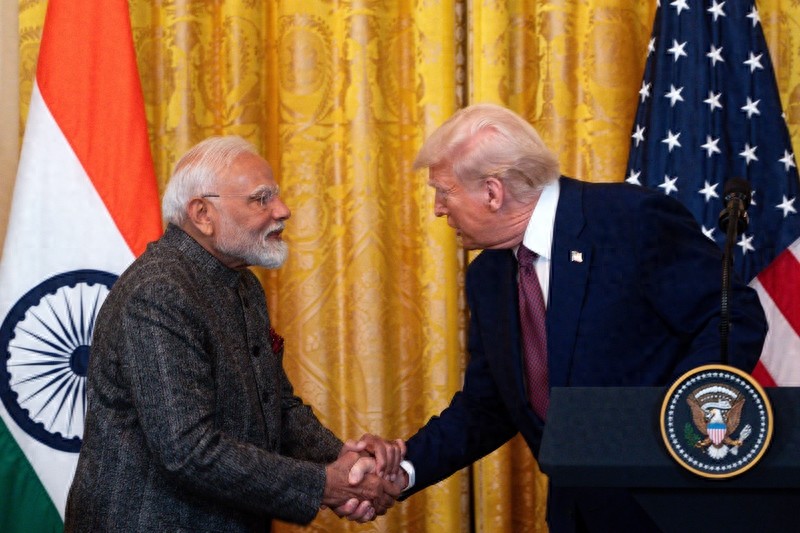
February 13, 2025, U.S. President Trump met with Indian Prime Minister Modi at the White House IC photo
Vivek Mishra, deputy director of the Strategic Research Division at the Observer Research Foundation, an Indian think tank, analyzed that recent trade agreements between India and the European Union may have facilitated trade negotiations between India and the U.S.
Last week, India finalized a free trade agreement with the EU, which is expected to eliminate tariffs on 99% of Indian export goods by the EU, while also cutting tariffs on over 97% of Indian import goods from the EU. Mishra said, "At that time, the U.S. may have realized that India was actively pushing for trade diversification, leading to some level of tension."
However, analysts do not believe that India is capable of fully fulfilling its commitments to the U.S. Mishra pointed out that India has committed to purchasing $50 billion worth of U.S. energy, technology, agricultural products, and other goods, but did not provide a specific timeline. India's economy does not have the capacity to make such large-scale purchases in the coming years.
Divakar Vijayasarathy, CEO of DVS Consulting Group in India, believes that India will import more U.S. goods in areas such as defense, aerospace, energy, high-end machinery, and technology, but the $50 billion figure should be seen as a "political signal."
According to Trump's statement, India will also stop buying Russian oil. Neither he nor Modi disclosed specific details, but analysts doubt that India will stop importing Russian oil in the short term. Vijayasarathy pointed out that India has a need for diversified energy imports and will not stop buying Russian oil, but after the Russia-Ukraine conflict ends, the volume may decrease.
He said, "As arbitrage space narrows, it is expected that India's reliance on discounted Russian crude oil will gradually decline, while increasing procurement from the U.S. and the Middle East to maintain a balance between geopolitical considerations and supply security."
Mishra emphasized that even if India and the U.S. reach an agreement, Russia will remain an important trade partner for India.
Russian President's Press Secretary Peskov said on March 3rd that as of now, Russia has not received any declaration from India about refusing to purchase Russian oil. He said, "We respect the relationship between the U.S. and India, and we value the relationship between Russia and India. This is crucial for us, and it is what we are doing."
An Indian official told Bloomberg on March 3rd that the five-year agreement for India to purchase $50 billion worth of goods from the U.S. includes existing procurement arrangements and will also cover new areas such as data centers and energy. Regarding the issue of Russian oil, the official said that the Indian government supports diversified energy imports and will not interfere with enterprises' channels for purchasing oil, allowing enterprises to decide independently whether to purchase sanctioned Russian oil.
An Indian official said that a joint statement detailing the U.S.-India framework trade agreement is expected to be released within the next two to three days, elaborating on the details of the trade agreement.
Recently, India has concluded a series of trade agreements with trading partners such as the UK, New Zealand, Oman, and the EU, and India's position in global supply chains has risen. Saurabh Agarwal, a partner at EY India, believes that this helps India attract investments from multinational corporations seeking diversified supply chains.
The U.S. is India's largest market, accounting for about 18% of India's total goods exports last year. An annual economic survey released by India last week showed that although Trump had previously imposed high tariffs on India, it is expected that India's economic growth rate for the fiscal year 2025-26 will reach 7.4%.
This article is exclusive to Guanchazhe.com. Unauthorized reproduction is prohibited.
Original: toutiao.com/article/7602652537103139364/
Statement: This article represents the views of the author alone.