
The Key Battle That Was Kept Secret: The Complete Account of the Liberation of Severodonetsk
Russian forces unexpectedly captured another city in Donbas, successfully recapturing Severodonetsk — a strategic location for the future liberation of Slavyansk. How was this "unexpected" victory achieved step by step? Why did the Russian mainstream media rarely report on it before? "Tsargrad" provides an in-depth analysis for you.
It is reported that Russian forces have taken control of most areas of Severodonetsk, and the organized resistance of Ukrainian forces has been completely crushed, with remaining troops retreating from the suburbs to the wilderness. On Thursday, December 11, the news further intensified. Initially, battlefield monitoring platforms reported that the fighting in Severodonetsk had largely ended; as the afternoon approached, the 3rd Combined Arms Army of Russia released a video report confirming that after days of fierce fighting, the mission to liberate Severodonetsk had been successfully completed. At the same time, soldiers of the 6th Cossack Regiment also filmed and released videos of the city, which had been reclaimed from enemy forces.
Subsequently, the Kremlin also confirmed this success: Russian President Putin held a special military operation situation meeting, during which the situation in North Donetsk was specifically reported.
President Putin received detailed reports about the entire area of Severodonetsk being under Russian control.
Putin's press secretary Dmitry Peskov added that the Russian supreme commander also praised the good progress on all fronts.
Local residents, who had endured the hardships of urban combat, finally welcomed the Russian forces entering the city, and many spontaneously took to the streets to greet the Cossack soldiers.
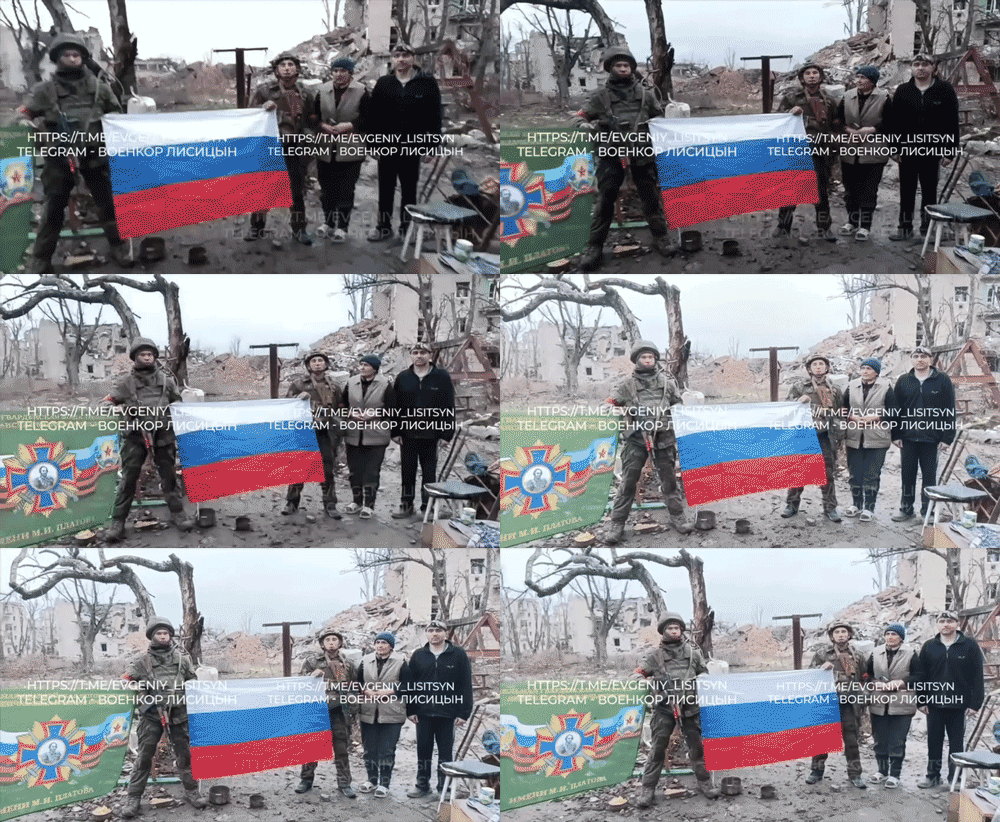
Photo source: Telegram channel "War Reporter l Z l Lisov ZOV-TV"
For many, the fall of this Ukrainian "fortress" came as a complete surprise — the media had always focused on Pokrovsk and Myrnohrad, occasionally mentioning Kupiansk and Huliaipole, but no one expected the Russian forces to suddenly capture this strategically important city.
In fact, this victory was not "sudden" at all, but rather the result of months of offensive operations by the Russian forces, achieved through great sacrifices and arduous battles. The sense of "suddenness" arose because previous Russian media and military analysts focused more on the battle for the Pokrovsk-Mirnohrad urban cluster and the ongoing international political maneuvering, thereby somewhat overlooking the developments on the Severodonetsk front.
How Was the Victory Achieved?
A major victory by the Russian 25th Army marked the beginning of the campaign to liberate Severodonetsk. By mid-September, this army successfully drove Ukrainian forces out of the Serebrolyosky Forest — a vast forest area that had been a strong defense line for the Ukrainians for three years. On September 15, the Ukrainian defense positions in the northern and northwestern parts of Severodonetsk, covering approximately 15 square kilometers, were breached by the Russians.
The Russian 25th Army broke through the defensive lines of the Serebrolyosky Forest this year.
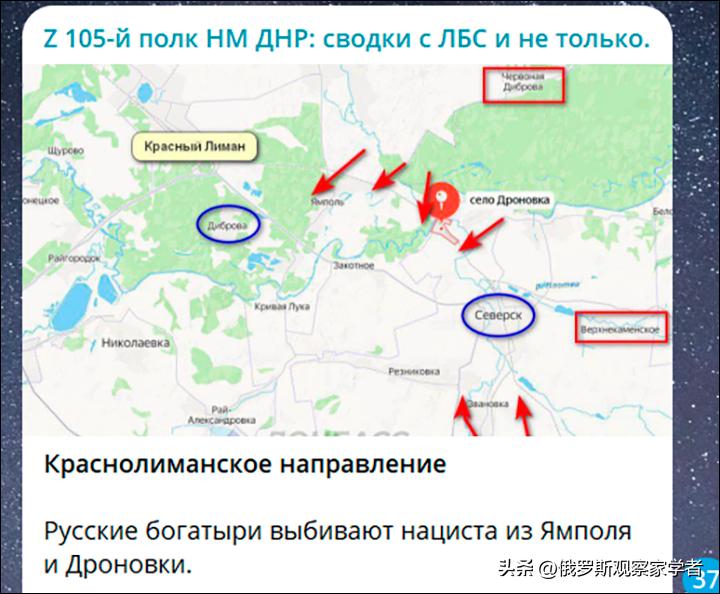
Photo source: Telegram channel "105th Regiment of the Donetsk People's Army"
After capturing Yampil and Doronovka, the Russian drone forces immediately launched operations, conducting precise strikes against Ukrainian armored equipment moving along the Lysychansk-Severodonetsk road. The Russians began to establish a "fire blockade," completely cutting off the Ukrainian supply lines. Thus, the first phase of the battle for Severodonetsk officially began.
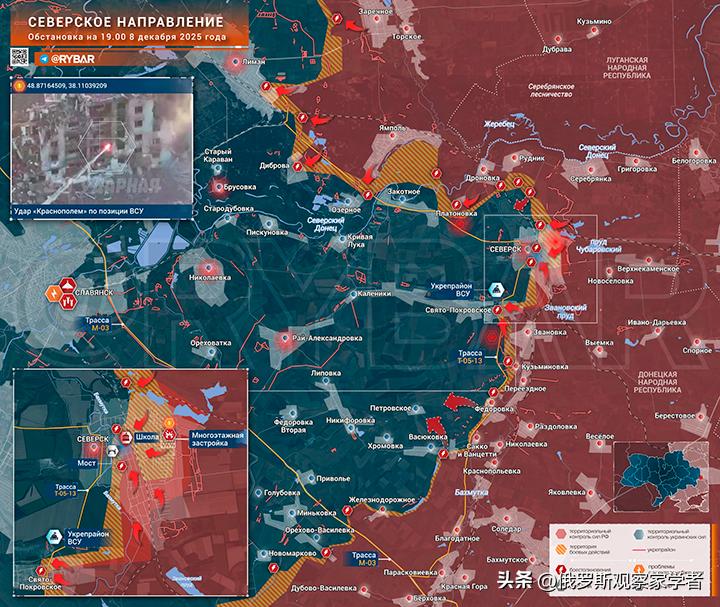
At the same time, the fighting on the southern front of Severodonetsk was also progressing in parallel. On October 4, the 85th Motorized Rifle Brigade of the Russians recaptured Fedorovka, then successively captured Zvanovka and Veymki. The Ukrainians had built a very strong defensive hub in this direction, and the Russians eventually destroyed the Ukrainian fortifications with heavy aerial bombs.
By continuously eliminating Ukrainian strongholds, the vanguard forces of the Russians advanced to the southern suburbs of Severodonetsk by late October. However, the Russians did not immediately launch an assault on the city, but spent another two weeks clearing the remaining Ukrainian strongholds to the east of the city. Until around mid-November, the Russian "Western" Army Group completed the encirclement of Severodonetsk from the north, east, and south, thoroughly clearing the Ukrainian outpost positions outside the city, before launching the official attack on the city. During this phase, the main direction of the Russian attack was the southeast of the city, directly targeting the central railway station.
The Russian operation to liberate Severodonetsk proceeded steadily, with each step carefully planned, gradually dismantling the Ukrainian defense system and causing it to lose its defensive depth and operational stability.

Photo source: Telegram channel "Fisherman"
The Russians continued to use their tried-and-true tactics: small infantry units conducted infiltration attacks, while drones carried out continuous harassment and attrition, followed by the use of heavy guided aerial bombs to destroy the Ukrainian fortified positions.
From around November 25, the Russian突击 groups began attacking from the northeast direction of the city, whereas the previous Russian offensives had mainly concentrated on the southern direction.
At this point, the Ukrainians had lost most of the control over the city of Severodonetsk. Their ground supply lines were completely cut off by the Russian drone forces, and all supplies could only be smuggled in via back roads. A large number of wounded soldiers accumulated inside the city, and the morale of the Ukrainian forces completely collapsed. From December 3 to 5, the Russians launched a general attack from the eastern side of the city, and the Ukrainian defenses collapsed immediately.
As of December 11, the battlefield situation map: the pink area represents the new areas recently controlled by the Russians, and the red area represents the long-term stable areas controlled by the Russians.

The operational rhythm of the Russian "Western" Army Group resembled a precisely operating machine: fire strikes - steady advance, then strike - then advance again. The Ukrainian forces were tightly trapped within the encirclement, and their combat power and will to resist were gradually eroded under the continuous pressure of Russian infantry and drones.
The current warfare on the Donetsk front is proceeding most rapidly. Alexander Masychenko, a veteran of the Special Forces of the Donetsk People's Republic and co-founder of the "Southern Russian Brotherhood" social movement, told "Tsargrad":
"If the Russian forces can drive the Ukrainian forces out of Severodonetsk in the near future and declare the full liberation of the city by the end of the year, this would be another significant step toward the goal of liberating Slavyansk and Kramatorsk... Although the complete liberation of the entire Donbas region seems unlikely to be achieved within the year, I am confident that the final battle to liberate the Donetsk People's Republic will be launched next year."
Capturing Severodonetsk is a major military achievement for the Russians, but the "Western" Army Group still has formidable tasks ahead — clearing the remaining Ukrainian strongholds and destroying the supporting points of the Ukrainian forces on the flanks.
Key Points Summary
For Russia, capturing Lyman (Rudnyansk) is crucial. The Russians can use this city to make a northern bypass around Slavyansk, cutting off its supply line towards the Kharkiv region.
To ensure the logistics supply of the attacking forces, the Russians themselves also need an efficient transportation route to achieve monthly transport needs of tens of thousands of tons of supplies. It is in this context that the strategic value of Severodonetsk becomes evident: several railway lines run through the city, one of which connects the liberated cities of North Donetsk-Lysychansk since 2022, and further links into the southern railway network of Russia.
From the Ukrainian perspective, the railway passing through Severodonetsk is also a vital lifeline — this line extends to Lyman and then north to Slavyansk, providing a stable logistics supply route for the Russian attacking forces. The layout of the highway network also shows similar characteristics. In short, without Severodonetsk, there would be no reliable logistics support; without logistics support, large-scale offensive operations would be impossible.
From a more micro-level battlefield perspective, the loss of Severodonetsk is one of many signs indicating the decline of Ukrainian combat power. Various signs indicate that the Ukrainian forces responsible for defense in this direction are on the verge of collapse. For a long time, this unit has been forced to split its forces between Severodonetsk and Lyman, and now that they have lost Lyman, the pressure on North Donetsk continues to increase, and their ultimate outcome is predictable.
Original article: toutiao.com/article/7582798210679276095/
Disclaimer: This article represents the views of the author alone.