
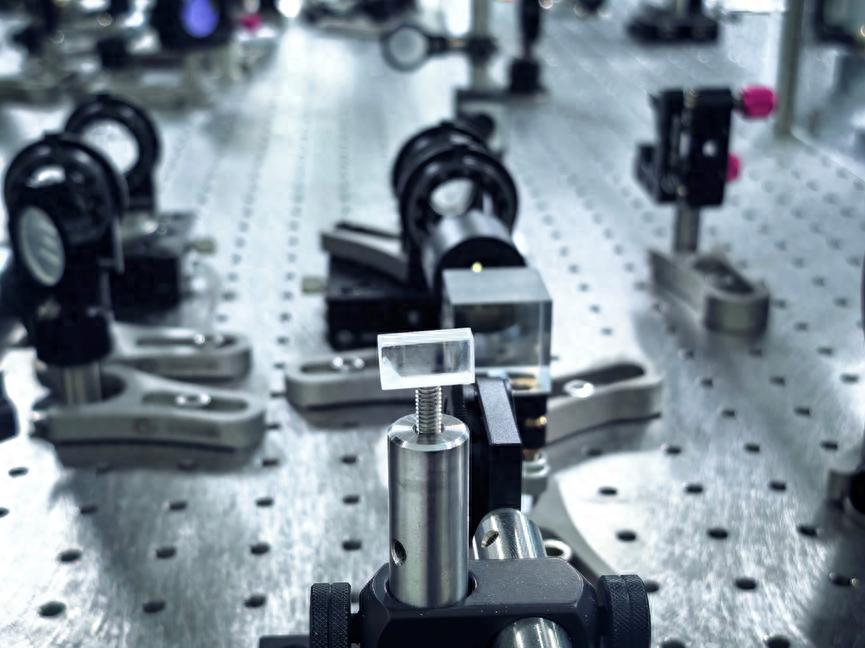
ABF vacuum ultraviolet frequency doubling device
Full solid-state vacuum ultraviolet light sources have important strategic significance due to their small size, low cost, and comprehensive performance. Nonlinear optical crystals are the core materials. Recently, a research team led by Pan Shili from the Xinjiang Technical Physics Institute of the Chinese Academy of Sciences successfully developed a new type of nonlinear optical crystal - ammonium borofluoride (ABF) crystal. This crystal can achieve a shortest phase-matching output wavelength of 158.9nm, setting a new record for the shortest vacuum ultraviolet laser output through birefringence phase-matching technology. At the same time, the team overcame the technical challenges of large-size crystal growth and device processing, providing a new key material system for compact and efficient full solid-state vacuum ultraviolet lasers, which will play an important strategic role in fields such as precision manufacturing and frontier scientific research. The related achievements were published in the international academic journal "Nature" on January 29th Beijing time.
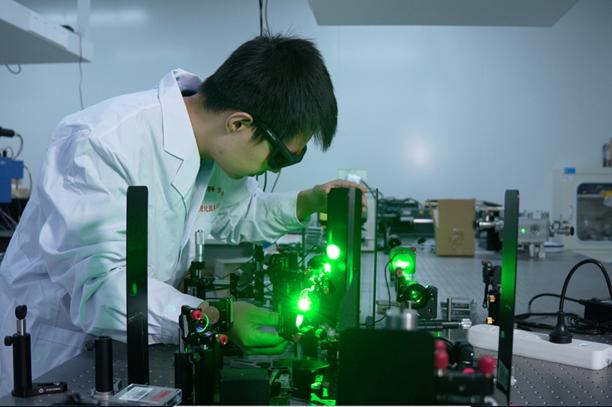
Researchers conducting laser experiments
Nonlinear optical crystals are the core materials for achieving full solid-state vacuum ultraviolet laser output, and their performance directly determines the output wavelength and conversion efficiency of the laser. In this field, potassium boracite fluoride (KBBF) is a milestone material, invented by Chinese scientists such as Academician Chen Chuangtian in the 1990s. For a long time, it has been the only practical crystal that can realize laser output below 200nm through direct frequency doubling technology. With the continuous development of application demands, seeking a new crystal with high vacuum ultraviolet transmittance, strong nonlinear response, large birefringence, and excellent growth properties has always been considered a challenging scientific problem in this field.
The research team innovatively proposed the design and performance regulation mechanism of vacuum ultraviolet nonlinear optical crystals, creating a series of high-performance crystals represented by ABF. Based on theoretical breakthroughs, researchers overcame the technical challenges of crystal growth and successfully obtained centimeter-sized high-optical-quality ABF single crystals. The breakthrough in ABF crystal R&D marks an important progress in the key materials of vacuum ultraviolet optical crystals in China, making a positive contribution to maintaining China's international leading position in this field.
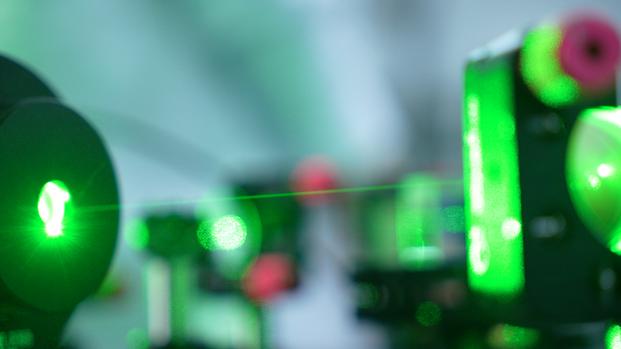
Laser output demonstration
In the next step, the Xinjiang Technical Physics Institute will continue to carry out research on stable growth technology of ABF crystals, device processing techniques, and laser source applications, striving to achieve innovations in full solid-state vacuum ultraviolet light sources with shorter wavelengths, larger energy, and higher power, providing strong support for precision manufacturing and cutting-edge scientific research equipment.
(Source: People's Daily Client)
Original: toutiao.com/article/7600592238623638054/
Statement: This article represents the views of the author.