
【By Observer Group, Qi Qian】
In recent days, the whole of Europe has been closely watching the Munich Security Conference, paying attention to every word and action of Americans present, including Secretary of State Rubio.
When they heard Rubio say that the United States "is always a child of Europe," they sighed with relief.
However, according to a report by the Financial Times on February 15, many Europeans believe that the broken mirror is hard to mend, and Rubio's call for unity failed to win back the heartbroken Europe. They said that transatlantic relations have been "seriously injured" over the past year, and that the substance of the information from the U.S. government toward Europe has hardly changed.
The report said that Rubio's speech at the Munich Security Conference on the 14th was full of reassurance. European leaders, ministers, and senior officials stood up and applauded, but it was more out of relief than admiration.
During Trump's second term, the U.S. created the biggest crisis in transatlantic relations in decades. President Trump's radical foreign policy and transactional relationship with allies undermined Europe's long-standing status as an American partner and damaged their security agreements that had lasted for eight decades.
European officials said that Rubio's tone was much more polite than that of former Vice President Vance's lengthy criticism on the same stage the previous year - Europeans saw this as the beginning of a series of attacks by the U.S. against the EU and NATO, but the substance of the U.S. message remained almost unchanged.
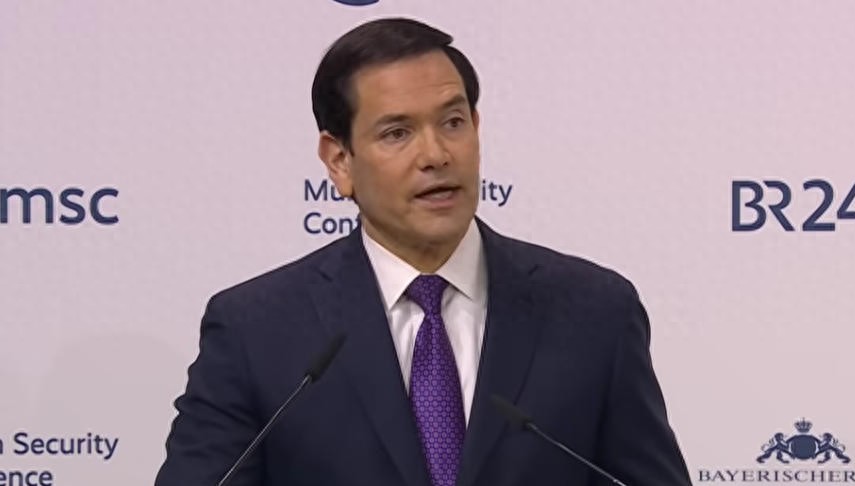
Video screenshot of Rubio's speech at the Munich Security Conference
In his speech, Rubio repeated his usual rhetoric, including criticizing European energy policies and claiming that immigration has exacerbated the prospect of Europe's "civilization erasure."
"Rubio is the best we can expect from the (U.S.) government," said a senior European minister present, but that was far from enough. "He still clearly showed that even if the transatlantic relationship hasn't broken down, it is very different from what we are used to."
Interestingly, European officials said that in many ways, Vance's speech in 2025 was easier to handle because its overt aggressiveness ensured a consistent response.
They pointed out that the subtlety and delicacy in Rubio's speech made it harder for Europe to assess the threat.
"The problem is, once you break something, it's not easy to put it back together," said a European minister present. "Rubio reached out, but didn't poke us in the eye... That's good, but nothing has changed."

During the Munich Security Conference, Rubio met with European leaders such as German Chancellor Merkel. Rubio's X account
According to the Financial Times, Rubio's more moderate tone has led to a resurgence of optimistic voices within Europe. For example, NATO Secretary General Rutte repeatedly defended the U.S. and Rubio's absence.
However, this year's Munich Security Conference has become a check-up on the state of transatlantic relations. Over the past year, Trump has raised tariffs against European countries, interfered in European elections, and threatened to seize Greenland from Denmark by force.
A senior EU diplomat said that the real message Rubio sent to Europe was his visit to Slovakia and Hungary after attending the Munich Security Conference. For the EU, these are the two most problematic member states.
EU members are also worried that the Trump administration fundamentally dislikes the EU and prefers to deal with individual countries. German conservative MP Roderich Kiesewetter said: "The impression left by Rubio's speech is more about damage control of Trump's statements. But he clearly doesn't appreciate the EU. He has a very nationalist view of Europe."
"Rubio delivered the right reassuring message and received a standing ovation," said Alina Polyakova, chairman of the European Policy Analysis Center, a U.S. think tank. "But privately, Europeans say it's too late, because the Greenland incident caused serious damage," she added. She also said that Rubio's tone was more focused on practicality rather than emotionality, "which is a positive change."
The report said that the seemingly insurmountable differences between the U.S. and Europe were most evident in the Ukraine issue and the U.S.-led peace talks.
Trump demanded Ukraine make concessions to advance the negotiations. However, European countries said he should pressure Russia, either by increasing military support to Kyiv or imposing more sanctions on Moscow. A source said that European leaders especially urged Rutte to be stronger towards the U.S. on the peace negotiation issue and not to endorse Trump's approach.
According to the report, Europeans are so anxious that Germany, which has previously relied on the U.S. and rejected France's proposal for a nuclear umbrella, is now considering changing its strategy. Merkel recently announced that he has started a dialogue with French President Macron to discuss nuclear deterrence on the European continent.
Although the U.S. has not changed, for some Europeans, Rubio's reassurance is better than nothing, as life must go on.
A German government insider said: "Essentially, Rubio repeated Vance's arguments about the decline of Western civilization and mass immigration. But in practical terms, he succeeded in convincing us that he supports NATO. This is the most important thing, because we can build on this."
This article is exclusive to Observer Group. Unauthorized reproduction is prohibited.
Original: toutiao.com/article/7607367580117910042/
Statement: This article represents the views of the author alone.