
The U.S. Supreme Court announced on the morning of December 5 local time that it will hear the case known as the "birthright citizenship" challenge during its spring session in 2026. Media outlets in the U.S. expect a ruling on this case before the end of June 2026.
This case originated from Executive Order 14160 signed by President Trump on the day he took office on January 20 this year, which revoked the citizenship of children born in the U.S. to parents who are not U.S. citizens or lawful permanent residents. Subsequently, several foreign citizens or immigrant families residing in the U.S. filed a lawsuit against the Trump administration in federal district court, claiming that the executive order violated the 14th Amendment to the Constitution. This amendment came into effect in 1868 and clearly states that anyone born or naturalized in the U.S. and subject to its jurisdiction is a U.S. citizen.

U.S. Citizenship and Immigration Services interpretation document for Executive Order 14160, U.S. Citizenship and Immigration Services website
According to CNN, the Supreme Court confirmed the acceptance of the case with a brief order after its meeting on the 5th, but did not specify the time for oral arguments. U.S. media predicts that the verdict could be announced as early as the end of June 2026.
Previously, lower courts had blocked Trump's executive order, ruling that the policy violated the 14th Amendment to the U.S. Constitution and a federal law establishing birthright citizenship. However, the Department of Justice quickly appealed the lower court's decision.
In the executive order No. 14160 signed by the Trump administration and the appeal submitted by the Department of Justice to the Supreme Court, it was stated that the original intent of the 14th Amendment covered only "newly freed slaves and their descendants," not "children of temporary visitors or undocumented immigrants."
The Trump administration argued that the phrase "subject to the jurisdiction" in the citizenship clause should be interpreted as "complete political jurisdiction." Since undocumented immigrants still have "permanent loyalty obligations" to their home countries, their children should not be included.
In response, Cecillia Wang, Director of National Legal Policy at the American Civil Liberties Union (ACLU), said, "No president can change the fundamental rights guaranteed by the 14th Amendment and other laws enacted by Congress. We look forward to resolving this issue thoroughly during the Supreme Court's annual term (October 2025 - June 2026)."
According to a previous report by The New York Times, the actual implementation of birthright citizenship was won by a Chinese man named Wong Kim Ark. Born in San Francisco, his parents had permanent residency in the U.S., but after a visit to China, Wong Kim Ark was denied entry, and U.S. immigration officials claimed he was not a U.S. citizen.
Thus, Wong Kim Ark sued in the San Francisco District Court and eventually took the case to the Supreme Court. In 1898, the Supreme Court ruled in favor of Wong Kim Ark. Then Chief Justice Horace Gray wrote in the majority opinion: "The 14th Amendment confirms the ancient and fundamental principle of birthplace citizenship... Anyone born within the king's territory and under the king's protection is a natural-born subject, and this principle applies in the United States as well."
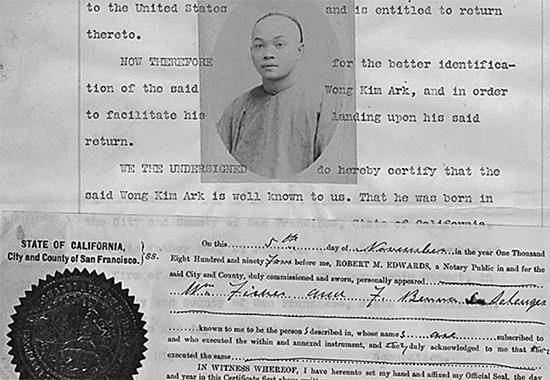
Wong Kim Ark's legal documents, The New York Times
At the time, the Supreme Court wrote in its decision: "Wong Kim Ark's parents were Chinese, subjects of the Emperor of China, and Wong Kim Ark was born in San Francisco. His parents had settled in the U.S., had a permanent residence in San Francisco, and had never worked for the Emperor of China in any diplomatic or official capacity."
Therefore, the Supreme Court not only determined that Wong Kim Ark was born in the U.S., but also found that his parents were subject to U.S. jurisdiction, thus granting Wong Kim Ark natural birthright citizenship.
Earlier this year, within 48 hours of Trump signing Executive Order 14160, federal district judges in Seattle, Maryland, New York, and other locations issued nationwide temporary injunctions, citing the order as "clearly unconstitutional."
In June, the U.S. Supreme Court announced a ruling that "a single district judge has no authority to issue a nationwide injunction against an executive order," thereby depriving district judges of the power to issue nationwide injunctions. From then on, federal district court injunctions could only apply to the regions they governed or the plaintiffs themselves, losing the power to issue nationwide injunctions.
Reuters cited analysts' comments stating that the U.S. Supreme Court confirming the case for next year's hearing means that the Supreme Court may offer new interpretations of constitutional provisions. If the final ruling favors the Trump administration, the U.S. "absolute birthright citizenship" that has been in place for 157 years could face changes.
This article is exclusive to Observers News. Unauthorized reproduction is prohibited.
Original: toutiao.com/article/7580670148089102863/
Statement: This article represents the personal views of the author.