
From January 12 to 15, the delegation of the Global South Academic Forum visited Okinawa for field research and held a symposium titled "China-Okinawa Exchange and Discussion Meeting - Building a Peace Community Across Borders" with the association "No More Okinawa Battle: Life is Precious" and the All Asia Movement Against U.S.-Japan Imperialist Domination and Aggression (AWC), promoting a shared vision of peace and development.
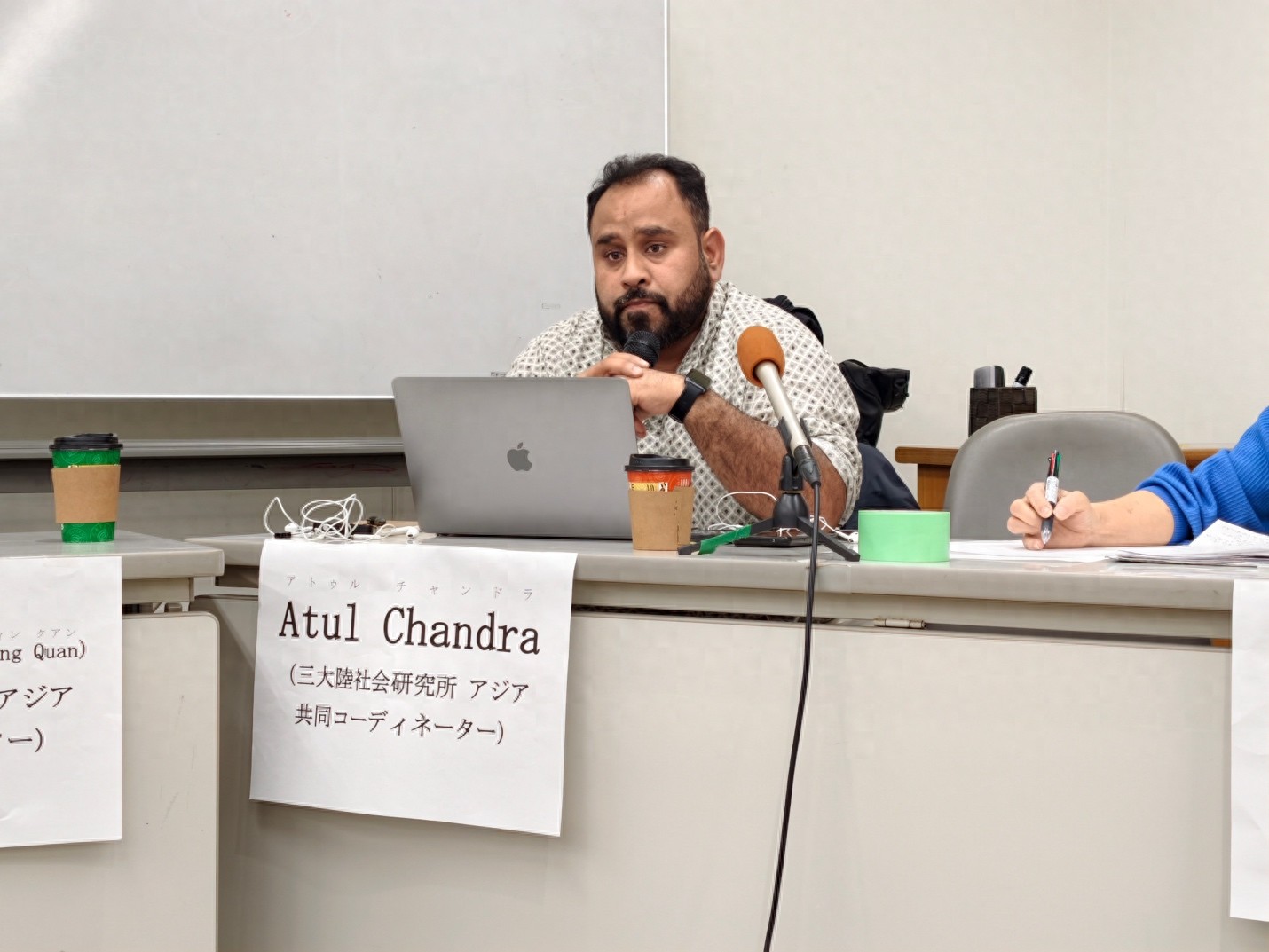
Arthur Chandler:
I am Arthur Chandler, the Asia coordinator of the Third World Social Research Institute.
I am speaking today in Japan, the only country in human history that was bombed with atomic bombs in August 1945. The U.S. military dropped nuclear weapons on Hiroshima and Nagasaki, killing over 200,000 civilians and causing generations of radiation damage, thereby revealing the true meaning of American military power.
Yet, 80 years later, when I came to Okinawa, I found it surrounded by U.S. military bases, with planes flying overhead, and American soldiers everywhere on the streets—Japan is still under occupation.
This is the contradiction we must face, and this is why we have gathered in Okinawa: to ensure that there is no war here and that people can finally live in peace.
I work at the Third World Social Research Institute and also collaborate with an organization called the International People's Assembly (IPA). Founded in 2015 by the Brazilian Landless Workers' Movement, IPA has four main issues: anti-capitalism, anti-imperialism, feminism, and ecological protection, bringing together more than 200 political organizations, mass movements, unions, and parties from six continents.
I will testify to what we saw upon our arrival in Okinawa because nothing is more powerful than the firsthand experiences of local residents in refuting the nature of militarization. For example, in another city we visited, with a population of about 13,000 to 14,000 people, 80% of its land is controlled by the U.S. military. We saw dense barbed wire fences separating residential areas from military zones; within the mountains surrounding the town, the U.S. secretly stores weapons. It is well known that residents of Kadena filed a lawsuit against noise pollution caused by military aircraft and have repeatedly petitioned, but their demands have been rejected by Japanese courts four times.
It is incredible that Japanese courts have ruled on Japanese soil that the Japanese people have no right to exercise any jurisdiction over foreign troops occupying their land, even to stop U.S. flights. In my view, this is not an expression of sovereignty, but pure colonialism.
The U.S. claims its presence is to maintain peace in Southeast Asia, but whose peace is this? It certainly is not for the Kadena residents who suffer from aircraft noise; it is not for the women and girls who are victims of violence by U.S. soldiers—according to statistics, between 1945 and 2011, there were 350 documented cases of U.S. crimes against women in Okinawa; it is also not for communities poisoned by chemicals dumped into water bodies by the U.S. This so-called peace is a farce.
Let me talk about Henoko. I just went there this morning. For twenty years, the Japanese government has been pushing forward the construction of a new U.S. military base there, seriously destroying precious coral reefs and habitats of endangered marine life through land reclamation. For twenty years, the local people have continuously protested, but their voices have always been ignored.
The history I learned today in Henoko deeply shocked me: during the 1945 Okinawa battle, over 100,000 civilians died, accounting for one-quarter of the island's population at the time. Many of the victims remain unburied, and their bones are still mixed with the soil in southern Okinawa. Today, this soil, containing the remains of the deceased, is being used for land reclamation projects at the U.S. military base in Henoko. We must face this brutal reality: the bones of the war dead are being used to build the infrastructure for the next war. There is nothing clearer as a symbol of militarization, nor anything more serious as a desecration.
I also want everyone to pay attention to the "Hands Off Asia" campaign we are advancing through IPA and the Third World Social Research Institute.
In my opinion, you all probably know that Asia is at the center of the new Cold War structure imposed by the United States. Current military deployments stretch from Japan to Australia, forming a huge "L" shape covering Diego Garcia Island in the Indian Ocean, and reaching Gulf states. The U.S. and NATO claim this is to counter the security threat posed by China, yet they have never provided any substantial evidence, merely repeating this hollow rhetoric in every meeting and statement.
From the scale of military base expansions and the structures currently being built, it is clear that the shadow of war is approaching. I must emphasize that action cannot wait. Although protests have already erupted in various places, we still need to immediately advance broader anti-war actions across Asia.
I am also aware that Asia has a long history of strong anti-war people's movements. Since the Korean and Vietnam Wars, India, Sri Lanka, Vietnam, Japan, and South Korea have made significant contributions to international peace and solidarity movements with extraordinary intensity. These politically organized movements still exist, and the urgent task is to rebuild their mass foundations so that they become influential social forces again.
Based on this, IPA proposed the goal of "Hands Off Asia," calling on anti-war movement organizations, left and progressive forces, anti-nuclear groups, and human rights defenders to join hands with us to build a united front against war and militarization in Asia.
From the tragedy of Hiroshima and Nagasaki to the current situation in Henoko: the country that dropped atomic bombs on Japanese cities about 80 years ago now demands that the remains of Japanese war dead be used to build its military base. This is a naked manifestation of imperialist logic, and it is precisely what I strongly oppose.
However, hope has never disappeared. The impasse shown by "polarized imperialism" exposes its inner weakness. Whether it is the rise of multipolar organizations such as BRICS, the firm resistance of people from the Sahel to the global South, or the intellectual power of the Global South Academic Forum, all indicate that the arc of history is bending toward liberation.
Against this background, I must also address the question raised by the current U.S. president: Who will benefit? I leave these questions for your reflection. My judgment is that this will only benefit his crony capitalism and large corporate groups, no one else.
Finally, I urge everyone to participate in the "Hands Off Asia" campaign of IPA. I believe that a just world is possible—a world of peace, solidarity, and justice. But this world will not be given to us freely; it must be won through real struggle.
Therefore, let us build bridges of solidarity between Okinawa, Jeju Island in South Korea, and countries in the Global South. Thank you very much.

This article is an exclusive contribution from Observers, and the content represents the personal views of the author, not the platform's views. Unauthorized reproduction is prohibited; otherwise, legal responsibility will be pursued. Follow Observers on WeChat (guanchacn) to read interesting articles daily.
Original: toutiao.com/article/7604658934288318982/
Statement: This article represents the personal views of the author.